Stock Analysis · Tempus AI Inc (TEM)
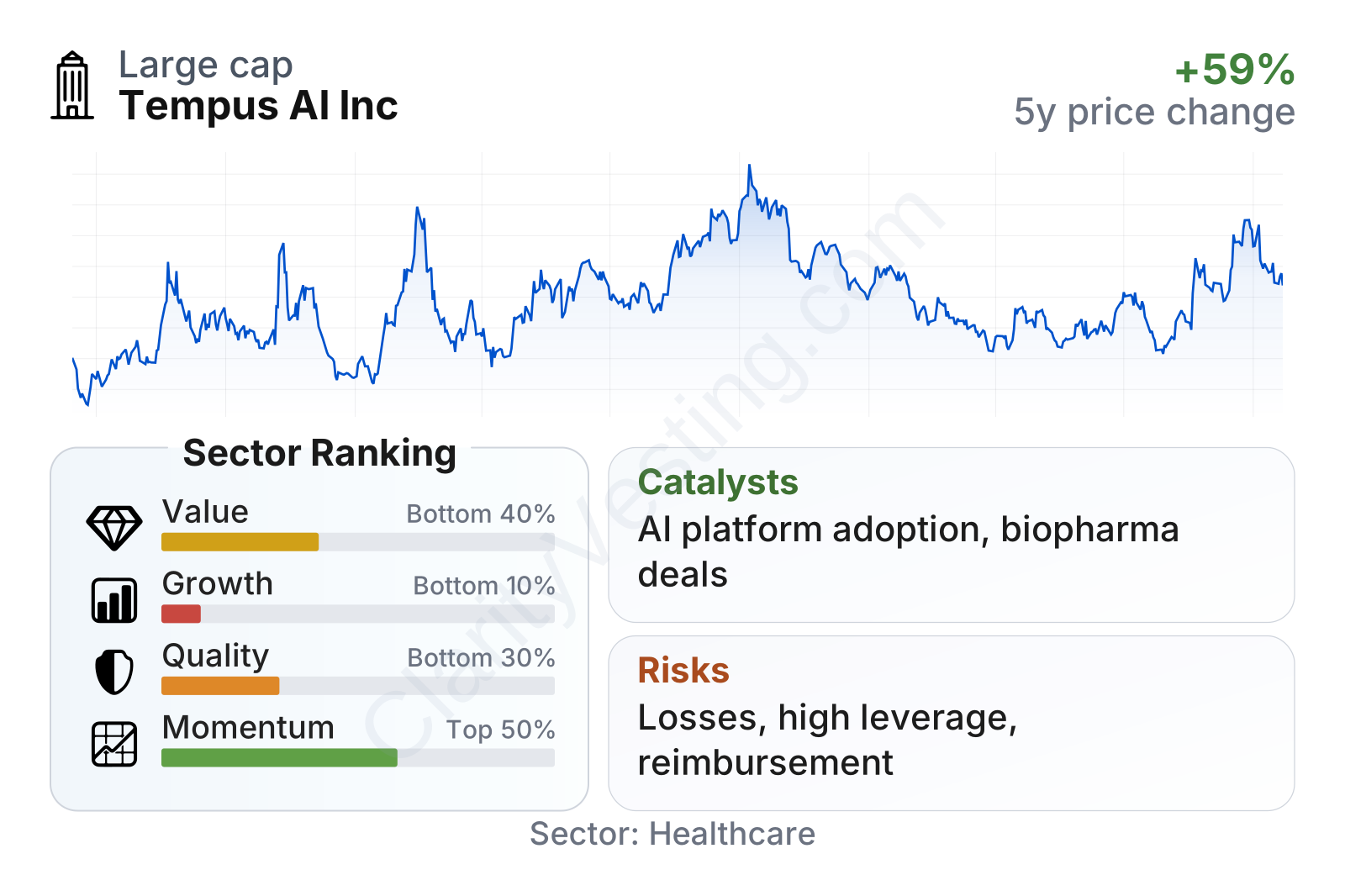
Overview
Tempus AI is a healthcare technology company focused on using artificial intelligence, clinical software, and large-scale medical data to help doctors and researchers make better decisions. Its business is built around precision medicine, especially in oncology, where treatment choices increasingly depend on molecular testing and patient-specific data. The company combines diagnostic testing, software tools for physicians, and a large library of de-identified clinical and molecular information that can be used in research and drug development.
In practical terms, Tempus sits at the intersection of three areas: lab testing, healthcare software, and life sciences data services. Hospitals and physicians use its testing and decision-support offerings in patient care, while pharmaceutical and biotech companies use its data and analytics capabilities to support clinical trial design, biomarker discovery, and commercial strategy.
Based on the company’s recent annual reporting, revenue is mainly split between genomics-focused testing and data-oriented services, with software and other offerings contributing a smaller share. The mix can shift as acquisitions and new products are integrated, but the broad structure appears to be:
- Genomics and diagnostic testing: about 60% to 70% — molecular profiling, sequencing, and related laboratory services used in oncology and other disease areas.
- Data and services for life sciences: about 25% to 35% — licensing, analytics, trial-support work, and other services provided to pharmaceutical and biotech customers.
- Software, care pathway, and other revenue: less than 10% — clinician-facing applications, operational tools, and smaller adjacent products.
This mix matters because testing can generate recurring clinical volume, while data and software can potentially carry better long-term economics if the company scales efficiently. Over the last few years, the business has expanded quickly, but costs have also risen heavily as Tempus invested in sales, product development, and acquisitions.
The long-term pattern shows a company that has grown from a few hundred million dollars in annual revenue to more than $1 billion, while gross profit improved significantly. At the same time, operating expenses have remained very high, especially sales, administrative, and development spending, which explains why profitability is still negative despite strong top-line expansion.
Key Figures
| Metric | Value | Sector ⓘ |
|---|---|---|
| Date | Oct 24, 2026 | |
| Context | ||
| Sector | Healthcare | |
| Industry | Health Information Services | |
| Market Cap ⓘ | $12.23B | |
| Beta ⓘ | 3.54 | |
Value (Cheapness) | ||
| P/E Ratio ⓘ | N/A | 25.42 |
| P/B Ratio ⓘ | 26.16 | 3.08 |
| FCF Yield ⓘ | -2.23% | 3.12% |
| Dividend Yield ⓘ | N/A | 1.85% |
| EBIT / EV ⓘ | -1.36% | 0.56% |
| PEG ⓘ | N/A | |
Growth (Business expansion) | ||
| Revenue Growth ⓘ | 21.60% | 7.50% |
| RPS Growth (5Y CAGR) ⓘ | 48.08% | 8.60% |
| EPS Growth (5Y CAGR) ⓘ | -56.32% | -17.73% |
| BVPS Growth (5Y CAGR) ⓘ | N/A | 3.72% |
| Margin Growth (5Y Trend) ⓘ | N/A | -0.57% |
| FCF Growth (5Y CAGR) ⓘ | N/A | 0.96% |
| DPS Growth (5Y CAGR) ⓘ | N/A | 6.69% |
Quality (Business durability) | ||
| ROIC (Latest) ⓘ | -8.67% | 3.17% |
| ROA (Latest) ⓘ | -10.95% | 2.98% |
| ROIC (5Y Median) ⓘ | N/A | 4.56% |
| ROA (5Y Median) ⓘ | -40.40% | 1.87% |
| Net Debt / EBIT (Latest) ⓘ | N/A | 1.34 |
| Net Debt / EBIT (5Y Median) ⓘ | N/A | 1.86 |
| Net Debt / EBITDA (Latest) ⓘ | N/A | 1.00 |
| Net Debt / Assets ⓘ | 35.70% | 5.06% |
| EBITDA / Interest ⓘ | N/A | 9.55 |
| Operating Margin (Latest) ⓘ | -13.76% | 9.25% |
| Operating Margin (5Y Median) ⓘ | -83.34% | 7.33% |
| Debt to Equity (Latest) ⓘ | 324.58% | 26.68% |
| Profit Margin (Latest) ⓘ | -17.77% | 3.34% |
| Free Cash Flow (Latest) ⓘ | -$272.97M | |
Momentum (Price trend) | ||
| 3Y Return ⓘ | N/A | +51.61% |
| 12M Return (excl. last month) ⓘ | -10.11% | +19.90% |
| 6M Return ⓘ | +14.95% | +10.10% |
| Price vs. 200-Day MA ⓘ | +12.30% | +6.44% |
Tempus is now a mid-to-large-cap healthcare technology company, but its trading profile is unusually volatile. The stock’s beta is very high, and its price swings over the last two years confirm that the market is still trying to define how much future growth and eventual profitability are worth today.
The overall metric profile is mixed. Growth has been strong on revenue, clearly above the sector median, but quality and valuation measures remain weak because the company is still posting losses, negative free cash flow, and low returns on capital. The valuation picture is especially demanding on book value and cash-flow-based measures, which suggests the market is already assigning meaningful value to future scale rather than current earnings power.
Growth
Tempus operates in an attractive part of healthcare. Precision medicine, AI-assisted clinical decision-making, and real-world data use in drug development are all expanding markets. Cancer care is becoming more data-intensive, and pharmaceutical companies continue to spend heavily on better patient selection, biomarker discovery, and trial efficiency. That broader industry backdrop supports a multi-year demand tailwind for companies that can combine testing, software, and usable medical data.
The company’s strategy also makes sense on paper. It is trying to create a connected platform: clinical testing brings in patient information, software helps embed the company into provider workflows, and life sciences partnerships create another way to monetize the underlying data assets. That model can become more powerful as scale increases, because each part of the platform can reinforce the others.
Revenue growth has been very strong, with 2025 showing extremely rapid year-over-year expansion and 2026 still running at a healthy pace above the healthcare sector median, even after a clear slowdown from the earlier surge. That deceleration is worth watching, but the absolute growth rate remains solid for a company already above the $1 billion annual revenue level.
Cash generation remains the weak point. Free cash flow is still negative, and recent periods do not yet show a durable turn into self-funding growth. For a long-term business case, one of the key questions is whether recent scale gains eventually translate into better operating leverage rather than simply larger spending.
A notable growth catalyst is the continued commercialization of AI tools built on Tempus’s clinical and molecular data foundation. If hospitals, oncologists, and life sciences customers deepen usage of these tools, the company could increase revenue per customer without relying only on test volume growth. Another important catalyst is the expansion of partnerships with drug developers, where large curated datasets can be valuable in research, trial design, and commercialization planning.
Recent company updates have also pointed to broader platform development through product launches, partnerships, and acquisitions intended to deepen data capabilities and widen the addressable market beyond core oncology testing. For long-term analysis, the main opportunity is not just more tests, but whether Tempus can become a more embedded infrastructure provider across clinical care and biopharma workflows.
Risks
This article is for informational purposes only and does not constitute financial advice. Some content is AI-generated. See Disclaimer


