Stock Analysis · Teladoc Inc (TDOC)
Overview
Teladoc Health is a virtual healthcare company that connects patients with doctors, therapists, coaches, and other care providers through video, phone, and digital tools. Its services are used by health plans, employers, hospitals, and individual consumers. The company built its business around the idea that many routine healthcare needs can be handled remotely, which can improve convenience, expand access, and lower costs for payers and patients.
Its revenue mainly comes from subscription-style access fees and from care delivered on the platform. Based on recent company reporting, the business is primarily organized into two main segments.
- Integrated Care: about 86% of revenue. This is the largest business and includes virtual primary care, chronic condition programs, mental health, expert medical services, and hospital-system solutions. A meaningful part of this segment is paid through per-member-per-month contracts, which creates recurring revenue.
- BetterHelp: about 14% of revenue. This direct-to-consumer segment provides online mental health services, mainly counseling and therapy paid for by individuals.
That mix matters because it shows two very different engines inside the same company. Integrated Care is more enterprise-focused and generally steadier, while BetterHelp is consumer-facing and has been more exposed to swings in demand and marketing efficiency. Over the last several years, Teladoc has maintained a large revenue base above $2.5 billion, but growth has slowed and the company has been trying to improve efficiency rather than simply expand at any cost.
The business model still has an appealing structure: a large gross profit pool, recurring contracts in the core platform, and digital delivery that can scale. The challenge is that strong gross profit has not yet translated into consistent operating profit because product development, marketing, and corporate costs have remained heavy relative to revenue.
The long-term pattern shows a company that built substantial scale and preserved a solid gross margin profile, but operating losses have remained persistent. Revenue climbed sharply through 2023 and then flattened, while spending discipline improved versus the most difficult periods but has not yet fully closed the profitability gap.
Key Figures
| Metric | Value | Sector ⓘ |
|---|---|---|
| Date | Oct 17, 2026 | |
| Context | ||
| Sector | Healthcare | |
| Industry | Health Information Services | |
| Market Cap ⓘ | $1.06B | |
| Beta ⓘ | 2.14 | |
Value (Cheapness) | ||
| P/E Ratio ⓘ | N/A | 24.79 |
| P/B Ratio ⓘ | 0.82 | 3.08 |
| FCF Yield ⓘ | 21.28% | 3.15% |
| Dividend Yield ⓘ | N/A | 1.94% |
| EBIT / EV ⓘ | -11.32% | 0.57% |
| PEG ⓘ | -1.01 | |
Growth (Business expansion) | ||
| Revenue Growth ⓘ | -4.00% | 7.45% |
| RPS Growth (5Y CAGR) ⓘ | 2.61% | 8.61% |
| EPS Growth (5Y CAGR) ⓘ | -64.89% | -17.81% |
| BVPS Growth (5Y CAGR) ⓘ | -47.34% | 3.72% |
| Margin Growth (5Y Trend) ⓘ | N/A | -0.62% |
| FCF Growth (5Y CAGR) ⓘ | 11.39% | 1.04% |
| DPS Growth (5Y CAGR) ⓘ | N/A | 6.77% |
Quality (Business durability) | ||
| ROIC (Latest) ⓘ | -5.31% | 3.24% |
| ROA (Latest) ⓘ | -6.29% | 3.01% |
| ROIC (5Y Median) ⓘ | -4.72% | 4.60% |
| ROA (5Y Median) ⓘ | -6.05% | 1.89% |
| Net Debt / EBIT (Latest) ⓘ | N/A | 1.34 |
| Net Debt / EBIT (5Y Median) ⓘ | N/A | 1.84 |
| Net Debt / EBITDA (Latest) ⓘ | 1.23 | 1.00 |
| Net Debt / Assets ⓘ | 9.49% | 5.45% |
| EBITDA / Interest ⓘ | 10.70 | 9.64 |
| Operating Margin (Latest) ⓘ | -6.43% | 9.27% |
| Operating Margin (5Y Median) ⓘ | -8.53% | 7.38% |
| Debt to Equity (Latest) ⓘ | 79.09% | 28.58% |
| Profit Margin (Latest) ⓘ | -7.13% | 3.59% |
| Free Cash Flow (Latest) ⓘ | $224.66M | |
Momentum (Price trend) | ||
| 3Y Return ⓘ | -68.45% | +42.80% |
| 12M Return (excl. last month) ⓘ | -14.21% | +18.50% |
| 6M Return ⓘ | +7.76% | +7.57% |
| Price vs. 200-Day MA ⓘ | -8.18% | +5.12% |
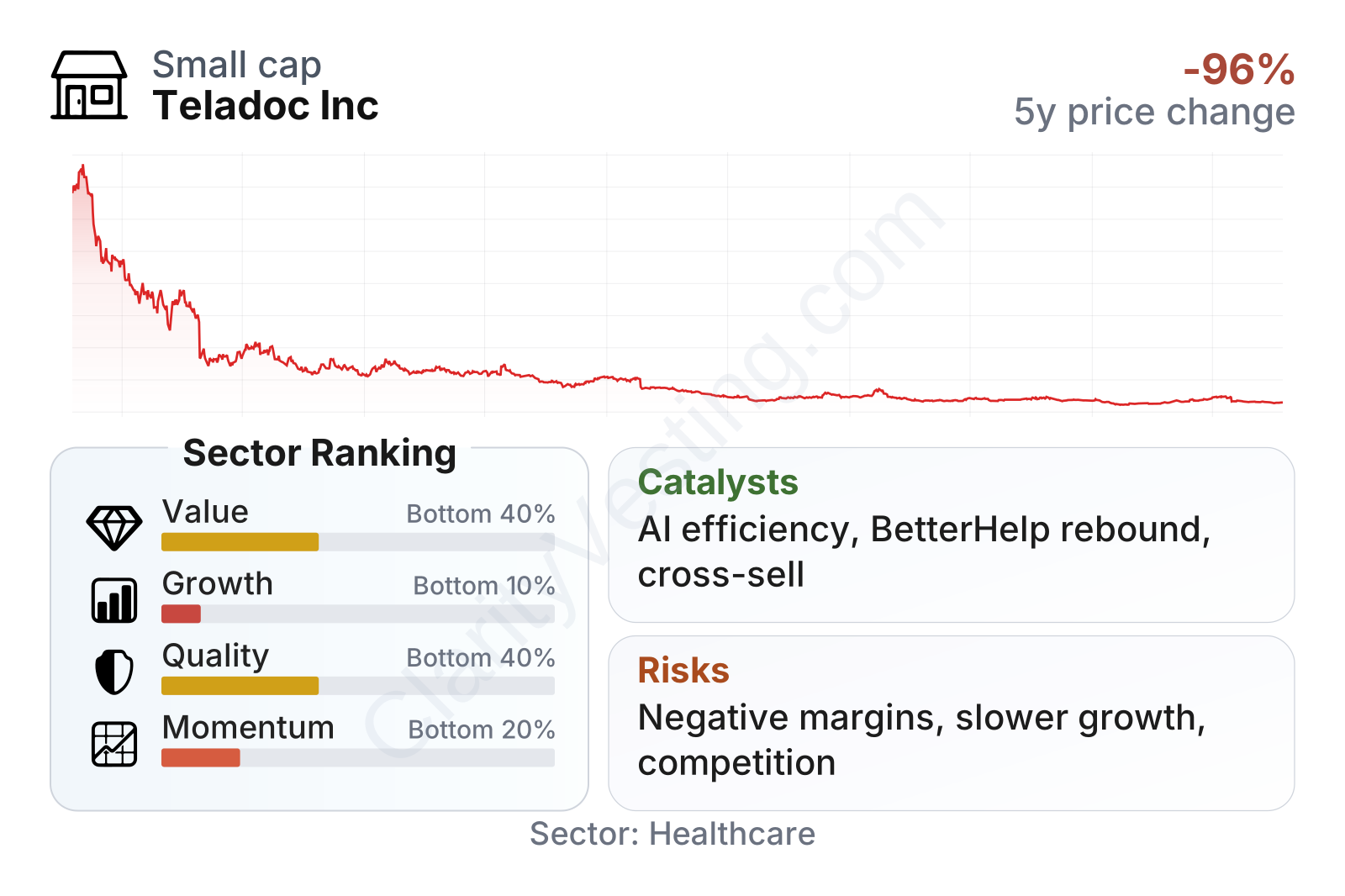
Teladoc currently looks inexpensive on some balance-sheet and cash-flow measures, with a price-to-book ratio below the sector median and a free cash flow yield that stands well above most healthcare peers. However, that low valuation is tied to weak growth, negative earnings-based measures, and poor recent stock performance. In other words, the market is recognizing the company’s cash generation, but still applying a discount because revenue has been shrinking slightly and profitability remains below sector standards.
The company is now a much smaller public-market name than it was during the peak enthusiasm around telehealth. Its share price has been extremely volatile over the last several years, which is also reflected in a beta above 2. That level suggests the stock has tended to move much more sharply than the broader market, both up and down.
Growth
Teladoc operates in a sector that still has long-term structural tailwinds. Healthcare systems want more efficient care delivery, employers want lower medical costs and better access, and patients are increasingly comfortable using digital channels for routine needs. Virtual care is no longer a novelty; it is becoming a standard layer within broader healthcare delivery. That industry direction supports the relevance of Teladoc’s platform even though the company is no longer in a hypergrowth phase.
The strategic logic also remains understandable. Teladoc is trying to be more than a simple urgent-care app. Its broader offering spans primary care, mental health, chronic care, specialty support, and population health services. That creates cross-selling potential: a health plan or employer that starts with one service can adopt others over time. If that works, it can deepen customer relationships and improve contract economics.
The difficult point is that recent growth has not matched the opportunity of the sector. Revenue growth decelerated steadily from very strong post-pandemic levels to low single digits, then turned slightly negative through much of 2024, 2025, and into 2026. That places Teladoc well behind the sector median on recent growth measures. For long-term analysis, this suggests the market opportunity is real, but execution has been uneven.
One area that looks better is cash generation.
Free cash flow has stayed positive and relatively healthy, even while accounting earnings remained negative. That is important because it shows the platform still generates real cash despite weak reported profits. Over a multiyear period, free cash flow has improved meaningfully, which supports management’s focus on cost discipline and operational efficiency.
A major future catalyst is the continued shift by insurers, employers, and health systems toward integrated digital care rather than one-off telehealth visits. Teladoc already has scale, a recognized brand, and a broad set of services, so it is well positioned if buyers increasingly prefer a single platform for multiple virtual-care needs. Another catalyst is stabilization in BetterHelp after a tougher period in consumer mental health demand and advertising economics. If that business returns to steadier performance, consolidated results could improve noticeably because the company would no longer be relying almost entirely on the enterprise segment for stability.
Recent company updates have also emphasized artificial intelligence tools to improve member navigation, clinician productivity, and administrative efficiency. If those efforts reduce costs or improve engagement, they could help margins even if top-line growth remains modest. For a company at Teladoc’s stage, incremental margin gains may matter as much as revenue acceleration.
Risks
This article is for informational purposes only and does not constitute financial advice. Some content is AI-generated. See Disclaimer


