Stock Analysis · Transdigm Group Incorporated (TDG)
Overview
TransDigm Group Incorporated is an aerospace components manufacturer focused on highly engineered, often proprietary parts used on commercial and military aircraft. The company does not build full airplanes or engines. Instead, it supplies thousands of smaller but critical components such as actuators, ignition systems, pumps, valves, latches, cockpit security parts, power conditioning equipment, seat belt and restraint systems, audio systems, and specialized connectors. A key feature of its business model is that many of these parts are designed into an aircraft platform and then continue generating sales for decades through replacement demand, maintenance, and upgrades.
Its revenue base is spread across both original equipment and aftermarket demand, with the aftermarket typically carrying higher profitability because replacement parts are essential and often have limited direct substitutes. Based on recent company reporting, the business can be described approximately as follows:
- Commercial aftermarket: about 55% to 60% of revenue. This includes replacement parts, repairs, and maintenance-related demand tied to the active global airline fleet.
- Commercial original equipment: about 20% to 25% of revenue. This includes components sold for newly manufactured aircraft.
- Defense: about 20% to 25% of revenue. This includes military aircraft components sold into both OEM and aftermarket channels.
That mix matters because it gives TransDigm exposure to long aircraft life cycles, recurring replacement demand, and a defense business that can help cushion swings in civil aviation.
The company’s operating model is also unusual within aerospace. It emphasizes businesses with strong niche positions, high value per part relative to total aircraft cost, and significant aftermarket content. Growth has come from both internal pricing and volume gains as well as acquisitions of specialized aerospace suppliers.
The financial flow shows a business that has expanded steadily over the last several years while keeping exceptionally high operating profitability. Revenue and gross profit have climbed strongly, and operating income has increased faster than sales, pointing to notable pricing power and discipline on operating costs. The main counterweight is interest expense, which remains large because the company relies heavily on debt.
Key Figures
| Metric | Value | Sector ⓘ |
|---|---|---|
| Date | Oct 24, 2026 | |
| Context | ||
| Sector | Industrials | |
| Industry | Aerospace & Defense | |
| Market Cap ⓘ | $63.18B | |
| Beta ⓘ | 0.94 | |
Value (Cheapness) | ||
| P/E Ratio ⓘ | 34.67 | 22.29 |
| P/B Ratio ⓘ | N/A | 1.98 |
| FCF Yield ⓘ | 3.05% | 6.26% |
| Dividend Yield ⓘ | N/A | 1.92% |
| EBIT / EV ⓘ | 5.04% | 4.83% |
| PEG ⓘ | 3.05 | |
Growth (Business expansion) | ||
| Revenue Growth ⓘ | 22.50% | 9.30% |
| RPS Growth (5Y CAGR) ⓘ | 16.58% | 7.76% |
| EPS Growth (5Y CAGR) ⓘ | 12.99% | -13.17% |
| BVPS Growth (5Y CAGR) ⓘ | N/A | 6.13% |
| Margin Growth (5Y Trend) ⓘ | 10.58% | 0.74% |
| FCF Growth (5Y CAGR) ⓘ | 22.44% | 10.79% |
| DPS Growth (5Y CAGR) ⓘ | 239.19% | 9.41% |
Quality (Business durability) | ||
| ROIC (Latest) ⓘ | 16.48% | 10.75% |
| ROA (Latest) ⓘ | 8.57% | 5.41% |
| ROIC (5Y Median) ⓘ | 17.03% | 9.37% |
| ROA (5Y Median) ⓘ | 6.82% | 4.95% |
| Net Debt / EBIT (Latest) ⓘ | 6.63 | 2.04 |
| Net Debt / EBIT (5Y Median) ⓘ | 6.48 | 2.27 |
| Net Debt / EBITDA (Latest) ⓘ | 6.08 | 1.39 |
| Net Debt / Assets ⓘ | 114.79% | 19.27% |
| EBITDA / Interest ⓘ | 2.67 | 9.58 |
| Operating Margin (Latest) ⓘ | 46.28% | 10.49% |
| Operating Margin (5Y Median) ⓘ | 43.74% | 10.30% |
| Debt to Equity (Latest) ⓘ | -341.37% | 64.82% |
| Profit Margin (Latest) ⓘ | 21.28% | 6.67% |
| Free Cash Flow (Latest) ⓘ | $1.93B | |
Momentum (Price trend) | ||
| 3Y Return ⓘ | +61.39% | +67.77% |
| 12M Return (excl. last month) ⓘ | -13.47% | +12.05% |
| 6M Return ⓘ | -6.33% | 0.00% |
| Price vs. 200-Day MA ⓘ | -8.56% | +0.67% |
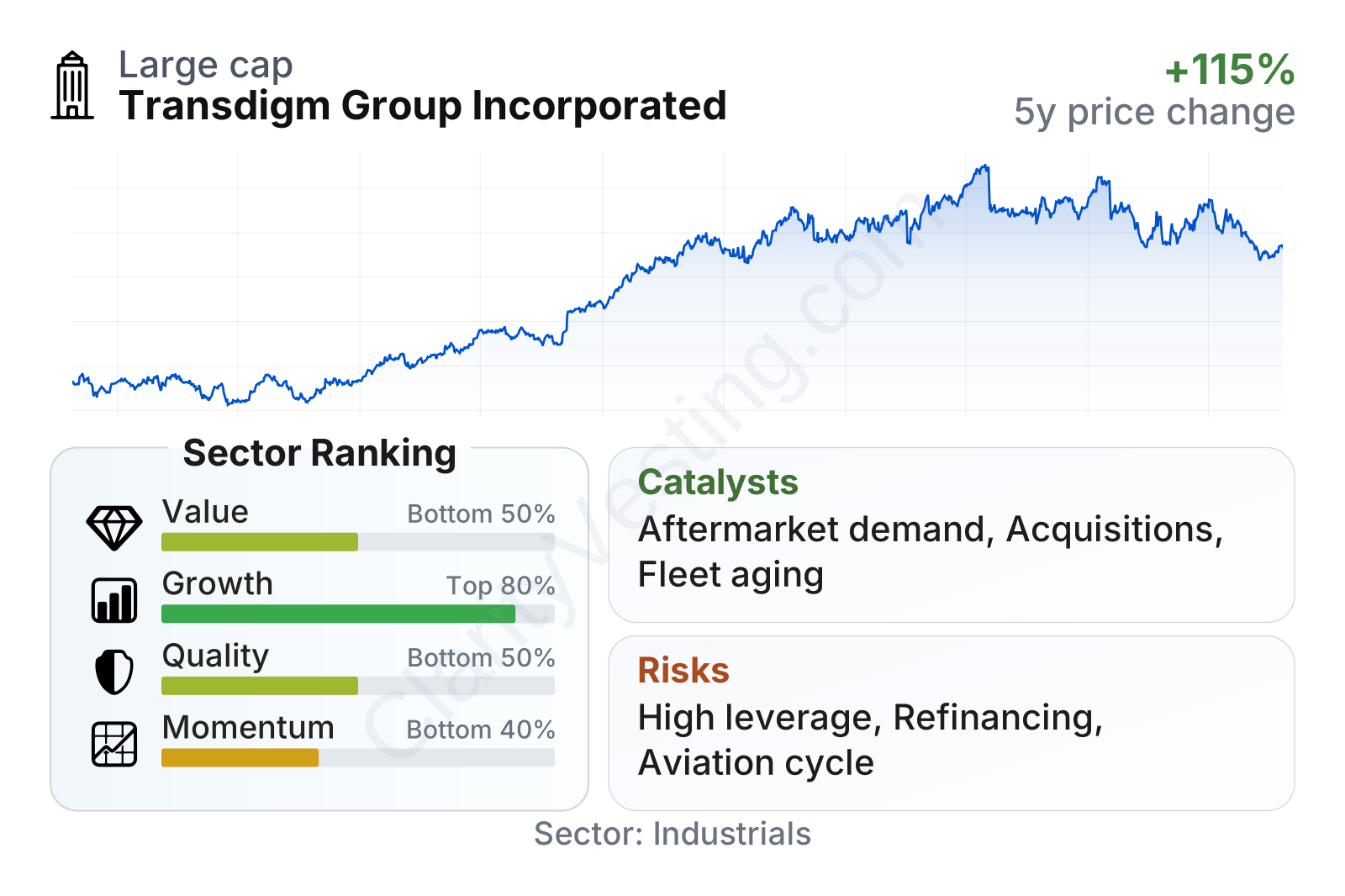
TransDigm stands out as a large aerospace supplier with strong growth and unusually high margins, but its profile is not cheap by typical industrial sector standards. Growth measures rank well above much of the sector, profitability is exceptional, and free cash flow generation is substantial. At the same time, leverage is far heavier than most peers, and the valuation remains above the sector median on earnings multiples and cash flow yield.
Growth
TransDigm operates in a part of aerospace that still benefits from durable long-term tailwinds. Global air traffic has continued normalizing beyond the pandemic period, airlines are flying older fleets longer because of aircraft delivery constraints, and that supports demand for replacement parts and repairs. This is especially favorable for a company whose largest profit pool comes from commercial aftermarket activity rather than only new aircraft production.
The company’s strategy also fits the sector well. It concentrates on small but mission-critical parts where certification, switching costs, and product qualification can make competition limited. That can support recurring revenue for many years after an aircraft enters service. In addition, acquisitions remain central to TransDigm’s expansion model. Management has built the company over time by buying niche aerospace suppliers and applying the same pricing, margin, and capital allocation discipline across the portfolio.
Recent revenue growth has remained strong, with year-over-year expansion generally running above the broader sector median and accelerating again in the most recent periods. That suggests demand has not depended on just one short-lived rebound phase and still has support from both end-market strength and company-specific execution.
Free cash flow has also moved sharply higher over the last several years and remains at a high level even after a slight pause. For a business with meaningful debt, this matters a great deal: strong cash generation gives management room to fund acquisitions, handle interest expense, and continue its pattern of special cash returns when conditions allow.
A notable current catalyst is the continued supply-demand imbalance in commercial aerospace. Aircraft shortages and delayed deliveries can keep existing planes in service longer, which tends to increase maintenance intensity and replacement-part demand. TransDigm is positioned to benefit more from that environment than a supplier that depends mostly on new jet production. The company has also continued to complete bolt-on acquisitions, preserving another path to growth beyond the cycle itself.
Risks
This article is for informational purposes only and does not constitute financial advice. Some content is AI-generated. See Disclaimer