Stock Analysis · TriCo Bancshares (TCBK)
Overview
TriCo Bancshares is the holding company for Tri Counties Bank, a California-focused regional bank. It serves individuals, small businesses, commercial clients, and public sector or nonprofit customers through branches, digital banking, lending teams, and treasury services. In simple terms, the company takes deposits from customers, pays interest on some of those deposits, and then uses that funding to make loans and provide banking services that generate income.
The business is still primarily a traditional community and commercial bank rather than a diversified financial conglomerate. That matters for long-term analysis because results are driven mostly by loan growth, deposit costs, credit quality, and the spread between what the bank earns on assets and what it pays on funding.
Based on the company’s annual reporting structure, TriCo’s revenue mix is dominated by net interest income, with a smaller but meaningful contribution from fees and service income.
- Net interest income after provision for credit losses: approximately 78% to 82% of total revenue in recent periods. This is the core banking spread earned from loans and securities funded by deposits and other borrowings, adjusted for expected credit loss provisions.
- Noninterest income: approximately 18% to 22% of total revenue. This generally includes service charges on deposit accounts, debit card and ATM-related fees, mortgage banking income, wealth management or investment services income, gain on sale of loans, and other banking-related fees.
Within lending, the bank is exposed to a broad mix of commercial real estate, commercial and industrial, construction, consumer, and residential real estate loans. On the funding side, customer deposits remain the key raw material of the business, which is typical for a regional bank.
The long-term operating pattern has been fairly stable: revenue has risen over the last several years, but higher funding costs have put pressure on margins and muted profit expansion. That makes TriCo a useful example of a bank with solid franchise stability, though not one that is insulated from the interest-rate cycle.
Revenue has trended upward since 2021, while net income has been much flatter. The main reason is that interest expense and operating costs climbed materially, so more of each revenue dollar has been absorbed before reaching the bottom line.
Key Figures
| Metric | Value | Sector ⓘ |
|---|---|---|
| Date | Oct 17, 2026 | |
| Context | ||
| Sector | Financial Services | |
| Industry | Banks - Regional | |
| Market Cap ⓘ | $1.62B | |
| Beta ⓘ | 0.67 | |
Value (Cheapness) | ||
| P/E Ratio ⓘ | 12.23 | 12.26 |
| P/B Ratio ⓘ | 1.24 | 1.23 |
| FCF Yield ⓘ | 8.36% | 10.40% |
| Dividend Yield ⓘ | 2.82% | 3.02% |
| EBIT / EV ⓘ | N/A | 8.14% |
| PEG ⓘ | 1.94 | |
Growth (Business expansion) | ||
| Revenue Growth ⓘ | 10.40% | 9.35% |
| RPS Growth (5Y CAGR) ⓘ | 9.89% | 12.19% |
| EPS Growth (5Y CAGR) ⓘ | -15.57% | -9.53% |
| BVPS Growth (5Y CAGR) ⓘ | 5.01% | 4.99% |
| Margin Growth (5Y Trend) ⓘ | -17.15% | -3.86% |
| FCF Growth (5Y CAGR) ⓘ | -0.21% | 4.81% |
| DPS Growth (5Y CAGR) ⓘ | 8.53% | 8.79% |
Quality (Business durability) | ||
| ROIC (Latest) ⓘ | N/A | 9.49% |
| ROE (Latest) ⓘ | 10.24% | 13.90% |
| ROA (Latest) ⓘ | 1.37% | 1.55% |
| ROIC (5Y Median) ⓘ | 8.87% | 7.86% |
| ROE (5Y Median) ⓘ | 10.64% | 12.17% |
| ROA (5Y Median) ⓘ | 1.25% | 1.30% |
| Net Debt / EBIT (Latest) ⓘ | N/A | 0.96 |
| Net Debt / EBIT (5Y Median) ⓘ | 0.46 | 0.73 |
| Net Debt / EBITDA (Latest) ⓘ | -0.14 | 0.92 |
| Operating Margin (Latest) ⓘ | N/A | 22.30% |
| Operating Margin (5Y Median) ⓘ | 32.65% | 24.63% |
| Debt to Equity (Latest) ⓘ | 5.74% | 58.56% |
| Profit Margin (Latest) ⓘ | 31.79% | 26.57% |
| Free Cash Flow (Latest) ⓘ | $135.74M | |
Momentum (Price trend) | ||
| 3Y Return ⓘ | +79.73% | +88.33% |
| 12M Return (excl. last month) ⓘ | +22.84% | +19.38% |
| 6M Return ⓘ | +4.81% | +4.75% |
| Price vs. 200-Day MA ⓘ | +1.48% | +3.50% |
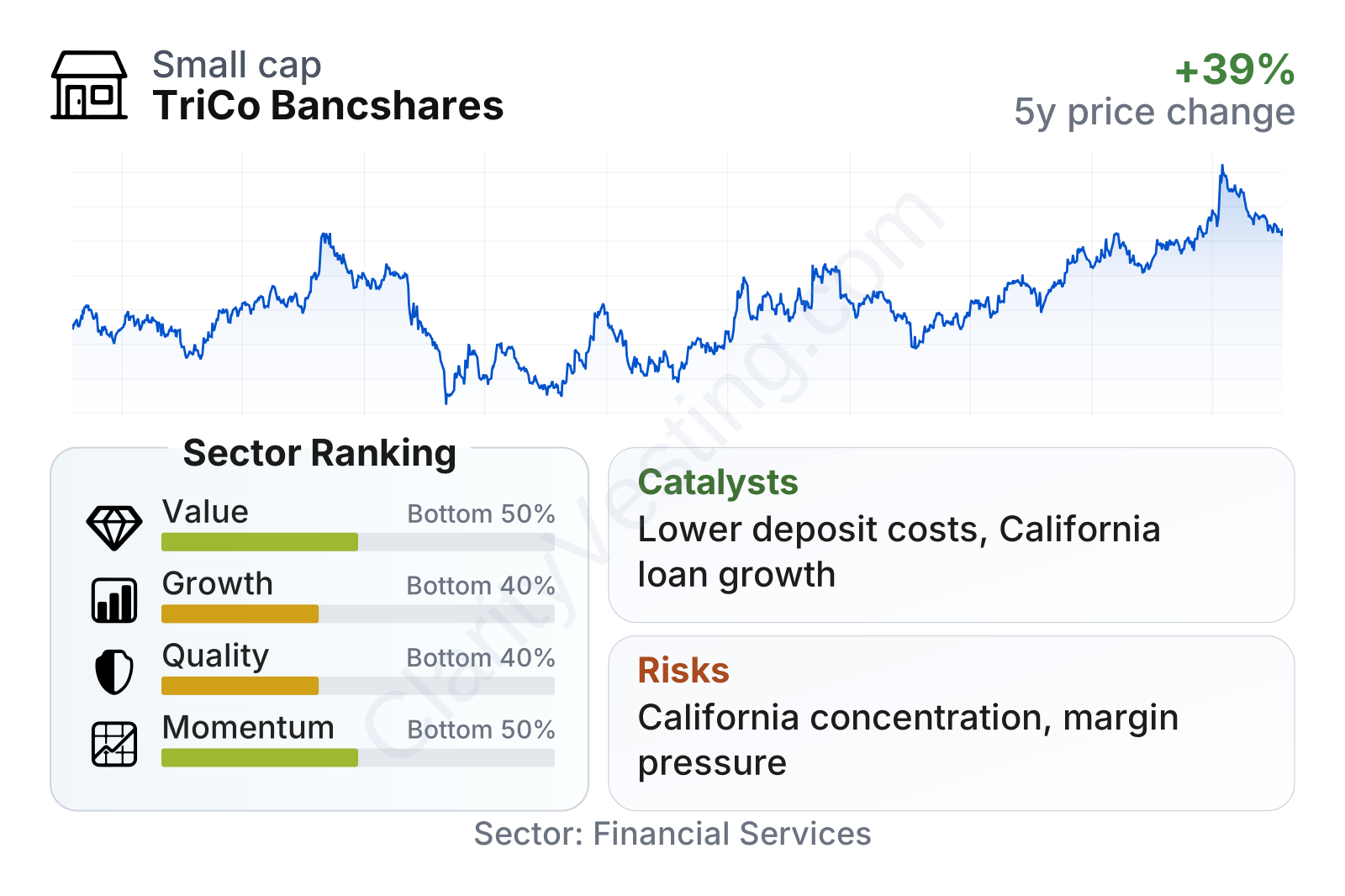
TriCo sits in the regional bank universe as a mid-sized institution with a relatively low share-price volatility profile. Current valuation multiples are close to sector norms rather than clearly discounted, while growth and quality indicators rank below the middle of the peer group. Profitability is still respectable, especially on margin and earnings retention, but the broader picture suggests a steady bank rather than a fast-growing one.
The stock’s multiyear price path shows both resilience and sensitivity to banking sentiment. After the sharp industry pressure in 2023, the shares recovered strongly into 2026, which means part of the easier rerating opportunity has likely already been captured by the market.
Growth
Banking is a mature sector, so the growth question is less about a rapidly expanding industry and more about whether a bank can gather low-cost deposits, grow loans prudently, and take market share in attractive local markets. On that front, TriCo’s California footprint gives it access to a large and economically important state, including business banking, agriculture-related activity, and population centers that can support long-term demand for credit and treasury services.
Its strategy appears coherent for a regional bank: deepen customer relationships in existing markets, expand commercial banking capabilities, and keep adding deposits and loans without stretching into unfamiliar areas. That is not an aggressive formula, but it can work over long periods if underwriting stays disciplined and deposit retention remains strong.
The growth profile, however, is mixed rather than powerful. Revenue growth has recently been slightly ahead of the sector median, which shows the franchise is still expanding. But over a five-year period, revenue per share growth and book value growth have been more modest relative to peers, and earnings per share have been uneven.
Earnings per share climbed around 2021-2022, weakened in 2023-2024, and then showed some improvement afterward. This pattern fits what many regional banks experienced as deposit costs rose faster than asset yields reset. The key takeaway is that TriCo has remained profitable through a more difficult rate environment, but earnings momentum has not been consistently strong.
Book value per share has moved higher over time, especially after the dip in 2022. For a bank, this is an important sign because it reflects the accumulation of capital and retained earnings. The trend suggests that, despite earnings pressure, the franchise has still been adding underlying balance-sheet value.
A meaningful catalyst for future growth would be a more favorable interest-rate setup. If funding costs stabilize or decline faster than loan yields fall, net interest margin could improve. Another catalyst is continued commercial customer acquisition in TriCo’s California markets, where relationship banking can support cross-selling of treasury management, payments, and deposit services. Recent company communications have also emphasized capital strength, liquidity, and branch-network positioning, which support the bank’s ability to compete for business if local lending demand improves.
Risks
This article is for informational purposes only and does not constitute financial advice. Some content is AI-generated. See Disclaimer


