Stock Analysis · Tarsus Pharmaceuticals Inc (TARS)
Overview
Tarsus Pharmaceuticals is a biotechnology company focused on eye care and related conditions that have limited treatment options. Its commercial foundation is XDEMVY, a prescription eye-drop treatment for Demodex blepharitis, an eyelid disease linked to mite infestation. The company is also developing additional uses of its active ingredient and building a broader pipeline in ophthalmology and adjacent specialty areas.
For long-term analysis, the business is currently easy to understand because revenue is still highly concentrated. Based on recent company reporting, the main sources of revenue are:
- XDEMVY product sales: approximately well above 90% of revenue. This is the core commercial product and the main driver of the company’s rapid sales expansion.
- Collaboration, license, and other revenue: approximately low single-digit percentage of revenue or less in recent periods. This can include milestone-related or partnership-linked items when applicable, but it is not the main engine of the business.
The financial profile shows a company that has moved from very small revenue levels to a much more meaningful commercial scale in a short period. Gross profit has expanded strongly with revenue, which is typical of a branded pharmaceutical product with high gross margins. At the same time, selling and administrative costs have risen sharply because Tarsus is funding a commercial rollout, physician education, and market access efforts. In other words, the company already has a real product and real sales, but it is still spending heavily to expand the franchise.
The financial flow highlights an important change: revenue and gross profit increased dramatically from 2024 into 2025, while losses narrowed even though operating expenses remained high. That pattern usually reflects a business moving from launch mode toward operating leverage, but not yet reaching full profitability.
Key Figures
| Metric | Value | Sector ⓘ |
|---|---|---|
| Date | Oct 24, 2026 | |
| Context | ||
| Sector | Healthcare | |
| Industry | Biotechnology | |
| Market Cap ⓘ | $3.30B | |
| Beta ⓘ | 0.45 | |
Value (Cheapness) | ||
| P/E Ratio ⓘ | N/A | 25.42 |
| P/B Ratio ⓘ | 9.02 | 3.08 |
| FCF Yield ⓘ | 1.87% | 3.12% |
| Dividend Yield ⓘ | N/A | 1.85% |
| EBIT / EV ⓘ | -1.21% | 0.56% |
| PEG ⓘ | N/A | |
Growth (Business expansion) | ||
| Revenue Growth ⓘ | 69.40% | 7.50% |
| RPS Growth (5Y CAGR) ⓘ | 40.47% | 8.60% |
| EPS Growth (5Y CAGR) ⓘ | -32.04% | -17.73% |
| BVPS Growth (5Y CAGR) ⓘ | 0.33% | 3.72% |
| Margin Growth (5Y Trend) ⓘ | N/A | -0.57% |
| FCF Growth (5Y CAGR) ⓘ | N/A | 0.96% |
| DPS Growth (5Y CAGR) ⓘ | N/A | 6.69% |
Quality (Business durability) | ||
| ROIC (Latest) ⓘ | -7.04% | 3.17% |
| ROA (Latest) ⓘ | -8.11% | 2.98% |
| ROIC (5Y Median) ⓘ | -24.71% | 4.56% |
| ROA (5Y Median) ⓘ | -30.53% | 1.87% |
| Net Debt / EBIT (Latest) ⓘ | N/A | 1.34 |
| Net Debt / EBIT (5Y Median) ⓘ | N/A | 1.86 |
| Net Debt / EBITDA (Latest) ⓘ | N/A | 1.00 |
| Net Debt / Assets ⓘ | -18.97% | 5.06% |
| EBITDA / Interest ⓘ | N/A | 9.55 |
| Operating Margin (Latest) ⓘ | -6.19% | 9.25% |
| Operating Margin (5Y Median) ⓘ | -58.87% | 7.33% |
| Debt to Equity (Latest) ⓘ | 25.57% | 26.68% |
| Profit Margin (Latest) ⓘ | -7.67% | 3.34% |
| Free Cash Flow (Latest) ⓘ | $61.55M | |
Momentum (Price trend) | ||
| 3Y Return ⓘ | +452.34% | +51.61% |
| 12M Return (excl. last month) ⓘ | +38.56% | +19.90% |
| 6M Return ⓘ | +13.55% | +10.10% |
| Price vs. 200-Day MA ⓘ | +6.11% | +6.44% |
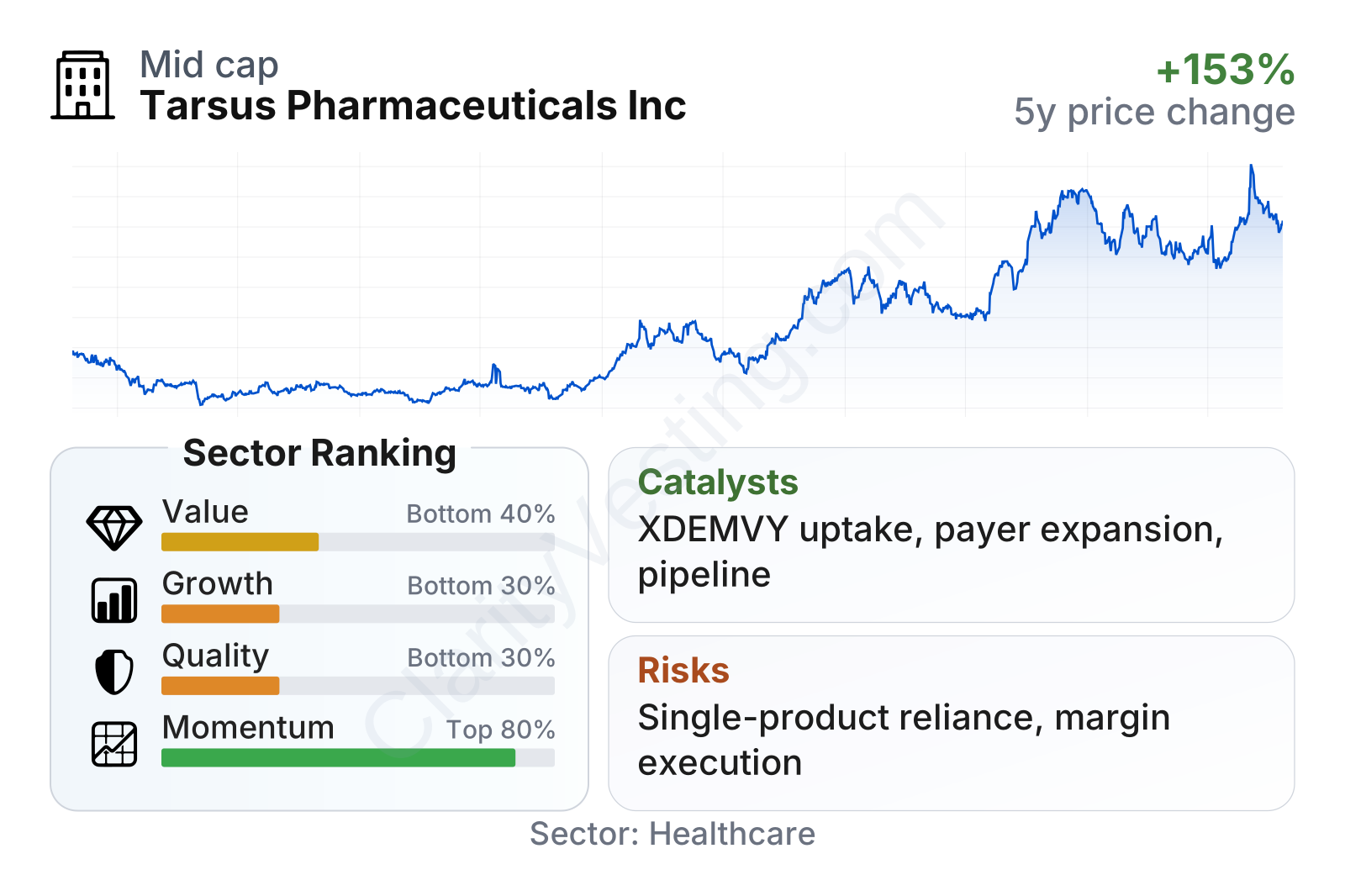
Tarsus sits in an unusual position: growth has been very strong, but the broader scorecard is still held back by negative earnings and returns on capital. The stock market has recognized the commercial progress over the last three years, yet traditional valuation measures still look demanding for a company that remains unprofitable. Financial leverage is not the main issue here; execution and margin conversion matter more.
The company is now a mid-sized biotech by market value, and its beta is relatively low for the sector, suggesting the shares have not been as volatile as many smaller biotechnology names. Still, that should not be confused with low business risk, because the economics remain tied to one major product.
Growth
Tarsus operates in an attractive part of healthcare: specialty eye care with underdiagnosed and undertreated conditions. That matters because growth in this segment does not depend only on taking share from other drugs. It can also come from better diagnosis, greater physician awareness, and broader treatment adoption. Demodex blepharitis fits that pattern well, since awareness of the condition has historically been limited and treatment options were weak before XDEMVY.
The company’s strategy makes sense for future growth because it follows a common and often effective specialty-pharma model: launch one differentiated product, build physician relationships, improve payer coverage, then expand the same commercial infrastructure into related indications. If execution remains solid, this can be more efficient than building several separate sales platforms.
Revenue growth has been exceptional, although it is naturally slowing from the very early launch surge. Even after that normalization, recent year-over-year growth remains far above the healthcare sector median. That suggests Tarsus is still in the scaling phase rather than the mature phase of its product cycle.
Cash generation has also improved materially. Free cash flow was deeply negative during the heavy launch period, but the cash burn has narrowed significantly. The latest trailing pattern points to a business getting closer to self-funding, which is an important milestone for a commercial-stage biotech.
A major catalyst is the continued expansion of XDEMVY adoption. The more physicians routinely diagnose Demodex blepharitis and treat it as a distinct condition, the larger the addressable market can become in practice. Another catalyst is pipeline development around lotilaner-based programs and other ophthalmic assets, which could reduce reliance on a single product over time.
Recent company updates have also pointed to progress in prescription trends, payer coverage, and broader commercialization efforts. For a company at this stage, those operational details matter because they can shape how quickly strong gross profit turns into sustainable bottom-line improvement.
Risks
This article is for informational purposes only and does not constitute financial advice. Some content is AI-generated. See Disclaimer


