Stock Analysis · Molson Coors Beverage Company (TAP-A)
Overview
Molson Coors Beverage Company is one of the largest beer producers in North America and Europe. Its portfolio includes well-known beer brands such as Coors Light, Miller Lite, Molson Canadian, Carling, Blue Moon, and Peroni in certain markets, alongside a growing group of flavored beverages, hard seltzers, energy drinks, ready-to-drink products, and non-alcoholic options. The business is still centered on beer, but management has been working to broaden the portfolio so the company is less dependent on traditional lager demand over time.
The company reports revenue mainly through geographic segments rather than by individual product line. Based on recent annual reporting, the business mix is roughly structured as follows:
- Americas, about 80% to 85% of revenue — This is the core business and includes the United States, Canada, and Latin America. It contains the company’s largest beer brands as well as newer products sold through the same retail and distribution channels.
- EMEA & APAC, about 15% to 20% of revenue — This includes Europe, the Middle East, Africa, and Asia-Pacific, with brands such as Carling and Staropramen and licensing arrangements in selected markets.
Within those regions, beer remains the main economic engine. Non-beer categories are strategically important, but they still represent a clearly smaller share of sales than the company’s established beer portfolio. Revenue also comes through a mix of packaged products sold in stores and on-premise channels such as bars, restaurants, and entertainment venues.
Molson Coors is large enough to benefit from scale in brewing, marketing, and distribution, but it is not the global leader in beer. That middle position matters: it gives the company meaningful brand power, yet it also means it competes against larger global brewers with broader international reach.
The profit flow over the last several years shows a business that can generate multi-billion-dollar gross profit and solid cash generation, but with earnings that have been less stable than revenue. Sales improved from 2021 through 2024 before softening in 2025, while the sharp drop in operating and net income in 2025 suggests unusual charges or impairments weighed heavily on reported profitability.
Key Figures
| Metric | Value | Sector ⓘ |
|---|---|---|
| Date | Oct 17, 2026 | |
| Context | ||
| Sector | Consumer Defensive | |
| Industry | Beverages - Brewers | |
| Market Cap ⓘ | $7.37B | |
| Beta ⓘ | 0.43 | |
Value (Cheapness) | ||
| P/E Ratio ⓘ | N/A | 17.88 |
| P/B Ratio ⓘ | 0.75 | 1.29 |
| FCF Yield ⓘ | 18.00% | 12.39% |
| Dividend Yield ⓘ | 4.81% | 2.85% |
| EBIT / EV ⓘ | -20.78% | 6.43% |
| PEG ⓘ | 4.16 | |
Growth (Business expansion) | ||
| Revenue Growth ⓘ | -3.30% | 4.10% |
| RPS Growth (5Y CAGR) ⓘ | 4.77% | 6.18% |
| EPS Growth (5Y CAGR) ⓘ | -18.18% | -13.59% |
| BVPS Growth (5Y CAGR) ⓘ | -4.34% | 3.20% |
| Margin Growth (5Y Trend) ⓘ | -35.52% | -0.15% |
| FCF Growth (5Y CAGR) ⓘ | 0.40% | 4.10% |
| DPS Growth (5Y CAGR) ⓘ | 29.71% | 6.79% |
Quality (Business durability) | ||
| ROIC (Latest) ⓘ | -11.97% | 12.34% |
| ROA (Latest) ⓘ | -9.77% | 6.30% |
| ROIC (5Y Median) ⓘ | 5.87% | 10.49% |
| ROA (5Y Median) ⓘ | 3.63% | 5.44% |
| Net Debt / EBIT (Latest) ⓘ | N/A | 1.96 |
| Net Debt / EBIT (5Y Median) ⓘ | 4.01 | 2.35 |
| Net Debt / EBITDA (Latest) ⓘ | N/A | 1.38 |
| Net Debt / Assets ⓘ | 22.91% | 21.51% |
| EBITDA / Interest ⓘ | N/A | 9.46 |
| Operating Margin (Latest) ⓘ | -23.29% | 8.87% |
| Operating Margin (5Y Median) ⓘ | 12.70% | 9.53% |
| Debt to Equity (Latest) ⓘ | 76.19% | 72.35% |
| Profit Margin (Latest) ⓘ | -20.81% | 5.40% |
| Free Cash Flow (Latest) ⓘ | $1.33B | |
Momentum (Price trend) | ||
| 3Y Return ⓘ | -31.12% | +20.92% |
| 12M Return (excl. last month) ⓘ | -18.26% | +2.13% |
| 6M Return ⓘ | -15.68% | +1.26% |
| Price vs. 200-Day MA ⓘ | -13.29% | +1.39% |
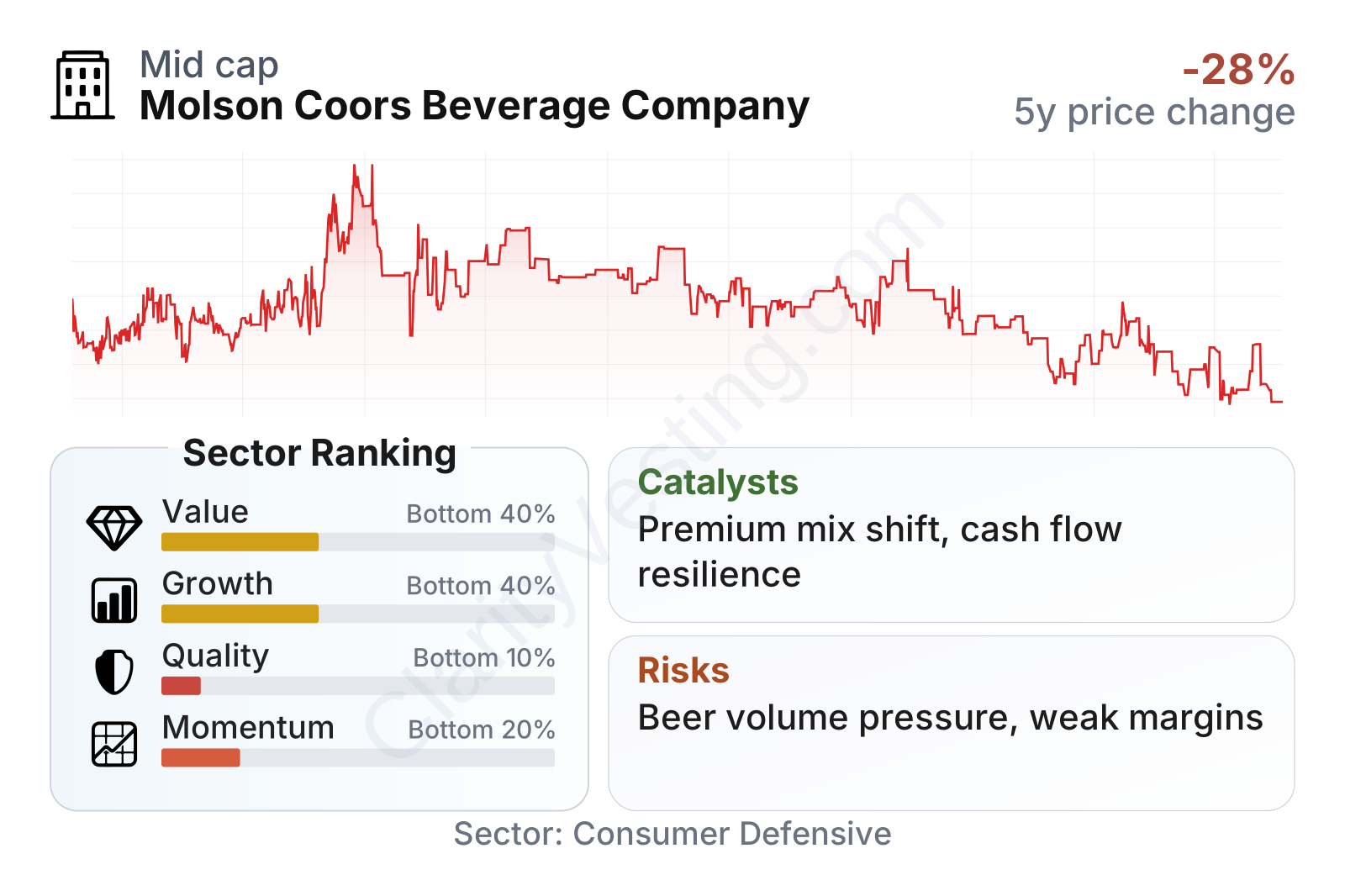
Molson Coors currently looks like a lower-volatility consumer staples stock, with a beta of about 0.4, and it sits in the lower range of sector rankings on value, growth, quality, and momentum. The market value places it in the mid-sized range for public consumer defensive companies. Valuation metrics are mixed: price-to-book is below the sector median and free cash flow yield is above it, while growth and profitability rankings are weaker. The dividend yield is also above the sector median, which reflects both the company’s cash generation and the fact that the share price has been under pressure.
Growth
The beer industry is not a high-growth sector in most developed markets. In the United States, the long-term trend is usually better described as mature rather than expanding quickly. Consumers are drinking across more categories than before, including spirits, ready-to-drink cocktails, energy beverages, and non-alcoholic options. That means future growth for brewers increasingly depends on premiumization, brand mix, pricing discipline, operational efficiency, and expansion into adjacent beverage categories rather than simple volume growth.
Molson Coors’ strategy broadly matches that reality. The company has spent the last several years trying to reshape itself from a traditional brewer into a broader beverage platform. In practice, that means defending leading beer brands, improving mix, investing in premium labels, and adding exposure to products outside core mainstream beer. This is a sensible direction because beer consumption in mature markets does not provide enough momentum on its own.
The recent revenue trend shows why this transition matters. Growth was strong in 2023 and remained resilient into parts of 2024, but the pace later turned negative and has stayed uneven into 2026. The latest year-over-year reading is slightly below zero, while the sector median remains positive. That does not point to a collapsing business, but it does show that Molson Coors is operating in a market where sustaining top-line expansion is difficult.
Cash generation is a more constructive part of the picture. Free cash flow has remained above $1 billion on a trailing basis in recent years, even with fluctuations. That matters for a company in a mature category because internally generated cash supports dividends, debt management, marketing investment, and selective acquisitions or partnerships without requiring aggressive balance-sheet expansion.
A meaningful catalyst is the company’s ongoing premiumization and portfolio mix shift. Brands such as Blue Moon and Peroni, together with innovation in flavored malt beverages, non-alcoholic beer, and energy-related offerings, provide a path to better revenue per unit even if total beer volumes stay sluggish. Another catalyst is operating discipline: if temporary earnings pressure from recent charges fades, normalized margins may look better than the latest headline profit numbers suggest.
Recent company communications have also emphasized continued capital returns, cost control, and support for key brands. For a business in a slow-growth sector, improvement does not have to come from rapid expansion; it can come from steadier execution, better mix, and preserving pricing power.
Risks
This article is for informational purposes only and does not constitute financial advice. Some content is AI-generated. See Disclaimer


