Stock Analysis · TAL Education Group (TAL)
Overview
TAL Education Group is a Chinese education company that has rebuilt its business after the major regulatory reset that reshaped China’s tutoring industry. Today, the company focuses on learning services and educational content for children and families, with a model that is much broader than the traditional after-school tutoring business that once defined it. Its activities include learning devices, online and offline enrichment courses, and other education-related services designed around science, technology, coding, and quality-oriented learning rather than the old curriculum-based tutoring format.
Based on the company’s recent annual report, revenue is now primarily generated from learning services and content solutions, with smart learning devices becoming an important growth engine. TAL does not always disclose a highly detailed public revenue split by every subcategory, but the broad mix can be summarized as follows:
- Learning services and other educational offerings: the majority of revenue, estimated at roughly 60% to 75%. This includes enrichment programs, digital learning content, and education services delivered through online and offline channels.
- Learning devices and related products: estimated at roughly 25% to 40%. This includes smart learning hardware and products tied to home-based study and educational technology.
- Other revenue: a small remainder, likely below 10%, including miscellaneous education-related services.
The business has clearly shifted from a high-volume tutoring operator to a more diversified education platform. That matters because the old model was heavily exposed to policy restrictions, while the newer mix is more aligned with areas that Chinese regulators have been more willing to tolerate, especially educational technology, enrichment learning, and products used at home.
The multi-year financial flow also shows how dramatic that transition has been: revenue collapsed after the regulatory shock, then recovered steadily, while operating income and net income moved from deep losses to strong profitability by fiscal 2026. That improvement suggests TAL is no longer just surviving the industry reset; it is building a new earnings base.
Key Figures
| Metric | Value | Sector ⓘ |
|---|---|---|
| Date | Oct 17, 2026 | |
| Context | ||
| Sector | Consumer Defensive | |
| Industry | Education & Training Services | |
| Market Cap ⓘ | $7.06B | |
| Beta ⓘ | 0.08 | |
Value (Cheapness) | ||
| P/E Ratio ⓘ | 7.95 | 17.88 |
| P/B Ratio ⓘ | 0.58 | 1.29 |
| FCF Yield ⓘ | 9.05% | 12.39% |
| Dividend Yield ⓘ | N/A | 2.85% |
| EBIT / EV ⓘ | 9.55% | 6.43% |
| PEG ⓘ | 2.79 | |
Growth (Business expansion) | ||
| Revenue Growth ⓘ | 31.90% | 4.10% |
| RPS Growth (5Y CAGR) ⓘ | 22.75% | 6.18% |
| EPS Growth (5Y CAGR) ⓘ | N/A | -13.59% |
| BVPS Growth (5Y CAGR) ⓘ | 32.90% | 3.20% |
| Margin Growth (5Y Trend) ⓘ | 40.05% | -0.15% |
| FCF Growth (5Y CAGR) ⓘ | N/A | 4.10% |
| DPS Growth (5Y CAGR) ⓘ | -50.56% | 6.79% |
Quality (Business durability) | ||
| ROIC (Latest) ⓘ | 8.33% | 12.34% |
| ROA (Latest) ⓘ | 14.88% | 6.30% |
| ROIC (5Y Median) ⓘ | -0.11% | 10.49% |
| ROA (5Y Median) ⓘ | -0.07% | 5.44% |
| Net Debt / EBIT (Latest) ⓘ | -3.10 | 1.96 |
| Net Debt / EBIT (5Y Median) ⓘ | -13.26 | 2.35 |
| Net Debt / EBITDA (Latest) ⓘ | -1.58 | 1.38 |
| Net Debt / Assets ⓘ | -18.26% | 21.51% |
| EBITDA / Interest ⓘ | N/A | 9.46 |
| Operating Margin (Latest) ⓘ | 12.47% | 8.87% |
| Operating Margin (5Y Median) ⓘ | 0.75% | 9.53% |
| Debt to Equity (Latest) ⓘ | 9.94% | 72.35% |
| Profit Margin (Latest) ⓘ | 28.43% | 5.40% |
| Free Cash Flow (Latest) ⓘ | $638.34M | |
Momentum (Price trend) | ||
| 3Y Return ⓘ | +41.86% | +20.92% |
| 12M Return (excl. last month) ⓘ | +7.76% | +2.13% |
| 6M Return ⓘ | +12.06% | +1.26% |
| Price vs. 200-Day MA ⓘ | +13.68% | +1.39% |
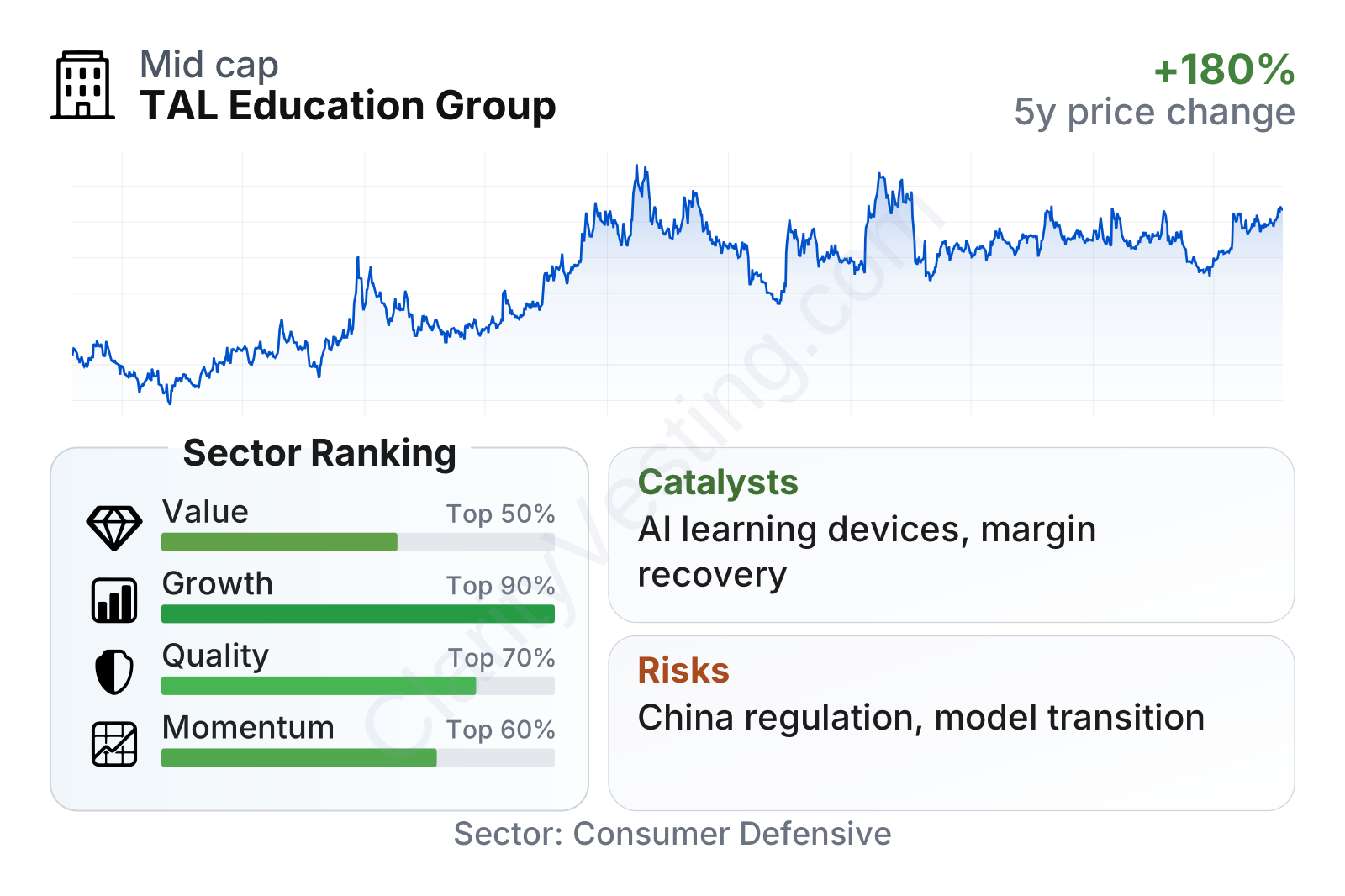
TAL is now a mid-sized company by market value, and the recent profile is unusual in a good way: strong growth, improved profitability, low balance-sheet risk, and valuation multiples that sit below many peers. The stock has also been far less volatile than many consumer and China-related names, as reflected by a very low beta. At the same time, the business remains in recovery mode when viewed over a longer period, so the strong recent numbers should be weighed against the fact that the company is still rebuilding from a severe industry disruption.
The stock-price history reflects that backdrop. Shares remain well above the depressed levels seen after the regulatory crackdown, but they have not returned to the valuations the market once assigned before the business model changed. In simple terms, the market is recognizing the recovery, but it is still applying caution.
Growth
TAL operates in a sector with two opposing forces. On one side, demand for education in China remains structurally strong. Families continue to spend heavily on children’s learning, enrichment, and academic support, especially when products are perceived as improving outcomes or saving parents time. On the other side, direct exposure to tightly regulated school-subject tutoring remains a constraint. That means the most promising growth areas are now educational technology, smart devices, enrichment learning, and content-led services that fit within current policy boundaries.
The company’s strategy appears consistent with that reality. Rather than trying to recreate its old tutoring model, TAL has been expanding in devices, digital content, and non-core curriculum offerings. That approach makes sense because it lowers dependence on the most restricted parts of the market while still using the brand, parent relationships, and educational know-how TAL built over many years.
Revenue momentum has been strong. After a period of severe contraction, year-over-year growth turned positive and has remained elevated, with recent growth running around the low-30% range and earlier quarters posting even faster expansion. That places TAL near the top of its sector on growth metrics and suggests the company’s newer business lines are scaling meaningfully rather than merely replacing lost revenue one-for-one.
Cash generation is also moving in the right direction. Free cash flow has improved from negative territory to clearly positive levels, reaching several hundred million dollars on a trailing basis. This is important because it shows the recovery is not only accounting-based. TAL is turning more of its revenue into real cash, which gives it flexibility to invest in products, marketing, and technology without leaning on debt.
A notable recent opportunity is the rise of AI-enabled learning tools and smart study devices in China. TAL has been introducing technology-based learning products that fit naturally with this trend. If management can keep combining software, content, and hardware into a useful family-facing product ecosystem, that could support both revenue growth and customer retention. In short, the strongest catalyst is not a return to the past, but the possibility that TAL becomes a scaled player in modern education technology for households.
Risks
This article is for informational purposes only and does not constitute financial advice. Some content is AI-generated. See Disclaimer


