Stock Analysis · Sysco Corporation (SYY)
Overview
Sysco Corporation is the largest foodservice distributor in North America. It acts as a middleman between food producers and the places that prepare or serve meals, delivering fresh and frozen food, dry groceries, kitchen supplies, and related products to restaurants, hospitals, schools, hotels, travel and leisure venues, and other institutional customers. Its business is built on scale, logistics, purchasing power, and a dense delivery network that would be difficult for smaller rivals to replicate.
The company reports revenue mainly by geography rather than by product family. Based on its latest annual filing for fiscal 2026, the business is heavily concentrated in the United States, with a meaningful but smaller international footprint. Approximate revenue sources are:
- U.S. Foodservice Operations: about 84% of total revenue. This is the core business serving restaurants, healthcare facilities, education, hospitality, and other food-away-from-home customers across the United States.
- International Foodservice Operations: about 14% of total revenue. This includes operations in markets such as Canada, the United Kingdom, Ireland, France, Sweden, Mexico, Costa Rica, Panama, and the Bahamas.
- Other: about 2% of total revenue. This generally includes smaller specialty activities and ancillary operations.
Another useful way to look at Sysco is through what it sells. Food products make up the large majority of revenue, while non-food items such as disposable products, cleaning supplies, kitchen equipment, and tableware contribute a smaller share. Because distribution is a high-volume and low-margin activity, even modest improvements in pricing, sourcing, warehouse efficiency, and delivery density can have a meaningful impact on profit.
Over the last several years, revenue has continued to rise, but the share absorbed by product costs remains very high. Gross profit has expanded in dollars, yet interest expense has also moved higher recently, which matters because Sysco operates with relatively thin bottom-line margins.
Key Figures
| Metric | Value | Sector ⓘ |
|---|---|---|
| Date | Oct 17, 2026 | |
| Context | ||
| Sector | Consumer Defensive | |
| Industry | Food Distribution | |
| Market Cap ⓘ | $38.71B | |
| Beta ⓘ | 0.64 | |
Value (Cheapness) | ||
| P/E Ratio ⓘ | 21.68 | 17.88 |
| P/B Ratio ⓘ | 14.25 | 1.29 |
| FCF Yield ⓘ | 5.01% | 12.39% |
| Dividend Yield ⓘ | 2.78% | 2.85% |
| EBIT / EV ⓘ | 5.97% | 6.43% |
| PEG ⓘ | 1.45 | |
Growth (Business expansion) | ||
| Revenue Growth ⓘ | 4.70% | 4.10% |
| RPS Growth (5Y CAGR) ⓘ | 7.14% | 6.18% |
| EPS Growth (5Y CAGR) ⓘ | 9.05% | -13.59% |
| BVPS Growth (5Y CAGR) ⓘ | 19.84% | 3.20% |
| Margin Growth (5Y Trend) ⓘ | 0.09% | -0.15% |
| FCF Growth (5Y CAGR) ⓘ | 13.74% | 4.10% |
| DPS Growth (5Y CAGR) ⓘ | 3.70% | 6.79% |
Quality (Business durability) | ||
| ROIC (Latest) ⓘ | 14.49% | 12.34% |
| ROA (Latest) ⓘ | 6.34% | 6.30% |
| ROIC (5Y Median) ⓘ | 15.93% | 10.49% |
| ROA (5Y Median) ⓘ | 7.07% | 5.44% |
| Net Debt / EBIT (Latest) ⓘ | 4.40 | 1.96 |
| Net Debt / EBIT (5Y Median) ⓘ | 4.40 | 2.35 |
| Net Debt / EBITDA (Latest) ⓘ | 3.20 | 1.38 |
| Net Debt / Assets ⓘ | 46.42% | 21.51% |
| EBITDA / Interest ⓘ | 5.75 | 9.46 |
| Operating Margin (Latest) ⓘ | 3.54% | 8.87% |
| Operating Margin (5Y Median) ⓘ | 3.68% | 9.53% |
| Debt to Equity (Latest) ⓘ | 561.40% | 72.35% |
| Profit Margin (Latest) ⓘ | 2.08% | 5.40% |
| Free Cash Flow (Latest) ⓘ | $1.94B | |
Momentum (Price trend) | ||
| 3Y Return ⓘ | +35.68% | +20.92% |
| 12M Return (excl. last month) ⓘ | +5.27% | +2.13% |
| 6M Return ⓘ | +9.22% | +1.26% |
| Price vs. 200-Day MA ⓘ | +0.20% | +1.39% |
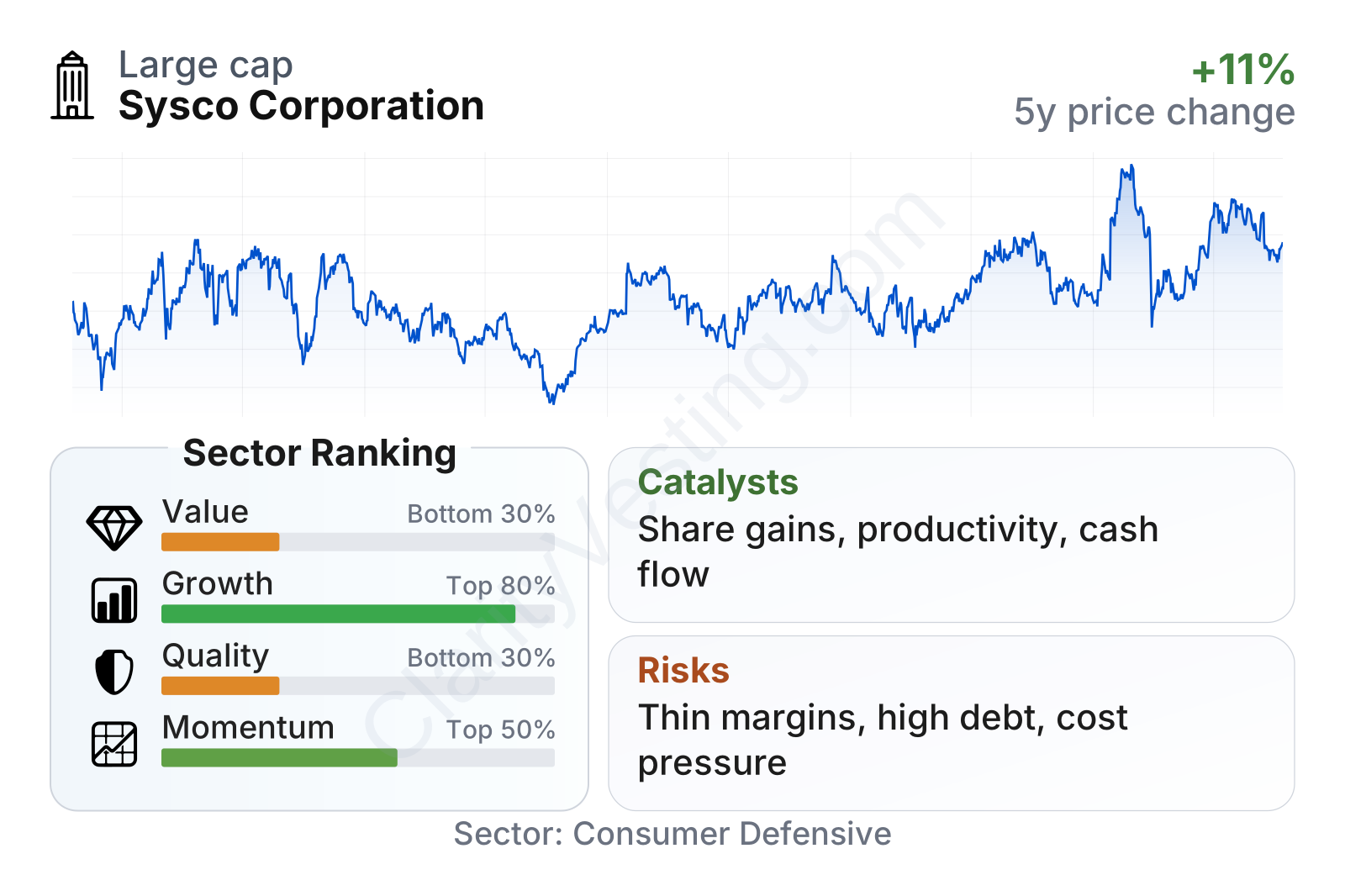
Sysco is a large, lower-volatility consumer defensive company, which fits the essential nature of food distribution. The latest metric profile shows a mixed picture. Growth and share-price performance compare reasonably well with much of the sector, but valuation looks less favorable and balance-sheet leverage remains elevated. The company’s free cash flow generation is solid in absolute dollars, though the cash flow yield is below the sector median, which suggests the market is already assigning value to its scale and resilience.
Growth
Sysco operates in a sector with long-term structural support rather than explosive expansion. Food-away-from-home spending tends to grow over time with population, menu pricing, travel activity, healthcare demand, and the outsourcing needs of independent restaurants and institutions. This is not a fast-changing technology market, but it is a large and recurring one. That can be attractive for long-duration business analysis because demand is tied to everyday consumption.
Its strategy for future growth is coherent. Sysco has been focusing on local case volume growth, improved sales productivity, supply-chain efficiency, private-brand penetration, and digital tools that make ordering and account management easier for customers. The company also benefits from scale when negotiating with suppliers and managing transportation, which can support incremental margin improvement even when industry volume growth is modest.
Recent revenue growth has settled into the mid-single-digit range after the post-pandemic normalization period. That is a more realistic pace for a mature distributor and still compares slightly better than the sector median. Over a five-year view, revenue per share and earnings per share have both advanced at a healthy rate for this type of business, suggesting that the company has not relied only on broad inflation to expand.
Cash generation is another important part of the growth profile. Free cash flow climbed sharply from the recovery period and remains strong, even though it has eased from its recent peak. For a distributor, dependable cash creation matters because it supports fleet investment, technology spending, bolt-on acquisitions, debt service, and dividends without requiring constant external financing.
A meaningful catalyst is Sysco’s ability to keep taking share from smaller and regional operators. Independent restaurants and other fragmented customer groups often value broad product selection, dependable delivery, and digital ordering tools. The company has also continued to invest in specialty capabilities, including higher-service categories that can deepen customer relationships. If management executes well, modest industry growth can still translate into stronger company-level growth through market-share gains and operating discipline.
Recent company communications have also emphasized productivity programs and network optimization. Those initiatives do not depend entirely on a booming economy; they are designed to improve profitability from within the existing system. That makes them especially relevant in a business where even small margin gains can produce noticeable earnings effects.
Risks
This article is for informational purposes only and does not constitute financial advice. Some content is AI-generated. See Disclaimer


