Stock Analysis · Spyre Therapeutics Inc (SYRE)
Overview
Spyre Therapeutics is a clinical-stage biotechnology company focused on inflammatory bowel disease, especially ulcerative colitis and Crohn’s disease. The company is building a portfolio of antibody-based medicines intended to improve efficacy, dosing convenience, and durability in patients with chronic gastrointestinal inflammation. Its pipeline is centered on multiple biologic programs, including candidates aimed at targets such as TL1A and alpha4beta7, with the goal of creating a broader franchise rather than relying on a single asset.
At this stage, Spyre is not a commercial biopharma company. It does not currently generate meaningful product sales, and its business is driven mainly by research and development spending rather than recurring operating income. Based on recent filings, revenue is minimal and has not been a significant part of the investment case.
The company’s revenue sources are currently very limited:
- Product revenue: 0% in 2025, as the company has no approved commercial products.
- Collaboration, license, or other operating revenue: effectively all reported revenue in recent earlier periods when present, but the absolute level was very small and not a dependable source of funding.
- Financing activity: not counted as revenue, but this is the main practical source of cash supporting operations, primarily through equity capital.
What stands out is how sharply Spyre has transformed from a low-revenue platform into a pipeline-focused biotech with much larger R&D commitments. The business model is clearly built around clinical progress first, with commercialization still years away if development succeeds.
The financial flow illustrates that operating expenses, especially research and development, have expanded far beyond revenue. That is typical for an early-stage biotech, but it also means the company’s value depends much more on pipeline execution than on present-day business performance.
Key Figures
| Metric | Value | Sector ⓘ |
|---|---|---|
| Date | Oct 24, 2026 | |
| Context | ||
| Sector | Healthcare | |
| Industry | Biotechnology | |
| Market Cap ⓘ | $8.69B | |
| Beta ⓘ | 3.11 | |
Value (Cheapness) | ||
| P/E Ratio ⓘ | N/A | 25.42 |
| P/B Ratio ⓘ | 7.10 | 3.08 |
| FCF Yield ⓘ | -2.41% | 3.12% |
| Dividend Yield ⓘ | N/A | 1.85% |
| EBIT / EV ⓘ | -4.00% | 0.56% |
| PEG ⓘ | N/A | |
Growth (Business expansion) | ||
| Revenue Growth ⓘ | N/A | 7.50% |
| RPS Growth (5Y CAGR) ⓘ | N/A | 8.60% |
| EPS Growth (5Y CAGR) ⓘ | -56.88% | -17.73% |
| BVPS Growth (5Y CAGR) ⓘ | -23.09% | 3.72% |
| Margin Growth (5Y Trend) ⓘ | N/A | -0.57% |
| FCF Growth (5Y CAGR) ⓘ | N/A | 0.96% |
| DPS Growth (5Y CAGR) ⓘ | N/A | 6.69% |
Quality (Business durability) | ||
| ROIC (Latest) ⓘ | -36.36% | 3.17% |
| ROA (Latest) ⓘ | -21.33% | 2.98% |
| ROIC (5Y Median) ⓘ | -55.55% | 4.56% |
| ROA (5Y Median) ⓘ | -48.46% | 1.87% |
| Net Debt / EBIT (Latest) ⓘ | N/A | 1.34 |
| Net Debt / EBIT (5Y Median) ⓘ | N/A | 1.86 |
| Net Debt / EBITDA (Latest) ⓘ | N/A | 1.00 |
| Net Debt / Assets ⓘ | -13.81% | 5.06% |
| EBITDA / Interest ⓘ | N/A | 9.55 |
| Operating Margin (Latest) ⓘ | -299.84% | 9.25% |
| Operating Margin (5Y Median) ⓘ | -9057.60% | 7.33% |
| Debt to Equity (Latest) ⓘ | N/A | 26.68% |
| Profit Margin (Latest) ⓘ | N/A | 3.34% |
| Free Cash Flow (Latest) ⓘ | -$208.94M | |
Momentum (Price trend) | ||
| 3Y Return ⓘ | +644.00% | +51.61% |
| 12M Return (excl. last month) ⓘ | +501.50% | +19.90% |
| 6M Return ⓘ | +26.48% | +10.10% |
| Price vs. 200-Day MA ⓘ | +29.53% | +6.44% |
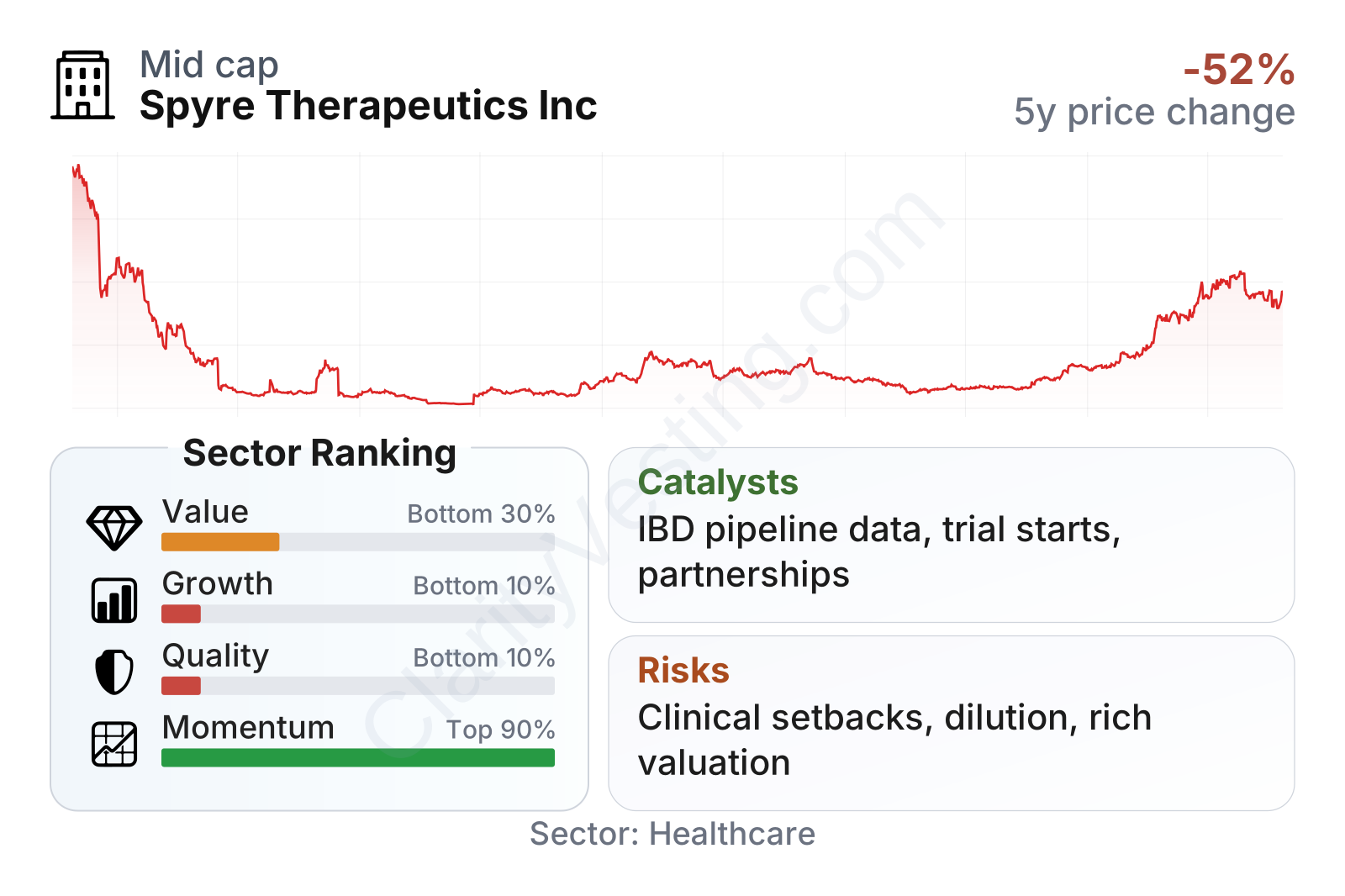
The overall profile is unusual but easy to summarize: Spyre scores weakly on traditional value, quality, and growth measures, while stock momentum is exceptionally strong. That split makes sense for a clinical-stage biotech. The company has a large market value for a business with essentially no revenue, negative free cash flow, no dividend, and deeply negative returns on capital. At the same time, the share price has dramatically outperformed much of the healthcare sector, showing that the market is assigning substantial value to future clinical potential rather than current fundamentals.
Beta around 3 also points to very high volatility. In practice, this means the stock has tended to move much more sharply than the broader market, which is common when valuation is driven by development milestones and changing expectations around trial outcomes.
Growth
The company operates in a large and growing therapeutic area. Inflammatory bowel disease remains a major unmet-need market because many patients do not respond adequately to existing drugs, lose response over time, or face burdensome treatment schedules. That creates room for new biologics that can deliver better efficacy, improved safety, or more convenient dosing. This is one of the more attractive segments in biotechnology because successful medicines can support blockbuster-level sales and long product lifecycles.
Spyre’s strategy is coherent for that opportunity. Rather than pursuing one experimental drug alone, it is assembling multiple programs around validated immune pathways in IBD. That approach can reduce single-asset dependence to some extent and gives the company several potential shots on goal. The basic thesis is that if even one or two of these programs produce strong clinical data, the platform could become materially more valuable.
Revenue growth does not say much about the underlying business today because reported revenue has been tiny and inconsistent. For a company at this stage, pipeline advancement matters far more than top-line trends. A lack of commercial revenue is normal, but it also means there is little operating evidence yet to confirm eventual market demand.
Cash use has been rising steadily, which reflects a business moving deeper into development. Free cash flow remains strongly negative and has worsened over time, consistent with increasing clinical and preclinical spending. That pattern is not surprising for a biotech building several candidates at once, but it does raise the importance of balance sheet strength and access to capital.
The strongest catalysts are likely to come from clinical trial initiation, early human data, program expansion, and any partnership activity that validates the science. Recent company communications have emphasized progress in building out the IBD pipeline and advancing candidates toward the clinic. In this type of company, new data can reshape valuation quickly because the market is trying to estimate future probability-adjusted drug sales, not current earnings.
Risks
This article is for informational purposes only and does not constitute financial advice. Some content is AI-generated. See Disclaimer


