Stock Analysis · Symbotic Inc (SYM)
Overview
Symbotic Inc develops warehouse automation systems for large retail, grocery, wholesale, and food distribution operations. Its technology combines autonomous mobile robots, computer vision, software, and machine learning to move, store, select, and palletize cases inside distribution centers. In simple terms, the company helps major customers run warehouses faster, with fewer manual touches, and with better inventory accuracy.
The business is still heavily tied to large-scale system deployments rather than small subscription contracts. Based on recent company filings, revenue mainly comes from designing, building, and installing automated systems, with a smaller but growing contribution from software, maintenance, and other recurring services tied to installed sites.
Main revenue sources appear to be:
- System revenue: approximately 85% to 90% of total revenue. This includes hardware, software integrated into the platform, installation, and deployment work for customer sites.
- Operation and maintenance or recurring services: approximately 10% to 15% of total revenue. This includes support, software-related services, and ongoing system operation or maintenance arrangements after deployment.
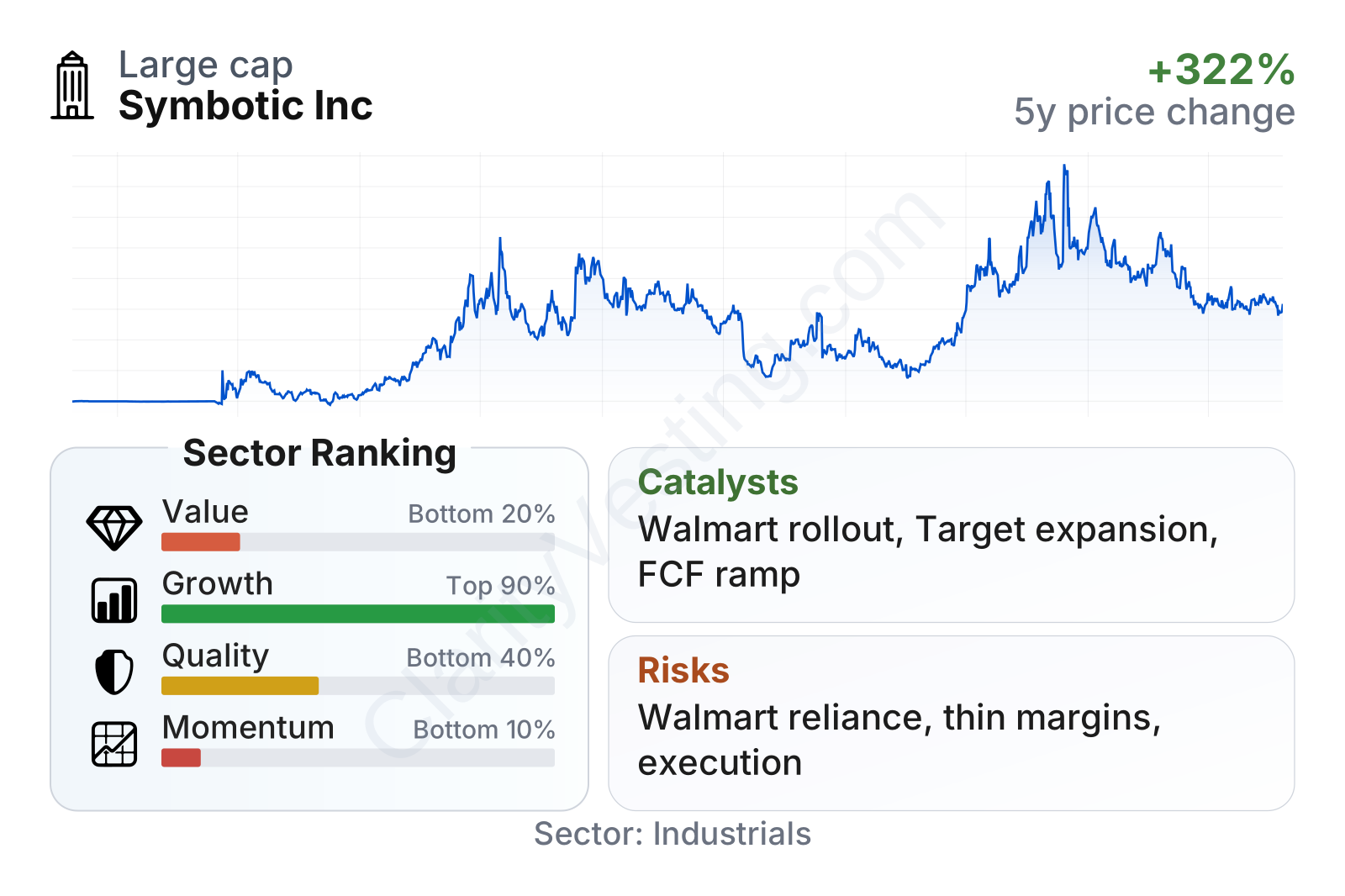
Customer concentration remains unusually high. Walmart has been the dominant customer and strategic partner, and Target has become another major growth driver through a broad warehouse automation agreement. That concentration helps support rapid expansion, but it also means a small number of relationships shape most of the company’s near-term outlook.
Over the last several years, the company has scaled revenue quickly, while gross profit has improved faster than sales. Even so, operating costs remain elevated because Symbotic is still investing heavily in research, engineering, and commercial expansion. The result is a business that has moved much closer to profitability, but has not yet reached the profit levels commonly seen in more mature industrial technology companies.
The long-term financial pattern is encouraging at a high level: revenue has expanded from a few hundred million dollars to well above $2 billion in a relatively short time, and gross profit has widened meaningfully. The main bottleneck is that operating expenses have also stayed high, so stronger scale has not yet translated into strong net margins.
Key Figures
| Metric | Value | Sector ⓘ |
|---|---|---|
| Date | Oct 24, 2026 | |
| Context | ||
| Sector | Industrials | |
| Industry | Specialty Industrial Machinery | |
| Market Cap ⓘ | $24.03B | |
| Beta ⓘ | 1.97 | |
Value (Cheapness) | ||
| P/E Ratio ⓘ | 496.12 | 22.29 |
| P/B Ratio ⓘ | 19.61 | 1.98 |
| FCF Yield ⓘ | 3.07% | 6.26% |
| Dividend Yield ⓘ | N/A | 1.92% |
| EBIT / EV ⓘ | 0.42% | 4.83% |
| PEG ⓘ | 5.39 | |
Growth (Business expansion) | ||
| Revenue Growth ⓘ | 21.70% | 9.30% |
| RPS Growth (5Y CAGR) ⓘ | 42.80% | 7.76% |
| EPS Growth (5Y CAGR) ⓘ | N/A | -13.17% |
| BVPS Growth (5Y CAGR) ⓘ | -63.89% | 6.13% |
| Margin Growth (5Y Trend) ⓘ | N/A | 0.74% |
| FCF Growth (5Y CAGR) ⓘ | 68.65% | 10.79% |
| DPS Growth (5Y CAGR) ⓘ | N/A | 9.41% |
Quality (Business durability) | ||
| ROIC (Latest) ⓘ | 3.46% | 10.75% |
| ROA (Latest) ⓘ | 0.43% | 5.41% |
| ROIC (5Y Median) ⓘ | -65.85% | 9.37% |
| ROA (5Y Median) ⓘ | -2.84% | 4.95% |
| Net Debt / EBIT (Latest) ⓘ | -105.29 | 2.04 |
| Net Debt / EBIT (5Y Median) ⓘ | N/A | 2.27 |
| Net Debt / EBITDA (Latest) ⓘ | -29.18 | 1.39 |
| Net Debt / Assets ⓘ | -48.82% | 19.27% |
| EBITDA / Interest ⓘ | N/A | 9.58 |
| Operating Margin (Latest) ⓘ | 0.62% | 10.49% |
| Operating Margin (5Y Median) ⓘ | -17.09% | 10.30% |
| Debt to Equity (Latest) ⓘ | 3.64% | 64.82% |
| Profit Margin (Latest) ⓘ | 0.31% | 6.67% |
| Free Cash Flow (Latest) ⓘ | $737.26M | |
Momentum (Price trend) | ||
| 3Y Return ⓘ | +0.87% | +67.77% |
| 12M Return (excl. last month) ⓘ | -22.94% | +12.05% |
| 6M Return ⓘ | -33.72% | 0.00% |
| Price vs. 200-Day MA ⓘ | -15.16% | +0.67% |
Symbotic sits in an unusual position. Growth metrics rank near the top of its sector, helped by revenue growth above the sector median and very strong multi-year expansion in revenue per share and free cash flow. Balance-sheet quality is also stronger than the average industrial peer because debt is low and cash generation has improved sharply. The weaker areas are valuation, profitability, and recent stock momentum. The market is still assigning a premium multiple to a business with very thin current margins, while share-price performance has cooled after a period of very large swings.
The stock’s trading history also shows that expectations can change quickly. After a dramatic rerating in 2023 and early 2024, the shares became much more volatile, which fits a company valued on future scale rather than current earnings stability.
Growth
Symbotic operates in a part of the market that still has a long runway: warehouse and supply-chain automation. Large retailers and distributors are under pressure to cut labor intensity, improve inventory accuracy, and handle more product variety with faster throughput. Those forces are structural rather than short-lived. They support continued interest in automated distribution centers, especially for high-volume operators that can justify the upfront investment.
Symbotic’s strategy also makes industrial sense. Instead of targeting small warehouses one by one, it focuses on very large customers with repeatable multi-site rollouts. That approach can create a strong scaling effect: once a customer validates the system at one site, future deployments can follow more efficiently. This is especially important with Walmart and Target, where the opportunity is not just one project but a network-wide buildout.
Revenue growth has slowed from the extremely high levels seen during the earlier ramp, but it is still running at a pace that remains well above the typical industrial company. That deceleration is not surprising for a business that has already crossed the $2 billion revenue level. What matters more is whether Symbotic can keep converting its large customer relationships into additional site launches and service revenue.
One of the strongest recent positives is cash generation. Even though accounting profits remain minimal, free cash flow has improved sharply. That suggests execution, billing, and project conversion have become more efficient as the installed base grows.
The rise in free cash flow is one of the clearest signs that the business is maturing operationally. For a company still early in its commercialization curve, strong cash inflow can reduce financing pressure and give management more flexibility to expand capacity, fund development, and pursue adjacent opportunities.
A meaningful catalyst is the company’s work beyond traditional warehouse automation. Symbotic has highlighted expansion into end-to-end supply chain capabilities and has also moved into adjacent automation opportunities through strategic partnerships and acquisitions. The most important growth signal remains the size and depth of its customer commitments: major retailers do not redesign distribution infrastructure lightly, so signed long-term programs can create visibility that many smaller automation firms do not have.
Risks
This article is for informational purposes only and does not constitute financial advice. Some content is AI-generated. See Disclaimer


