Stock Analysis · Sydbank A/S (SYANY)
Overview
Sydbank A/S is a Danish regional bank focused on traditional banking activities for households, small and medium-sized businesses, and corporate clients. Its operations are centered in Denmark, with a particularly strong position in Southern Jutland and other local markets, and it also serves clients in areas such as wealth management, mortgage-related products, payments, leasing, and capital markets services. In simple terms, Sydbank makes money by taking deposits, lending money, charging fees for financial services, and earning income from investment and market-related activities.
Like most banks, Sydbank’s revenue mix changes with interest rates, loan demand, customer activity, and market conditions. Public reporting for banks in Denmark typically groups income into broad banking categories rather than product-by-product consumer segments. Based on Sydbank’s recent annual reporting structure, the main sources of income can be summarized as follows:
- Net interest income: approximately 60% to 70% of core income in recent periods. This includes the spread between interest earned on loans and securities and interest paid on deposits and funding.
- Fees, commissions, and other customer-related income: approximately 20% to 30%. This mainly covers asset management, payment services, mortgage intermediation, securities trading for clients, and everyday banking fees.
- Trading, investment, and treasury-related income: approximately 5% to 15%. This can include gains or losses from securities, market activities, and balance sheet management.
- Other income: typically a small share. This may include leasing, ancillary services, and one-off accounting items.
Over the last several years, total revenue expanded materially from the low-to-mid hundreds of millions of dollars equivalent to well above $1 billion, helped by stronger net interest income during the higher-rate period. At the same time, profitability has been more volatile than revenue, showing that banking income can rise quickly when rates help margins, but earnings can still swing because of funding costs, loan impairments, taxes, and market-related items.
The business mix shows a bank that benefited from the rate upswing, with revenue rising strongly from 2021 through 2024 before easing in 2025. Expenses have also moved higher, and net income has become less consistent than the top line, which is important for judging how durable the recent earnings base really is.
Key Figures
| Metric | Value | Sector ⓘ |
|---|---|---|
| Date | Nov 21, 2026 | |
| Context | ||
| Sector | Financial Services | |
| Industry | Banks - Regional | |
| Market Cap ⓘ | $8.97B | |
| Beta ⓘ | 0.38 | |
Value (Cheapness) | ||
| P/E Ratio ⓘ | 22.48 | 12.01 |
| P/B Ratio ⓘ | N/A | 1.48 |
| FCF Yield ⓘ | -17.64% | 8.77% |
| Dividend Yield ⓘ | 3.67% | 3.01% |
| EBIT / EV ⓘ | N/A | 8.31% |
| PEG ⓘ | N/A | |
Growth (Business expansion) | ||
| Revenue Growth ⓘ | 74.80% | 6.70% |
| RPS Growth (5Y CAGR) ⓘ | 18.94% | 12.35% |
| EPS Growth (5Y CAGR) ⓘ | 2.85% | -0.27% |
| BVPS Growth (5Y CAGR) ⓘ | 32.35% | 4.83% |
| Margin Growth (5Y Trend) ⓘ | -8.67% | -4.16% |
| FCF Growth (5Y CAGR) ⓘ | N/A | 4.69% |
| DPS Growth (5Y CAGR) ⓘ | 26.86% | 8.82% |
Quality (Business durability) | ||
| ROIC (Latest) ⓘ | N/A | 9.49% |
| ROE (Latest) ⓘ | 7.66% | 14.02% |
| ROA (Latest) ⓘ | 0.80% | 1.53% |
| ROIC (5Y Median) ⓘ | 6.71% | 7.80% |
| ROE (5Y Median) ⓘ | 13.76% | 12.09% |
| ROA (5Y Median) ⓘ | 1.09% | 1.28% |
| Net Debt / EBIT (Latest) ⓘ | N/A | 0.88 |
| Net Debt / EBIT (5Y Median) ⓘ | -1.88 | 0.73 |
| Net Debt / EBITDA (Latest) ⓘ | -0.19 | 0.71 |
| Operating Margin (Latest) ⓘ | N/A | 23.37% |
| Operating Margin (5Y Median) ⓘ | 36.66% | 24.29% |
| Debt to Equity (Latest) ⓘ | 64.81% | 59.34% |
| Profit Margin (Latest) ⓘ | 22.77% | 26.65% |
| Free Cash Flow (Latest) ⓘ | -$1.58B | |
Momentum (Price trend) | ||
| 3Y Return ⓘ | +186.42% | +73.29% |
| 12M Return (excl. last month) ⓘ | +62.11% | +18.35% |
| 6M Return ⓘ | +32.06% | +3.24% |
| Price vs. 200-Day MA ⓘ | +24.02% | +2.17% |
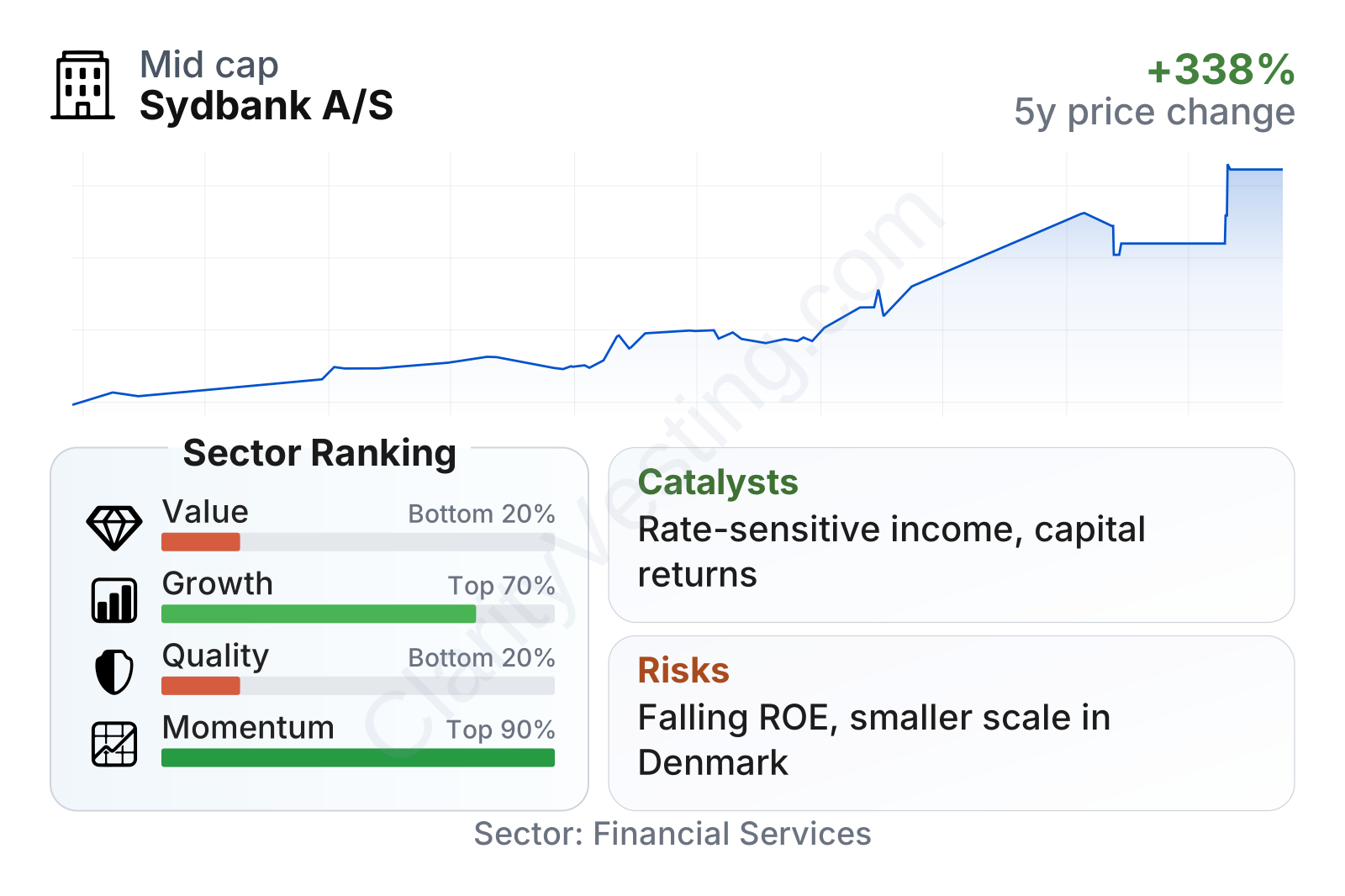
Sydbank is a mid-sized regional bank by public market standards, and its share price momentum has been very strong over the last 6 months, 12 months, and 3 years compared with much of the banking sector. At the same time, the valuation profile looks less favorable: the earnings multiple sits above the sector median, while the overall value ranking is weak. The dividend yield is above the sector median, but profitability quality is currently softer than many peers, with return measures below sector norms and free cash flow negative on a trailing basis, which is not unusual to interpret cautiously for banks but still signals that headline valuation needs to be viewed alongside balance sheet and earnings quality.
Growth
Sydbank operates in a mature sector rather than a high-growth one. Regional banking in Denmark is closely tied to economic activity, housing finance, savings flows, and interest-rate conditions. That means long-term growth usually comes from gaining customers, deepening relationships, expanding fee-based services, and maintaining disciplined credit quality, rather than from rapid expansion in the way a technology company might grow.
Its strategy is still logical for future growth. Sydbank remains focused on relationship banking in its home market, where local presence and customer trust matter. For a bank of this type, growth tends to come from a combination of stable lending, wealth and investment services, and efficient use of capital. The encouraging part is that book value per share has risen very sharply over the last five years, suggesting that the bank has been building shareholder equity even through uneven earnings cycles.
Earnings per share have been volatile rather than steadily rising. That is not unusual for banks exposed to changing rates and credit conditions, but it does reduce visibility. A strong jump in one year followed by a weaker trailing period suggests the market may already be looking through temporary softness and expecting earnings normalization later on.
The book value trend is more constructive. Growth in book value per share has materially outpaced the sector median over five years, which matters for a bank because book value is a core measure of the capital base supporting future lending and income generation. Revenue growth has also been unusually strong compared with the sector, helped by the higher-rate environment and solid customer activity.
A practical catalyst for Sydbank is the path of European and Danish interest rates. If rates remain at levels that support healthy lending spreads without causing major credit stress, banks like Sydbank can continue generating solid core income. Another favorable factor is its ability to return capital through dividends, with dividend growth over five years well ahead of the sector median. In addition, any continued improvement in customer volumes, wealth management activity, or mortgage-related services could support fee income even if rates become less favorable.
Recent company updates have also pointed to continued capital strength and ongoing shareholder distributions, which keeps attention on the bank’s ability to convert its balance sheet strength into per-share value over time. For a regional bank, that can be an important part of the long-term growth equation when the broader industry is not structurally high-growth.
Risks
This article is for informational purposes only and does not constitute financial advice. Some content is AI-generated. See Disclaimer


