Stock Analysis · Swiss Life Holding AG (SWSDF)
Overview
Swiss Life Holding AG is a large European life insurance and financial solutions group headquartered in Switzerland. Its core business is helping individuals and corporate clients prepare for retirement, protect their families, and manage long-term savings. In practice, that means selling life insurance, pension and annuity products, and also earning fees from financial advice, asset management, and distribution businesses.
The company operates mainly in Switzerland, France, Germany, and International markets. Swiss Life is especially known for its strong position in pensions and retirement planning, which gives it exposure to a structural theme: aging populations in Europe and the growing need for private retirement savings alongside public pension systems.
Its revenue mix is not always presented in a simple product-by-product way because insurance groups combine premiums, policy fees, investment-related income, and advisory revenues. Based on Swiss Life’s business model and segment reporting, the main economic sources of revenue and profit are broadly the following:
- Life insurance and pension solutions in Switzerland: roughly the largest contributor, supported by individual life policies, occupational pensions, and related savings products.
- Insurance operations in France and Germany: a meaningful share of group business, including life, health-related protection, savings, and retirement-oriented contracts.
- Fee-based financial advice and distribution: an important and growing source, generated through advisory networks and brokerage platforms serving households and small businesses.
- Asset management and investment-related fees: income earned from managing assets for policyholders and third parties, including real estate and institutional mandates.
- International and other activities: a smaller contribution, including cross-border wealthy-client solutions and selected niche markets.
What matters most for long-term analysis is that Swiss Life is no longer just a traditional insurer. It has been building a broader model where capital-light fee income complements insurance earnings. That is helpful because fee businesses often require less balance-sheet risk than writing long-duration insurance guarantees.
The business flow over recent years also points to improving scale. Revenue rebounded strongly after the 2022 dip and moved back to a clearly higher level by 2024 and 2025, while operating income remained relatively steady around the same general range. Net income has been stable rather than explosive, which is typical for a mature insurer, but the overall picture suggests a resilient earnings base rather than a highly cyclical one.
The business mix shows a company with large recurring inflows, heavy operating obligations typical of insurance, and a fairly consistent profit outcome. Revenue has expanded meaningfully since 2023, while operating profit and net income have stayed comparatively steady, suggesting growth is currently coming more from scale and business mix than from a sharp jump in margins.
Key Figures
| Metric | Value | Sector ⓘ |
|---|---|---|
| Date | Oct 03, 2026 | |
| Context | ||
| Sector | Financial Services | |
| Industry | Insurance - Diversified | |
| Market Cap ⓘ | $31.16B | |
| Beta ⓘ | 0.53 | |
Value (Cheapness) | ||
| P/E Ratio ⓘ | 20.24 | 12.60 |
| P/B Ratio ⓘ | 6.32 | 1.23 |
| FCF Yield ⓘ | 10.87% | 10.16% |
| Dividend Yield ⓘ | 3.27% | 2.96% |
| EBIT / EV ⓘ | N/A | 7.77% |
| PEG ⓘ | 2.24 | |
Growth (Business expansion) | ||
| Revenue Growth ⓘ | 3.40% | 9.50% |
| RPS Growth (5Y CAGR) ⓘ | -3.02% | 12.10% |
| EPS Growth (5Y CAGR) ⓘ | -28.25% | -9.45% |
| BVPS Growth (5Y CAGR) ⓘ | -17.63% | 5.01% |
| Margin Growth (5Y Trend) ⓘ | 2.35% | -4.07% |
| FCF Growth (5Y CAGR) ⓘ | 86.31% | 4.96% |
| DPS Growth (5Y CAGR) ⓘ | 13.49% | 8.79% |
Quality (Business durability) | ||
| ROIC (Latest) ⓘ | N/A | 9.60% |
| ROE (Latest) ⓘ | 36.66% | 13.84% |
| ROA (Latest) ⓘ | 1.11% | 1.53% |
| ROIC (5Y Median) ⓘ | 7.51% | 7.86% |
| ROE (5Y Median) ⓘ | 13.39% | 12.20% |
| ROA (5Y Median) ⓘ | 0.52% | 1.29% |
| Net Debt / EBIT (Latest) ⓘ | N/A | 0.91 |
| Net Debt / EBIT (5Y Median) ⓘ | 2.13 | 0.74 |
| Net Debt / EBITDA (Latest) ⓘ | 2.26 | 0.97 |
| Operating Margin (Latest) ⓘ | N/A | 22.12% |
| Operating Margin (5Y Median) ⓘ | 14.14% | 24.39% |
| Debt to Equity (Latest) ⓘ | 258.41% | 60.37% |
| Profit Margin (Latest) ⓘ | 10.85% | 26.62% |
| Free Cash Flow (Latest) ⓘ | $3.39B | |
Momentum (Price trend) | ||
| 3Y Return ⓘ | +131.02% | +89.23% |
| 12M Return (excl. last month) ⓘ | +14.35% | +17.35% |
| 6M Return ⓘ | +13.77% | +10.00% |
| Price vs. 200-Day MA ⓘ | +59.17% | +3.73% |
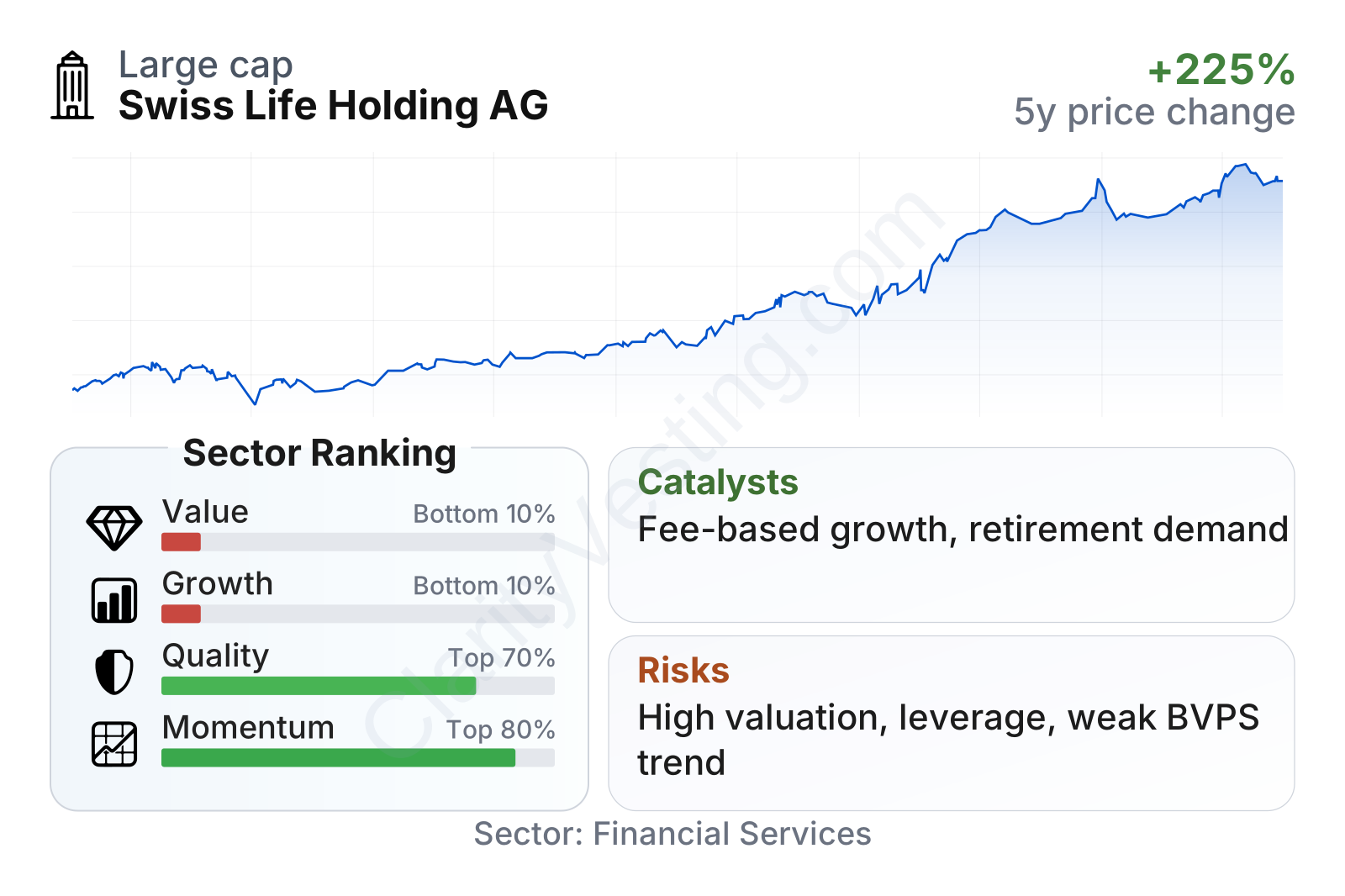
Swiss Life stands out as a large, lower-volatility financial stock, with a beta around 0.5. Profitability is solid in some respects, especially return on equity, which is well above the sector median, but that needs to be read together with a highly leveraged balance sheet that is normal to a degree for insurers yet still elevated relative to many financial peers. Free cash flow generation looks strong, and the dividend yield is slightly above the sector median. On the other hand, the stock scores poorly on conventional value and growth measures: valuation multiples are above sector norms, while long-term revenue per share, earnings per share, and book value per share trends have been weak. Market performance has been strong, especially over three years, so the market has clearly rewarded the company despite moderate underlying growth.
Growth
Swiss Life operates in a sector with durable long-term demand. Retirement provision, life insurance, annuities, and financial advice are supported by demographic aging, longer life expectancy, and pressure on public pension systems across Europe. Those forces do not guarantee fast growth, but they do create a steady need for the kinds of products and services Swiss Life provides.
The company’s strategy also makes sense for future growth because it is not relying only on traditional life insurance. Management has spent years expanding fee-based businesses such as financial advice, brokerage, and asset management. That shift matters because fee income can be more scalable and less capital-intensive than guaranteed insurance liabilities. For a mature insurer, improving the mix can be just as important as growing headline premiums.
Recent operating trends support that view, but only partially. Revenue growth over the last year has been positive, though slower than the sector median. Margin trend over five years has improved, which suggests the business has become somewhat more efficient or better balanced. Free cash flow growth has been particularly strong over the longer term, and dividend growth has also been healthy. These are encouraging signals for a company in a mature market.
The difficulty is that per-share growth has not been consistently strong over a five-year view. Earnings per share and revenue per share have both been under pressure over that period, which means the company has not yet translated its strategic repositioning into broad-based compounding across all headline measures. This makes Swiss Life more of a steady-value creation case than a rapid-growth one.
Book value per share has trended down over the past several years, with only a brief stabilization before another decline. For an insurer, this is worth watching because book value often serves as a simple check on how much balance-sheet value is building for shareholders over time. A falling book value per share does not automatically mean deterioration in business quality, but it does suggest that capital returns, market movements, accounting effects, or liability dynamics have outweighed retained value growth.
A meaningful catalyst is the company’s continued emphasis on fee-generating businesses tied to retirement advice and asset management. If that mix continues to expand, Swiss Life could become less dependent on spread income and more resilient across interest-rate cycles. Another useful tailwind is the higher-rate environment compared with the ultra-low-rate years, since life insurers generally benefit when they can reinvest at more attractive yields, provided liabilities remain well managed.
Risks
This article is for informational purposes only and does not constitute financial advice. Some content is AI-generated. See Disclaimer


