Stock Analysis · Swiss Prime Site AG (SWPRF)
Overview
Swiss Prime Site AG is one of Switzerland’s largest listed real estate companies. Its business is centered on owning, developing, and managing high-quality commercial properties in strong Swiss locations, especially offices, retail sites, mixed-use buildings, and urban real estate. In addition to rental income, the group also operates a real estate services platform through Wincasa, which manages properties for third parties. This gives the company a mix of recurring rental cash flow and fee-based service income.
The company’s revenue base is mainly built around the following activities:
- Rental income from investment properties: approximately 70% to 80% of revenue in recent years. This is the core business and includes rent from office, retail, mixed-use, and other commercial properties.
- Real estate services: approximately 10% to 20%. This mainly comes from Wincasa, which provides property management, center management, and related services.
- Development, sales, and other property-related income: approximately 5% to 15%. This includes development gains, disposal activity, and other smaller revenue streams that can vary from year to year.
For long-term readers, the key point is that Swiss Prime Site is not a pure homebuilder or a highly cyclical trading vehicle. It is primarily a landlord of Swiss commercial real estate with a meaningful services arm attached to that property platform. That usually makes earnings more stable than those of developers that depend heavily on project sales.
The business mix has also shown resilience: total revenue has moved within a relatively narrow band over several years, while profitability has been more affected by valuation movements, financing costs, and transaction timing than by large swings in underlying rental activity.
The profit structure shows a business with strong gross profitability and generally controlled operating expenses, although net income has been more volatile than revenue. Interest expense remains an important line to watch, which is typical for a property owner using debt to finance assets.
Key Figures
| Metric | Value | Sector ⓘ |
|---|---|---|
| Date | Oct 17, 2026 | |
| Context | ||
| Sector | Real Estate | |
| Industry | Real Estate - Diversified | |
| Market Cap ⓘ | $8.10B | |
| Beta ⓘ | 0.47 | |
Value (Cheapness) | ||
| P/E Ratio ⓘ | 15.76 | 17.38 |
| P/B Ratio ⓘ | 2.05 | 0.85 |
| FCF Yield ⓘ | 8.96% | 7.38% |
| Dividend Yield ⓘ | 2.54% | 4.85% |
| EBIT / EV ⓘ | N/A | 3.78% |
| PEG ⓘ | N/A | |
Growth (Business expansion) | ||
| Revenue Growth ⓘ | -0.10% | 5.30% |
| RPS Growth (5Y CAGR) ⓘ | -11.59% | 6.02% |
| EPS Growth (5Y CAGR) ⓘ | -24.89% | -11.37% |
| BVPS Growth (5Y CAGR) ⓘ | -2.57% | 0.45% |
| Margin Growth (5Y Trend) ⓘ | 2.55% | -0.22% |
| FCF Growth (5Y CAGR) ⓘ | -7.38% | 5.40% |
| DPS Growth (5Y CAGR) ⓘ | -3.17% | 5.02% |
Quality (Business durability) | ||
| ROIC (Latest) ⓘ | 6.46% | 5.69% |
| ROE (Latest) ⓘ | 11.29% | 7.56% |
| ROA (Latest) ⓘ | 5.40% | 2.85% |
| ROIC (5Y Median) ⓘ | 4.12% | 4.22% |
| ROE (5Y Median) ⓘ | 5.57% | 6.03% |
| ROA (5Y Median) ⓘ | 2.68% | 2.44% |
| Net Debt / EBIT (Latest) ⓘ | 5.92 | 7.59 |
| Net Debt / EBIT (5Y Median) ⓘ | 10.28 | 8.40 |
| Net Debt / EBITDA (Latest) ⓘ | 5.85 | 5.27 |
| Net Debt / Assets ⓘ | 41.17% | 37.76% |
| EBITDA / Interest ⓘ | 4.28 | 4.10 |
| Operating Margin (Latest) ⓘ | 87.30% | 35.29% |
| Operating Margin (5Y Median) ⓘ | 78.97% | 37.31% |
| Debt to Equity (Latest) ⓘ | 86.94% | 88.87% |
| Profit Margin (Latest) ⓘ | 73.38% | 19.61% |
| Free Cash Flow (Latest) ⓘ | $725.67M | |
Momentum (Price trend) | ||
| 3Y Return ⓘ | +66.34% | +30.75% |
| 12M Return (excl. last month) ⓘ | +17.92% | +4.36% |
| 6M Return ⓘ | -19.81% | -2.52% |
| Price vs. 200-Day MA ⓘ | -5.06% | -2.34% |
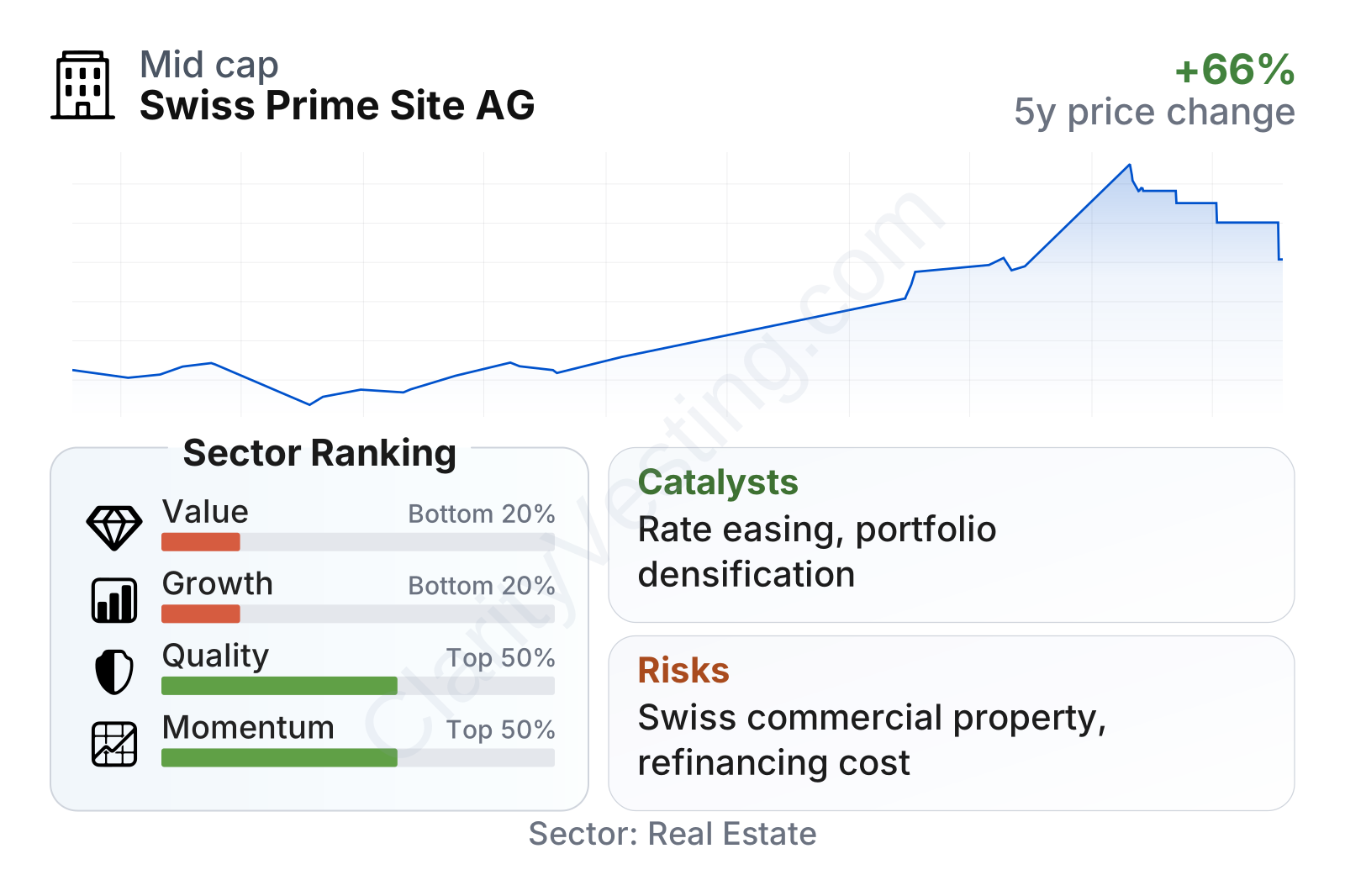
Swiss Prime Site is a large real estate company with a relatively low share-price volatility profile, reflected by a beta well below 1. On profitability and balance sheet efficiency, it stands in the better half of the sector, with returns on equity and assets above sector medians and interest coverage that looks solid for a landlord. The weaker area is growth: recent revenue momentum and multi-year per-share trends have lagged the broader real estate group. On valuation, the picture is mixed. The earnings multiple is close to the sector range, but the price-to-book ratio is clearly richer than the sector median, suggesting the market assigns a premium to asset quality, stability, or both.
Growth
Swiss Prime Site operates in a sector that is mature rather than fast-growing, but that does not mean growth is absent. Prime commercial real estate in Switzerland benefits from structural support such as limited land supply in major urban areas, strict planning frameworks, and the country’s reputation for economic stability. Demand for well-located properties can remain firm even when broader real estate conditions are uneven, especially for assets tied to strong business districts and transportation hubs.
The company’s strategy is sensible for this type of market. It combines stable rent collection from an established property portfolio with selective development and active asset management. That approach can create growth through redevelopment, tenant mix optimization, occupancy improvement, and rent indexation rather than relying only on large acquisitions. The services business also adds a second engine that is less capital-intensive than owning buildings directly.
Revenue per share has generally moved sideways to down over the last several years, with a more visible drop in the most recent period shown. That does not automatically mean the core portfolio is weakening, because per-share figures can also be influenced by property sales, project timing, or changes in valuation-related accounting. Still, it indicates that Swiss Prime Site has not recently produced broad-based top-line expansion on a per-share basis.
The dividend trend has been comparatively steadier than revenue per share, though the latest period shows pressure there as well. For a real estate company, this matters because long-term market confidence often depends on how durable rental cash generation appears through different financing and property cycles.
A potential catalyst is the operating environment for prime Swiss property itself. If interest rates stabilize or ease, property values and financing conditions can become more supportive. That can help listed landlords through lower refinancing pressure, stronger transaction markets, and better sentiment toward income-producing real estate. The company’s focus on high-quality assets in major Swiss locations means it is well positioned to benefit if those conditions improve.
Another positive driver is development and densification within the existing portfolio. In a country where new supply is not easy to create, upgrading or repurposing centrally located assets can unlock value without requiring the company to expand aggressively into unfamiliar markets.
Risks
This article is for informational purposes only and does not constitute financial advice. Some content is AI-generated. See Disclaimer


