Stock Analysis · Swire Properties Limited (SWPFF)
Overview
Swire Properties Limited is a Hong Kong-based real estate company focused on owning, developing, and managing premium commercial, retail, hotel, and residential properties. Its core business is not simply selling buildings. The more important part of the model is holding major mixed-use assets for recurring rental income, especially office towers and shopping malls in dense urban locations. The company’s best-known projects include Pacific Place and Taikoo Place in Hong Kong, as well as large developments in Mainland China such as Taikoo Li and Taikoo Hui.
The business is built around long-life real estate assets in gateway cities. That usually means earnings can be affected by property valuation swings from year to year, while cash generation is more closely tied to occupancy, rent levels, tenant quality, hotel demand, and occasional residential project completions.
Based on the company’s recent annual reporting structure, the main revenue sources are approximately:
- Property investment: about 80% to 85% — mainly office and retail rental income from Hong Kong, Mainland China, and a smaller international portfolio. This is the recurring core of the company.
- Hotels: about 8% to 12% — income from owned and managed hotels, with results linked to travel demand, room rates, and business activity.
- Property trading / residential sales: about 5% to 10% — proceeds from development-for-sale projects. This tends to be the most uneven revenue stream because completion timing can move results significantly between years.
Geographically, Hong Kong remains the main earnings base, but Mainland China has become a major strategic growth market through high-end retail-led mixed-use projects. That mix matters because Hong Kong offices have been under pressure, while prime retail assets in selected Chinese cities have offered a different growth profile.
The multi-year income flow also shows a business with resilient gross profit generation but much more volatile bottom-line results, largely because financing costs and property-related revaluations can sharply change reported earnings from one year to the next.
Key Figures
| Metric | Value | Sector ⓘ |
|---|---|---|
| Date | Oct 24, 2026 | |
| Context | ||
| Sector | Real Estate | |
| Industry | Real Estate Services | |
| Market Cap ⓘ | $17.98B | |
| Beta ⓘ | 0.79 | |
Value (Cheapness) | ||
| P/E Ratio ⓘ | 43.86 | 17.85 |
| P/B Ratio ⓘ | 0.01 | 0.87 |
| FCF Yield ⓘ | 76.49% | 7.30% |
| Dividend Yield ⓘ | 37.74% | 4.83% |
| EBIT / EV ⓘ | N/A | 3.78% |
| PEG ⓘ | 0.44 | |
Growth (Business expansion) | ||
| Revenue Growth ⓘ | 13.00% | 5.35% |
| RPS Growth (5Y CAGR) ⓘ | 66.89% | 6.02% |
| EPS Growth (5Y CAGR) ⓘ | -67.19% | -10.65% |
| BVPS Growth (5Y CAGR) ⓘ | 63.97% | 0.43% |
| Margin Growth (5Y Trend) ⓘ | -52.57% | -0.69% |
| FCF Growth (5Y CAGR) ⓘ | 10.93% | 5.40% |
| DPS Growth (5Y CAGR) ⓘ | 75.03% | 5.07% |
Quality (Business durability) | ||
| ROIC (Latest) ⓘ | 0.80% | 5.69% |
| ROE (Latest) ⓘ | -0.17% | 7.37% |
| ROA (Latest) ⓘ | -0.13% | 2.85% |
| ROIC (5Y Median) ⓘ | 0.98% | 4.26% |
| ROE (5Y Median) ⓘ | 0.93% | 6.04% |
| ROA (5Y Median) ⓘ | 0.76% | 2.45% |
| Net Debt / EBIT (Latest) ⓘ | 8.25 | 7.55 |
| Net Debt / EBIT (5Y Median) ⓘ | 5.74 | 8.26 |
| Net Debt / EBITDA (Latest) ⓘ | 6.88 | 5.26 |
| Net Debt / Assets ⓘ | 12.67% | 37.45% |
| EBITDA / Interest ⓘ | 2.38 | 4.11 |
| Operating Margin (Latest) ⓘ | 17.22% | 33.86% |
| Operating Margin (5Y Median) ⓘ | 32.05% | 37.49% |
| Debt to Equity (Latest) ⓘ | 20.17% | 88.76% |
| Profit Margin (Latest) ⓘ | 18.69% | 18.94% |
| Free Cash Flow (Latest) ⓘ | $13.76B | |
Momentum (Price trend) | ||
| 3Y Return ⓘ | +74.73% | +36.33% |
| 12M Return (excl. last month) ⓘ | +21.73% | +4.32% |
| 6M Return ⓘ | -4.06% | -1.74% |
| Price vs. 200-Day MA ⓘ | +27.33% | -1.42% |
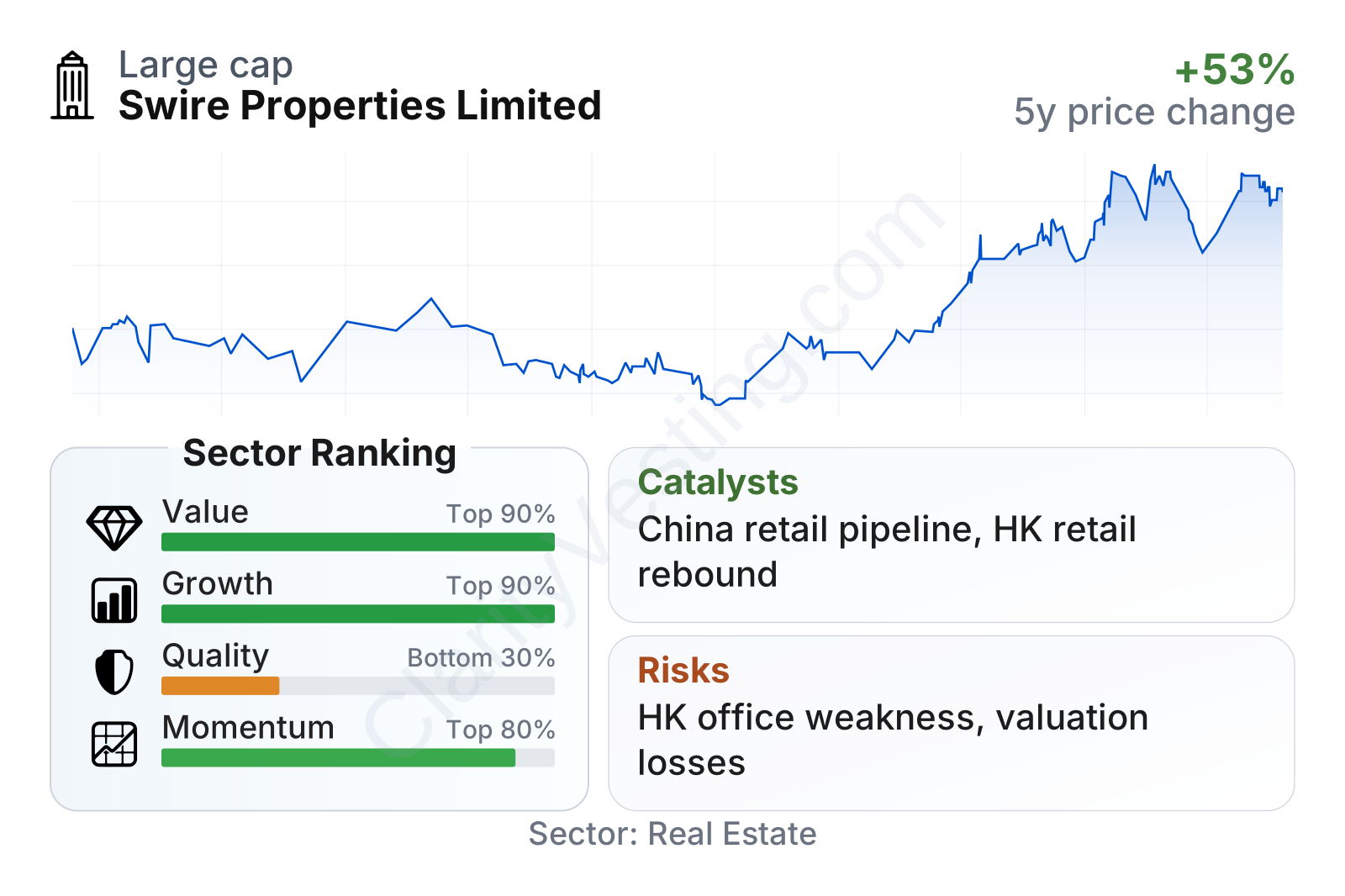
Swire Properties is a large real estate company with a relatively low share-price volatility profile, as suggested by a beta below 1. On the factor view, it ranks strongly on value, growth, and momentum relative to much of the real estate sector, but clearly weaker on quality. That split is important: the market appears to be recognizing asset value and cash generation, while profitability and returns on capital remain subdued.
The value profile looks unusual. The shares trade at a very low price-to-book multiple versus the sector median, while free cash flow yield and trailing dividend yield stand far above typical sector levels. At the same time, the earnings multiple is high because reported profits have been depressed. In other words, the stock screens as cheap on asset backing and cash flow, but not on accounting earnings.
Growth indicators are also distorted in a favorable direction by recent recovery and asset-related movements. Revenue growth has been better than the sector median, and book value per share and dividend growth over five years stand out. However, earnings per share and operating margin trends have been much weaker, which suggests top-line resilience has not translated cleanly into higher profitability.
Growth
Swire Properties operates in a sector that is mature rather than structurally high-growth, but some of its niches still have expansion potential. Prime mixed-use developments in dense urban districts can benefit from limited land supply, premium tenant demand, and long asset lives. In particular, high-end retail destinations in major Chinese cities and landmark office-retail clusters tend to create durable ecosystems that are difficult to replicate.
The company’s strategy for future growth remains sensible on paper: concentrate capital on premium districts, keep a meaningful share of earnings from recurring rent, and expand selectively in Mainland China. That approach can work well over long periods because trophy assets often preserve relevance better than lower-quality properties, especially when connected to transit, affluent neighborhoods, and strong tenant networks.
A visible catalyst is the company’s development pipeline in Mainland China. New phases and maturing projects can gradually lift rental income as occupancy rises and retail traffic improves. Another support comes from Hong Kong retail and hospitality normalization if tourism and premium consumption continue recovering. For a landlord with prime malls and mixed-use estates, that can feed through into tenant sales, rent reversions, and hotel performance.
Revenue per share has been uneven over the past several years, which is normal for a property group with both recurring rental income and more cyclical development contributions. The broader picture still points to a business that has kept a substantial revenue base intact despite weak office conditions and property-market volatility.
The dividend trend has generally moved upward over time, reflecting the company’s preference to maintain distributions through cycles. That said, unusually large recent per-share jumps should be treated cautiously in interpretation because they may reflect technical factors rather than a simple step-change in ordinary earning power.
Recent company updates have also pointed to ongoing investment in large projects and portfolio repositioning. For long-term analysis, the important issue is less about one quarter’s rent collection and more about whether the next wave of completed projects can offset pressure in older office assets. If Mainland China retail-led properties continue to mature well, they could become a more important counterweight to Hong Kong office softness.
Risks
This article is for informational purposes only and does not constitute financial advice. Some content is AI-generated. See Disclaimer


