Stock Analysis · SoftwareONE Holding AG (SWONF)
Overview
SoftwareONE Holding AG is a Switzerland-based technology services company focused on helping businesses buy, manage, and optimize software and cloud technology. In simple terms, it acts as an adviser, reseller, and implementation partner for companies that need to control software spending, move workloads to the cloud, and run complex vendor relationships such as Microsoft, Amazon Web Services, and other enterprise software providers.
The business is built around two broad activities: software and cloud marketplace services on one side, and higher-value consulting and managed services on the other. The first side helps customers procure licenses, subscriptions, and cloud capacity; the second helps them migrate systems, modernize applications, manage cloud environments, and improve cybersecurity and governance. This mix matters because resale activity brings scale and customer access, while services usually carry better margins and create stickier client relationships.
Based on company reporting in recent annual materials, revenue and gross profit are mainly generated from the following sources:
- Software and cloud marketplace / resale activity: approximately 55% to 65% of revenue in recent years. This includes software licensing, cloud subscriptions, and related vendor programs. It is the larger revenue bucket, but it is generally lower margin.
- Services and solutions: approximately 35% to 45% of revenue. This includes cloud migration, software asset management, application modernization, managed cloud services, and advisory work. This is typically the more profitable part of the model.
- Vendor concentration: Microsoft is historically the most important ecosystem partner, representing a very large share of business activity, with Amazon Web Services and other software vendors adding diversification.
The broader pattern over the last several years is that SoftwareONE has been trying to increase the weight of recurring cloud and service-led work, while still using its global software procurement position to maintain customer reach. That strategic shift is important because it can improve profitability and reduce dependence on one-time license transactions.
The profit flow over recent years shows a business with solid gross profit generation but uneven conversion into net earnings. Revenue has climbed overall, especially in 2025, yet operating costs, financing costs, and restructuring effects have kept bottom-line results volatile. That makes margin recovery more important than revenue growth alone.
Key Figures
| Metric | Value | Sector ⓘ |
|---|---|---|
| Date | Oct 10, 2026 | |
| Context | ||
| Sector | Technology | |
| Industry | Software - Application | |
| Market Cap ⓘ | $2.36B | |
| Beta ⓘ | 1.21 | |
Value (Cheapness) | ||
| P/E Ratio ⓘ | 45.57 | 30.74 |
| FCF Yield ⓘ | 22.31% | 4.05% |
| Dividend Yield ⓘ | 1.43% | 1.29% |
| EBIT / EV ⓘ | N/A | 2.81% |
| PEG ⓘ | N/A | |
Growth (Business expansion) | ||
| Revenue Growth ⓘ | 68.20% | 15.80% |
| RPS Growth (5Y CAGR) ⓘ | 8.47% | 8.56% |
| EPS Growth (5Y CAGR) ⓘ | -5.95% | -11.61% |
| Margin Growth (5Y Trend) ⓘ | -6.46% | 0.49% |
| FCF Growth (5Y CAGR) ⓘ | 12.95% | 9.80% |
| DPS Growth (5Y CAGR) ⓘ | 0.01% | 7.74% |
Quality (Business durability) | ||
| ROIC (Latest) ⓘ | N/A | 9.39% |
| ROIC (5Y Median) ⓘ | 9.62% | 8.35% |
| Net Debt / EBIT (Latest) ⓘ | 2.64 | 0.50 |
| Net Debt / EBIT (5Y Median) ⓘ | -3.06 | 0.51 |
| Net Debt / EBITDA (Latest) ⓘ | 1.18 | 0.28 |
| Net Debt / Assets ⓘ | 6.23% | 3.46% |
| EBITDA / Interest ⓘ | 6.65 | 13.31 |
| Operating Margin (Latest) ⓘ | 7.16% | 9.77% |
| Operating Margin (5Y Median) ⓘ | 7.26% | 8.53% |
| Debt to Equity (Latest) ⓘ | 87.49% | 34.80% |
| Profit Margin (Latest) ⓘ | 2.86% | 7.13% |
| Free Cash Flow (Latest) ⓘ | $525.70M | |
Momentum (Price trend) | ||
| 3Y Return ⓘ | -36.95% | +54.57% |
| 12M Return (excl. last month) ⓘ | +34.83% | +16.76% |
| 6M Return ⓘ | +40.20% | +22.43% |
| Price vs. 200-Day MA ⓘ | +6.58% | +8.85% |
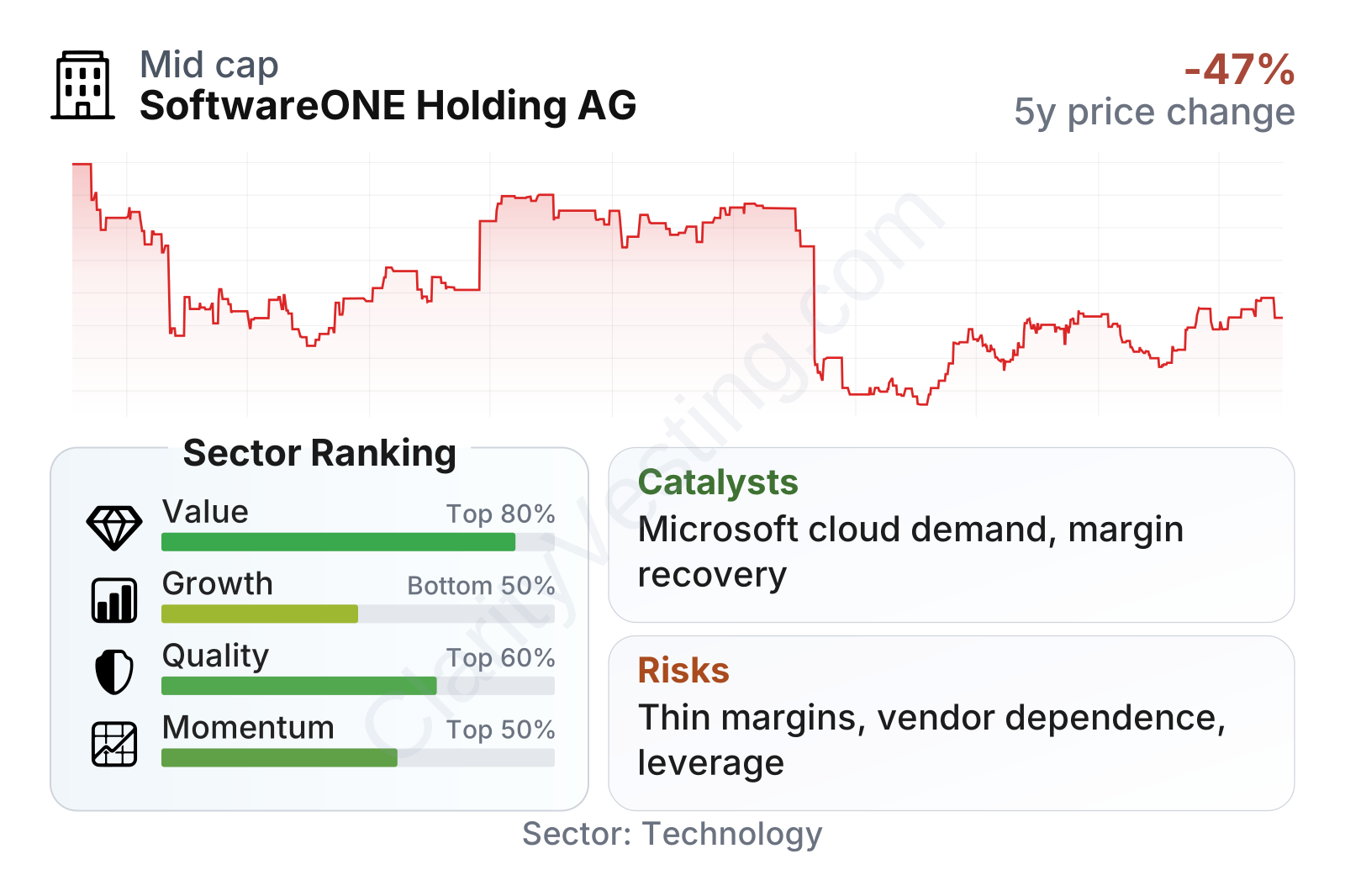
The recent profile is mixed. On valuation, the earnings multiple is above the sector median, but free cash flow generation stands out as unusually strong relative to the current market value. Quality metrics are around the middle of the software sector rather than at the top: long-term returns on invested capital are respectable, but profit margins are below sector norms and leverage is higher than many software peers. Growth indicators also need context. Reported recent revenue growth looks very strong, but the longer five-year trend is much more moderate and margin progression has been negative. Share price performance has improved over the last 6 to 12 months, although the longer three-year record remains weak after a sharp reset.
SoftwareONE is a mid-sized listed software services company with above-average share price volatility for the sector. The combination of strong cash flow, modest profitability, and a recovering stock chart suggests the market is balancing turnaround potential against execution risk.
Growth
SoftwareONE operates in a part of the technology market that still benefits from long-term structural demand. Companies continue to shift spending from on-premise software to cloud subscriptions, multi-cloud environments are becoming more common, and software cost control has become more important as IT budgets face scrutiny. These trends support demand for licensing optimization, cloud migration, FinOps, managed services, cybersecurity, and application modernization—exactly the areas where SoftwareONE is trying to deepen its role.
The company’s strategy broadly makes sense for that environment. Pure software reselling is useful for customer acquisition, but it is not the most attractive business on its own. The stronger opportunity is to attach consulting and recurring managed services to those customer relationships. If SoftwareONE can expand wallet share inside existing accounts, improve cross-selling between software procurement and cloud services, and standardize delivery across its global platform, growth quality could improve even if the top line does not accelerate dramatically.
A major catalyst is the company’s position in the Microsoft ecosystem. Many enterprise customers still need help managing licensing complexity, migrating to Azure, adopting AI-related productivity tools, and controlling cloud costs after migration. Public company materials also highlight capabilities in AWS and application services, which can reduce reliance on a single vendor over time. Another possible catalyst is operating simplification: if restructuring and platform integration efforts translate into better cost discipline, even moderate revenue growth could produce a stronger earnings recovery.
Recent annual reporting also points to a business that is still growing in absolute terms, with revenue moving above the $1.2 billion level in 2025 after being close to $1.0 billion in the prior two years. That is encouraging, but the more important test is whether that growth turns into sustainably higher operating income and cleaner net profit.
Risks
This article is for informational purposes only and does not constitute financial advice. Some content is AI-generated. See Disclaimer