Stock Analysis · Stanley Black & Decker Inc (SWK)
Overview
Stanley Black & Decker is an industrial company best known for power tools, hand tools, outdoor equipment, and engineered fastening systems. Its brands include DeWalt, Stanley, Craftsman, Black+Decker, Cub Cadet, and Irwin. The business serves both professional users such as contractors and industrial customers, and consumer buyers through home centers, hardware stores, e-commerce channels, and distributors around the world.
The company’s revenue base is concentrated in tools and outdoor products, while a smaller portion comes from industrial customers. Based on recent annual reporting, the main sources of revenue are approximately:
- Tools & Outdoor: about 91% of revenue. This includes professional power tools, hand tools, accessories, storage, and outdoor products such as lawn and garden equipment sold under brands like DeWalt, Stanley, Craftsman, Black+Decker, and Cub Cadet.
- Industrial: about 9% of revenue. This segment mainly includes engineered fastening systems and infrastructure-related products supplied to manufacturers and industrial clients.
Within the broader business, professional tools and construction-related demand are especially important because they typically carry stronger brand loyalty and recurring accessory sales. Geographically, Stanley Black & Decker remains heavily exposed to North America, with additional business across Europe and emerging markets.
The company has gone through a difficult reset since the demand surge that followed the pandemic. Revenue has eased from the 2022 peak, but profitability and cash generation have started to recover as management reduced inventories, simplified operations, and focused on cost savings. That makes the current version of Stanley Black & Decker less about expansion at any price and more about rebuilding earnings quality.
The long-term pattern shows a business that kept a large revenue base but suffered a sharp drop in operating profit after 2021, largely because costs rose faster than sales and interest expense became much heavier. More recently, gross profit and operating income have improved from the low point, which supports the idea that the restructuring program is having an effect, even if margins are still below earlier levels.
Key Figures
| Metric | Value | Sector ⓘ |
|---|---|---|
| Date | Oct 10, 2026 | |
| Context | ||
| Sector | Industrials | |
| Industry | Tools & Accessories | |
| Market Cap ⓘ | $13.59B | |
| Beta ⓘ | 1.17 | |
Value (Cheapness) | ||
| P/E Ratio ⓘ | 22.00 | 22.32 |
| P/B Ratio ⓘ | 1.50 | 1.98 |
| FCF Yield ⓘ | 9.49% | 6.34% |
| Dividend Yield ⓘ | 3.70% | 1.95% |
| EBIT / EV ⓘ | 5.23% | 4.71% |
| PEG ⓘ | 1.39 | |
Growth (Business expansion) | ||
| Revenue Growth ⓘ | 0.40% | 9.25% |
| RPS Growth (5Y CAGR) ⓘ | 1.80% | 7.75% |
| EPS Growth (5Y CAGR) ⓘ | -15.87% | -13.37% |
| BVPS Growth (5Y CAGR) ⓘ | -2.72% | 6.12% |
| Margin Growth (5Y Trend) ⓘ | -5.74% | 0.81% |
| FCF Growth (5Y CAGR) ⓘ | 47.84% | 11.01% |
| DPS Growth (5Y CAGR) ⓘ | 2.41% | 9.48% |
Quality (Business durability) | ||
| ROIC (Latest) ⓘ | 5.23% | 10.70% |
| ROA (Latest) ⓘ | 2.97% | 5.38% |
| ROIC (5Y Median) ⓘ | 5.71% | 9.26% |
| ROA (5Y Median) ⓘ | 1.87% | 4.94% |
| Net Debt / EBIT (Latest) ⓘ | 4.42 | 2.08 |
| Net Debt / EBIT (5Y Median) ⓘ | 8.59 | 2.29 |
| Net Debt / EBITDA (Latest) ⓘ | 2.95 | 1.43 |
| Net Debt / Assets ⓘ | 20.73% | 19.34% |
| EBITDA / Interest ⓘ | 3.69 | 9.54 |
| Operating Margin (Latest) ⓘ | 6.18% | 10.34% |
| Operating Margin (5Y Median) ⓘ | 4.77% | 10.29% |
| Debt to Equity (Latest) ⓘ | 53.11% | 65.52% |
| Profit Margin (Latest) ⓘ | 4.07% | 6.63% |
| Free Cash Flow (Latest) ⓘ | $1.29B | |
Momentum (Price trend) | ||
| 3Y Return ⓘ | +27.53% | +61.33% |
| 12M Return (excl. last month) ⓘ | +28.36% | +14.82% |
| 6M Return ⓘ | +33.17% | +3.53% |
| Price vs. 200-Day MA ⓘ | +6.79% | +0.88% |
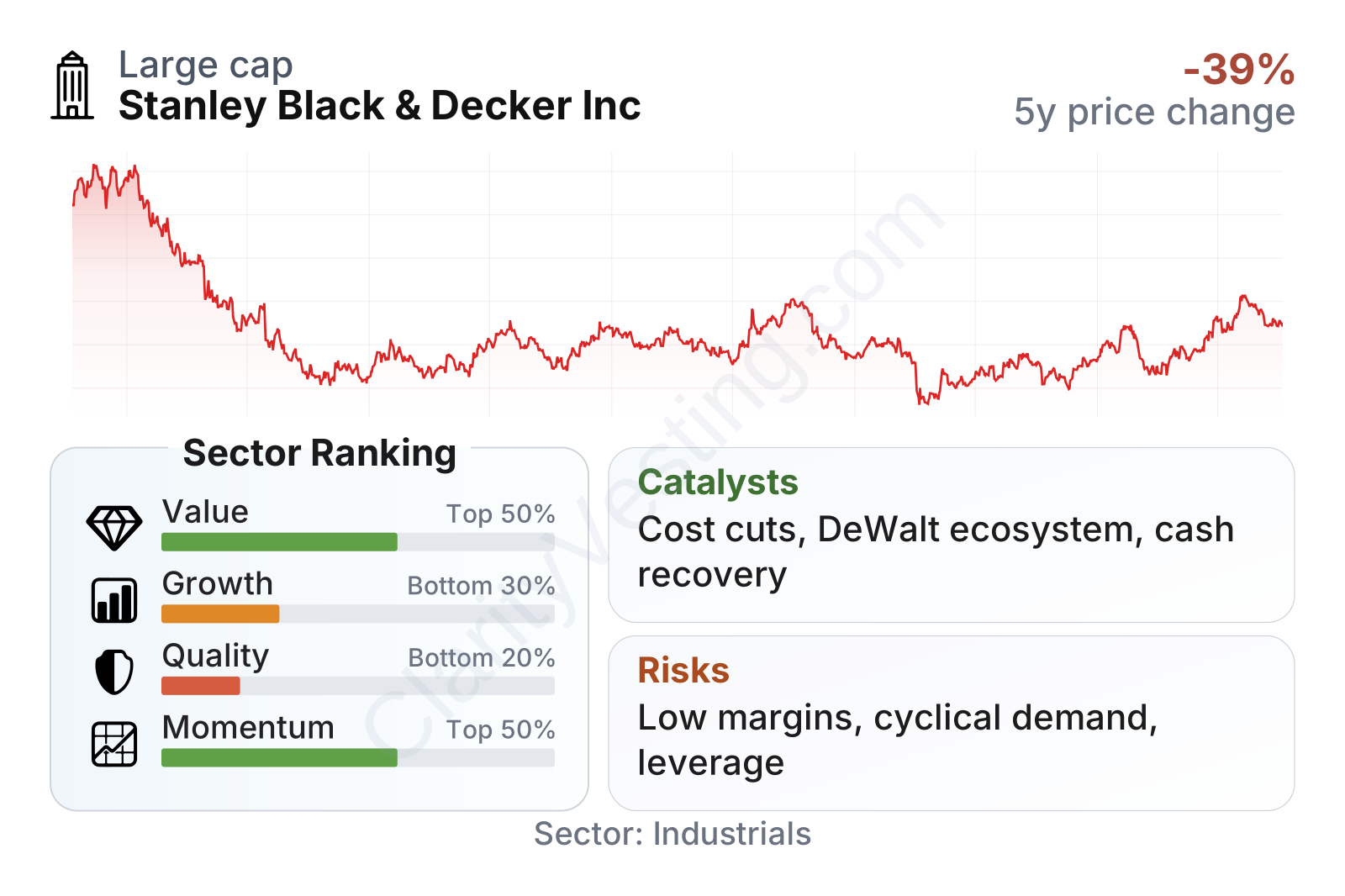
Stanley Black & Decker currently looks mixed on the surface: valuation metrics are around the middle of the industrial sector, and cash generation is relatively strong, but growth and business quality remain weaker than many peers. The table points to a company whose recovery is real but incomplete. It is a large, established manufacturer with a dividend yield above the sector median and free cash flow yield that stands out positively, yet returns on capital and margins still lag the broader group.
The share price history reflects that uneven path. After a steep decline from 2021 into 2022, the stock spent a long period rebuilding confidence. More recent performance has been better than the sector over the last 6 to 12 months, suggesting that the market is recognizing operational progress, but the longer three-year record still shows how much value was lost during the downturn.
Growth
Stanley Black & Decker operates in categories that should remain relevant over the long run. Professional construction tools, home improvement products, infrastructure fastening systems, electrification of equipment, and cordless tool ecosystems are all areas with durable demand. This is not a fast-growing software-style market, but it is a large and resilient sector supported by repair, renovation, construction activity, and replacement cycles.
The company’s strategy for future growth is centered on three practical goals: strengthening core tool brands, expanding the professional customer base, and improving profitability through supply chain simplification and cost reduction. In simple terms, management is trying to make the business more efficient first, then use that stronger base to grow again. That approach makes sense because Stanley Black & Decker’s biggest issue in recent years was not lack of brand recognition, but weak execution after a period of inflated inventories and cost pressure.
Revenue growth has been weak for several quarters, with a long stretch of declines before a recent return to roughly flat to slightly positive year-over-year movement. That is still far behind the typical industrial company, so the near-term growth profile remains modest. The more encouraging point is that the declines appear to have stabilized, which matters for a company trying to rebuild margins.
Cash flow is one of the clearest signs of improvement. Free cash flow moved from deeply negative territory during the inventory correction period to solidly positive levels. For a manufacturing business, that shift is important because it gives the company more flexibility to support restructuring, reduce debt, and maintain shareholder distributions without depending as much on outside financing.
A meaningful catalyst is the company’s multi-year transformation plan, often described through cost reduction, supply chain redesign, and portfolio focus on stronger categories. Stanley Black & Decker has also emphasized innovation in cordless systems and professional-grade products, especially under DeWalt, where battery platforms can encourage repeat purchases of compatible tools and accessories. That ecosystem effect can support steadier demand over time.
Another favorable backdrop is the gradual normalization of housing-related and repair demand after a difficult period for consumer-facing durable goods. If North American home improvement spending and non-residential construction activity remain stable, Stanley Black & Decker has room for operating leverage: even modest sales improvement could have a larger effect on profit than it would have during the downturn.
Recent company updates in 2026 have continued to highlight progress on operational streamlining and productivity actions rather than a dramatic top-line breakout. That suggests the biggest opportunity in the near term is still earnings recovery from self-help measures, not a sudden surge in sales.
Risks
This article is for informational purposes only and does not constitute financial advice. Some content is AI-generated. See Disclaimer