Stock Analysis · Severn Trent PLC (SVTRF)
Overview
Severn Trent PLC is a U.K.-based regulated water utility. Its core job is straightforward: it supplies clean water and wastewater services to households and businesses, mainly across the Midlands and parts of Wales and England. For long-term analysis, this matters because water utilities operate in an essential service with demand that is usually stable regardless of the economic cycle.
The business is built around infrastructure that is difficult to replicate: reservoirs, treatment plants, underground pipe networks, and sewer systems. That creates high barriers to entry. In practice, customers in its service area do not choose another water network operator, so Severn Trent functions more like a regional monopoly under regulatory supervision than a conventional competitive business.
Based on recent annual reporting, revenue is heavily concentrated in regulated utility activities. The approximate mix is as follows:
- Water and wastewater services: about 85% to 90% of revenue. This includes household and business billing for water supply, sewerage, treatment, and network services.
- Business services and other non-household activities: about 5% to 10%. This can include retail services for eligible business customers and adjacent utility-related activities.
- Green power, waste, and other activities: about 5% or less. These operations are smaller and can include renewable energy and by-product recovery from sewage treatment.
The overall picture is a utility whose cash generation is still driven mainly by regulated network assets rather than discretionary consumer spending or fast-changing technology markets.
Over the last several years, revenue has moved upward and operating profit has improved, with a noticeable rebound in net income by fiscal 2026. That said, utilities can show uneven cost classifications from year to year, so the more useful takeaway is the broader trend: a larger revenue base and stronger operating earnings, while interest expense remains meaningful because the business carries substantial debt to fund infrastructure.
Key Figures
| Metric | Value | Sector ⓘ |
|---|---|---|
| Date | Oct 31, 2026 | |
| Context | ||
| Sector | Utilities | |
| Industry | Utilities - Regulated Water | |
| Market Cap ⓘ | $13.13B | |
| Beta ⓘ | 0.54 | |
Value (Cheapness) | ||
| P/E Ratio ⓘ | 26.33 | 17.37 |
| P/B Ratio ⓘ | 7.11 | 1.55 |
| FCF Yield ⓘ | -12.30% | 0.55% |
| Dividend Yield ⓘ | 2.90% | 3.65% |
| EBIT / EV ⓘ | 5.71% | 4.97% |
| PEG ⓘ | 4.56 | |
Growth (Business expansion) | ||
| Revenue Growth ⓘ | 15.30% | 5.90% |
| RPS Growth (5Y CAGR) ⓘ | 4.68% | 3.69% |
| EPS Growth (5Y CAGR) ⓘ | -9.91% | -10.48% |
| BVPS Growth (5Y CAGR) ⓘ | 4.68% | 4.26% |
| Margin Growth (5Y Trend) ⓘ | 2.23% | 3.59% |
| FCF Growth (5Y CAGR) ⓘ | N/A | -8.84% |
| DPS Growth (5Y CAGR) ⓘ | 4.70% | 4.70% |
Quality (Business durability) | ||
| ROIC (Latest) ⓘ | N/A | 6.45% |
| ROA (Latest) ⓘ | 3.69% | 3.17% |
| ROIC (5Y Median) ⓘ | 6.31% | 5.97% |
| ROA (5Y Median) ⓘ | 1.12% | 2.74% |
| Net Debt / EBIT (Latest) ⓘ | 7.22 | 7.22 |
| Net Debt / EBIT (5Y Median) ⓘ | 11.85 | 7.25 |
| Net Debt / EBITDA (Latest) ⓘ | 4.41 | 4.37 |
| Net Debt / Assets ⓘ | 62.32% | 39.16% |
| EBITDA / Interest ⓘ | 4.28 | 4.58 |
| Operating Margin (Latest) ⓘ | 28.92% | 20.63% |
| Operating Margin (5Y Median) ⓘ | 28.95% | 19.99% |
| Debt to Equity (Latest) ⓘ | 596.63% | 138.21% |
| Profit Margin (Latest) ⓘ | 13.10% | 11.32% |
| Free Cash Flow (Latest) ⓘ | -$1.61B | |
Momentum (Price trend) | ||
| 3Y Return ⓘ | +61.06% | +57.19% |
| 12M Return (excl. last month) ⓘ | +23.18% | +6.50% |
| 6M Return ⓘ | +5.97% | -2.89% |
| Price vs. 200-Day MA ⓘ | +21.57% | +0.01% |
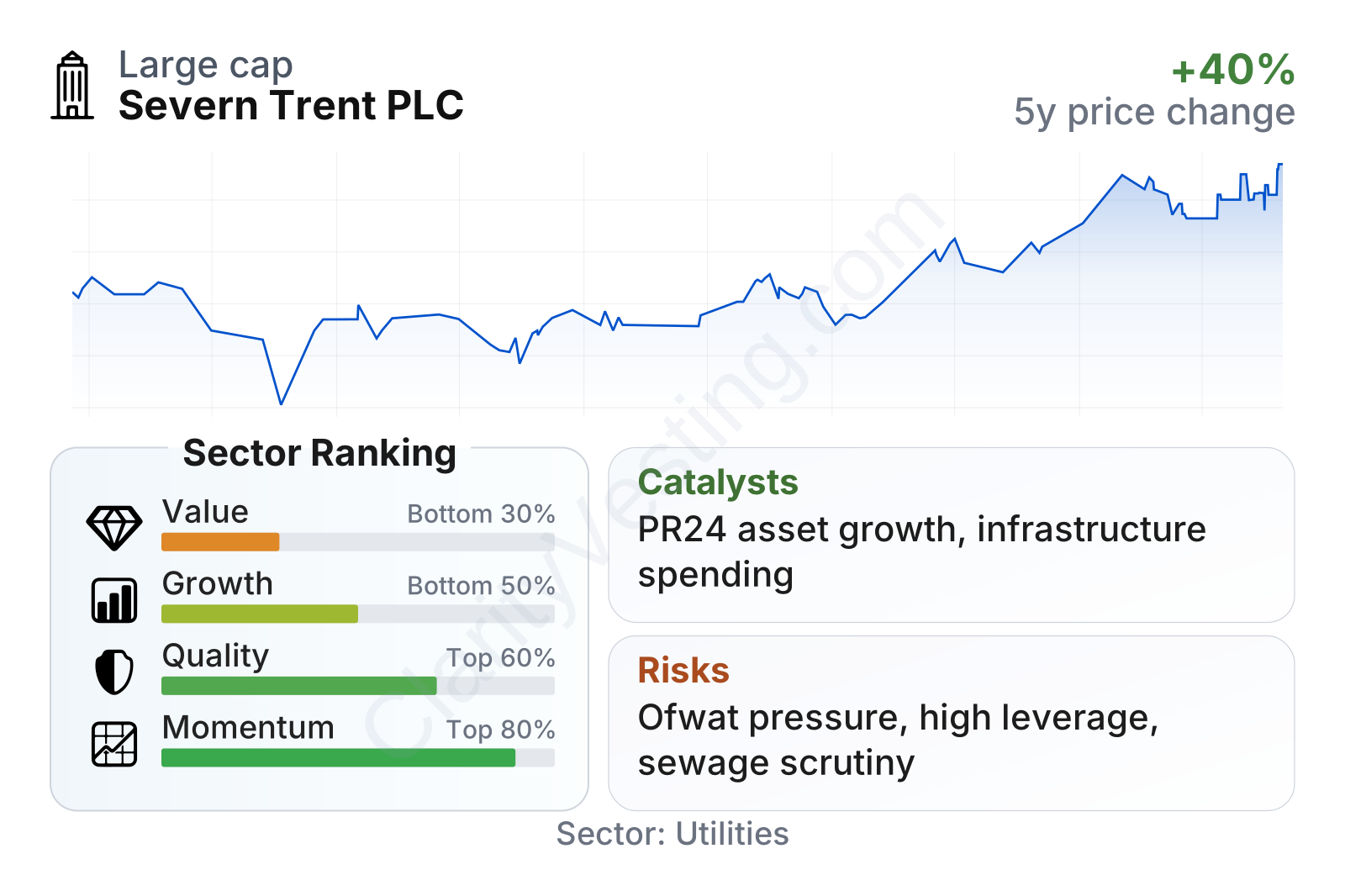
Severn Trent sits in the larger end of the regulated water utility space and its share price behavior has been relatively defensive, reflected in a low beta. Recent market momentum has been stronger than much of the sector, with returns over the past year and past three years ahead of typical utility peers. On operating quality, margins and profitability are solid for the industry, but leverage is clearly elevated. Valuation metrics look demanding versus the sector median, especially on price-to-book and earnings multiples, while free cash flow is currently negative because capital spending is running at a very high level.
Growth
Severn Trent operates in a sector with modest volume growth but long-duration investment demand. Water networks in the U.K. need continual upgrades for resilience, leakage reduction, storm overflow compliance, environmental quality, and population-related capacity needs. That does not make the sector a high-growth industry in the traditional sense, but it does support long investment cycles and periodic expansion of the regulated asset base, which can lift allowed returns over time.
The company’s strategy is aligned with that structure. It continues to invest heavily in infrastructure, environmental performance, and network resilience. For a regulated utility, growth is often less about winning customers and more about expanding and improving the asset base that regulators allow it to earn returns on. In that framework, Severn Trent’s spending program is a growth driver, even though it pressures near-term free cash flow.
Revenue per share has generally trended upward over the past five years, despite some year-to-year fluctuations. The latest year shows a renewed step up, which fits with stronger reported revenue growth. Compared with the broader utilities sector, top-line expansion has recently been better than average, although earnings growth over a longer period has been less consistent because financing costs and regulatory timing can distort bottom-line progress.
A key catalyst is the new regulatory period in U.K. water. When utilities secure approval for large capital programs, they gain a clearer path for future investment and potential growth in regulated returns, provided execution remains on track. Another meaningful catalyst is the political and environmental pressure to improve water quality and reduce leakage and sewage incidents. While this creates compliance obligations, it also supports continued investment in assets that can enlarge the company’s regulated earnings base over time.
Recent company communications have emphasized record or near-record levels of capital investment and a larger program for the years ahead. For a business like Severn Trent, that is one of the clearest signs of future scale expansion, even if the benefits are spread across several years rather than appearing immediately.
Risks
This article is for informational purposes only and does not constitute financial advice. Some content is AI-generated. See Disclaimer


