Stock Analysis · Savara Inc (SVRA)
Overview
Savara Inc is a biotechnology company focused on rare respiratory disease. Its main asset is molgramostim nebulizer solution, often called MOLBREEVI in company materials, an inhaled treatment being developed for autoimmune pulmonary alveolar proteinosis, or aPAP. This is a rare lung disease in which material builds up in the air sacs of the lungs and makes breathing progressively harder. Savara’s business is therefore much narrower than that of a diversified drug company: the company is essentially built around one late-stage product candidate and the effort to bring it to market.
At this stage, Savara does not operate like a mature pharmaceutical company with recurring commercial sales. Based on recent filings, revenue is either negligible or effectively absent, while spending is concentrated on clinical development, regulatory work, and preparation for a possible launch.
The current economic profile is best understood through where cash is being spent rather than where sales are coming from.
- Product revenue: approximately 0%. Savara has not yet established a meaningful commercial revenue base.
- Other revenue: approximately 0% to negligible. No recurring secondary business line appears large enough to matter to the investment case.
- Operating spending priority: research and development is the largest use of funds, followed by general and administrative costs, which is typical for a clinical-stage biotech preparing for pivotal milestones and potential commercialization.
The company’s expense mix has become more aggressive over time. Research and development spending rose materially from 2023 through 2025, and administrative costs also increased, which suggests Savara has been investing more heavily as it moved its lead program closer to potential regulatory review and launch readiness.
The business picture is straightforward: Savara is not being valued on current earnings or product diversification, but on the future commercial potential of one lead therapy in a rare disease market.
Key Figures
| Metric | Value | Sector ⓘ |
|---|---|---|
| Date | Oct 17, 2026 | |
| Context | ||
| Sector | Healthcare | |
| Industry | Biotechnology | |
| Market Cap ⓘ | $1.00B | |
| Beta ⓘ | 0.20 | |
Value (Cheapness) | ||
| P/E Ratio ⓘ | N/A | 24.79 |
| P/B Ratio ⓘ | 8.53 | 3.08 |
| FCF Yield ⓘ | -11.04% | 3.15% |
| Dividend Yield ⓘ | N/A | 1.94% |
| EBIT / EV ⓘ | -15.71% | 0.57% |
| PEG ⓘ | N/A | |
Growth (Business expansion) | ||
| Revenue Growth ⓘ | N/A | 7.45% |
| RPS Growth (5Y CAGR) ⓘ | N/A | 8.61% |
| EPS Growth (5Y CAGR) ⓘ | N/A | -17.81% |
| BVPS Growth (5Y CAGR) ⓘ | -4.08% | 3.72% |
| Margin Growth (5Y Trend) ⓘ | N/A | -0.62% |
| FCF Growth (5Y CAGR) ⓘ | N/A | 1.04% |
| DPS Growth (5Y CAGR) ⓘ | N/A | 6.77% |
Quality (Business durability) | ||
| ROIC (Latest) ⓘ | -58.97% | 3.24% |
| ROA (Latest) ⓘ | -83.65% | 3.01% |
| ROIC (5Y Median) ⓘ | -30.73% | 4.60% |
| ROA (5Y Median) ⓘ | -34.47% | 1.89% |
| Net Debt / EBIT (Latest) ⓘ | N/A | 1.34 |
| Net Debt / EBIT (5Y Median) ⓘ | N/A | 1.84 |
| Net Debt / EBITDA (Latest) ⓘ | N/A | 1.00 |
| Net Debt / Assets ⓘ | -6.08% | 5.45% |
| EBITDA / Interest ⓘ | N/A | 9.64 |
| Operating Margin (Latest) ⓘ | N/A | 9.27% |
| Operating Margin (5Y Median) ⓘ | N/A | 7.38% |
| Debt to Equity (Latest) ⓘ | 20.96% | 28.58% |
| Profit Margin (Latest) ⓘ | N/A | 3.59% |
| Free Cash Flow (Latest) ⓘ | -$110.66M | |
Momentum (Price trend) | ||
| 3Y Return ⓘ | +31.61% | +42.80% |
| 12M Return (excl. last month) ⓘ | +43.64% | +18.50% |
| 6M Return ⓘ | -18.69% | +7.57% |
| Price vs. 200-Day MA ⓘ | -12.11% | +5.12% |
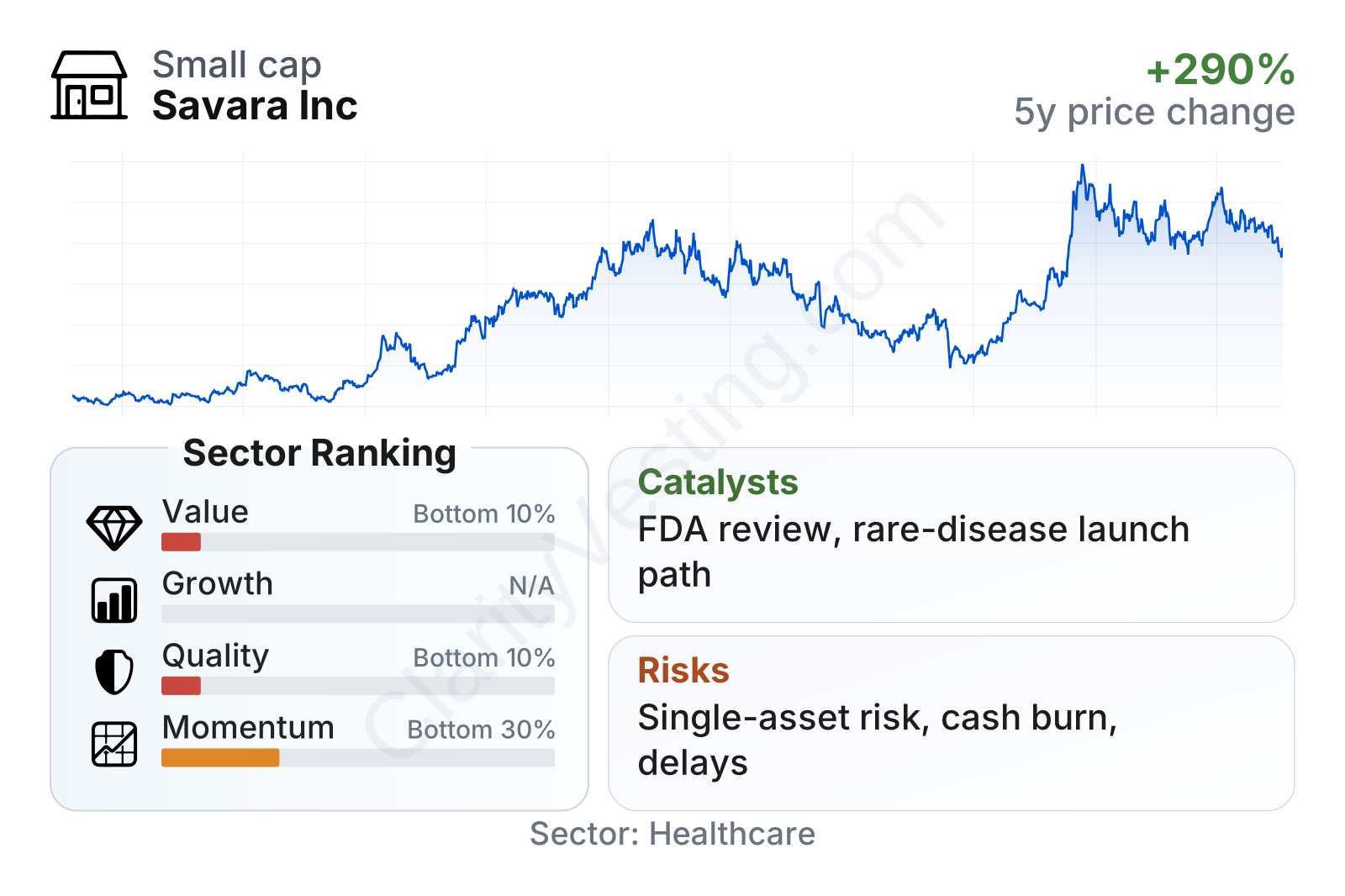
Savara is a small-cap biotech with a market value around the $1 billion range and a low beta, but its operating profile remains highly speculative in fundamental terms. The valuation metrics rank near the bottom of the healthcare sector because traditional measures such as earnings yield, free cash flow yield, and returns on capital are deeply negative or not yet meaningful. The price-to-book ratio is well above the sector median, which signals that the market is assigning substantial value to future prospects rather than current financial output.
Momentum has been mixed. The stock performed strongly over the prior twelve-month period on a longer view, but more recent trading has softened, with the share price sitting below its 200-day average. That pattern is common in biotech names where sentiment can shift quickly around regulatory timing, clinical interpretation, and launch expectations.
Growth
Savara operates in a part of healthcare that can generate attractive economics if a treatment reaches approval: rare diseases. These markets are often smaller in patient numbers, but they can still be commercially meaningful because pricing tends to be higher, competition can be limited, and physicians often concentrate care in specialist centers. In Savara’s case, the focus on aPAP also offers a relatively clear strategic identity rather than a broad pipeline spread across unrelated areas.
The company’s strategy makes sense if one accepts the central premise that success in a rare disease can create value even from a single-asset platform. Savara has concentrated resources on advancing molgramostim nebulizer solution through late-stage development and regulatory engagement. That focus can be a strength because it avoids the capital dilution that often comes from trying to run many programs at once, but it also means the future depends heavily on one decision path.
A major catalyst is the regulatory path for its lead therapy. Public company communications in 2026 have centered on interactions with the U.S. Food and Drug Administration and the planned review process for autoimmune PAP. For a company like Savara, the most significant inflection point is not modest quarterly progress but a binary step such as acceptance of a filing, an advisory discussion, approval, or a delay. If the program advances smoothly, the company could move from a pre-revenue developer into a commercial rare-disease company.
Recent developments have reinforced why the market continues to pay attention. Savara has highlighted regulatory progress for MOLBREEVI and preparations tied to a potential launch. In practical terms, that matters because the gap between clinical success and commercial revenue is often shorter in rare disease than in broad primary care markets, especially when the physician base is specialized and patients are easier to identify.
The financial side of this growth plan is less comfortable. Free cash flow has remained negative and has worsened over the last several years, moving from roughly negative $40 million territory to more than negative $100 million on a trailing basis. That trend shows Savara is spending ahead of revenue, which is normal for a late-stage biotech, but it also means future growth still requires continued cash support until commercial sales begin.
Risks
This article is for informational purposes only and does not constitute financial advice. Some content is AI-generated. See Disclaimer


