Stock Analysis · Supernus Pharmaceuticals Inc (SUPN)
Overview
Supernus Pharmaceuticals is a mid-sized biopharmaceutical company focused mainly on diseases of the central nervous system. In simple terms, it develops and sells medicines for conditions such as attention-deficit hyperactivity disorder, epilepsy, migraine, Parkinson’s disease, and other neurologic or psychiatric disorders. Its business today is largely built on commercialized prescription drugs, while part of its spending is directed toward developing future products through internal research and acquired programs.
The company’s revenue is primarily product revenue from marketed medicines in the United States. Based on the latest annual filing and recent quarterly disclosures, the mix is concentrated in a handful of products, with newer growth products becoming more important while some older medicines face generic pressure.
- Qelbree: approximately 38% of 2025 total revenue. This is a non-stimulant treatment for ADHD and has become the company’s largest product.
- GOCOVRI: approximately 25% of 2025 total revenue. Used mainly in Parkinson’s disease-related indications.
- APOKYN and related device revenue: approximately 13% of 2025 total revenue. This product franchise is used in Parkinson’s disease.
- Trokendi XR: approximately 10% of 2025 total revenue. This epilepsy and migraine product has been declining because of generic competition.
- Oxtellar XR: approximately 9% of 2025 total revenue. Another epilepsy product also pressured by generics.
- Other product and royalty revenue: approximately 5% combined. This includes smaller products and collaboration-related revenue where applicable.
That revenue profile shows a company in transition: older epilepsy drugs are no longer the main engine, and more of the business now depends on newer brands led by Qelbree and on the performance of its Parkinson’s franchise.
The broader financial picture also reflects this transition. Revenue has generally moved upward over the last several years, gross profit remains strong because branded pharmaceuticals carry high margins, but operating expenses have risen meaningfully as the company invests in commercialization and development. That has made earnings less stable than sales.
Over the last five years, revenue has increased overall, but operating profitability has been much less consistent. Gross profit stayed high while selling, general, and administrative costs expanded sharply, showing that commercial growth has required heavier spending. Research and development has also remained meaningful, consistent with a company trying to refresh its product base.
Key Figures
| Metric | Value | Sector ⓘ |
|---|---|---|
| Date | Oct 24, 2026 | |
| Context | ||
| Sector | Healthcare | |
| Industry | Drug Manufacturers - Specialty & Generic | |
| Market Cap ⓘ | $2.40B | |
| Beta ⓘ | 0.55 | |
Value (Cheapness) | ||
| P/E Ratio ⓘ | N/A | 25.42 |
| P/B Ratio ⓘ | 2.37 | 3.08 |
| FCF Yield ⓘ | 0.78% | 3.12% |
| Dividend Yield ⓘ | N/A | 1.85% |
| EBIT / EV ⓘ | -5.36% | 0.56% |
| PEG ⓘ | 1.47 | |
Growth (Business expansion) | ||
| Revenue Growth ⓘ | 32.40% | 7.50% |
| RPS Growth (5Y CAGR) ⓘ | 4.53% | 8.60% |
| EPS Growth (5Y CAGR) ⓘ | -21.96% | -17.73% |
| BVPS Growth (5Y CAGR) ⓘ | 5.80% | 3.72% |
| Margin Growth (5Y Trend) ⓘ | -23.48% | -0.57% |
| FCF Growth (5Y CAGR) ⓘ | -22.13% | 0.96% |
| DPS Growth (5Y CAGR) ⓘ | N/A | 6.69% |
Quality (Business durability) | ||
| ROIC (Latest) ⓘ | -8.69% | 3.17% |
| ROA (Latest) ⓘ | -7.72% | 2.98% |
| ROIC (5Y Median) ⓘ | 5.46% | 4.56% |
| ROA (5Y Median) ⓘ | 3.35% | 1.87% |
| Net Debt / EBIT (Latest) ⓘ | N/A | 1.34 |
| Net Debt / EBIT (5Y Median) ⓘ | 0.98 | 1.86 |
| Net Debt / EBITDA (Latest) ⓘ | N/A | 1.00 |
| Net Debt / Assets ⓘ | -9.79% | 5.06% |
| EBITDA / Interest ⓘ | N/A | 9.55 |
| Operating Margin (Latest) ⓘ | -14.16% | 9.25% |
| Operating Margin (5Y Median) ⓘ | 10.16% | 7.33% |
| Debt to Equity (Latest) ⓘ | 3.90% | 26.68% |
| Profit Margin (Latest) ⓘ | -13.23% | 3.34% |
| Free Cash Flow (Latest) ⓘ | $18.79M | |
Momentum (Price trend) | ||
| 3Y Return ⓘ | +77.06% | +51.61% |
| 12M Return (excl. last month) ⓘ | -6.88% | +19.90% |
| 6M Return ⓘ | -16.35% | +10.10% |
| Price vs. 200-Day MA ⓘ | -11.60% | +6.44% |
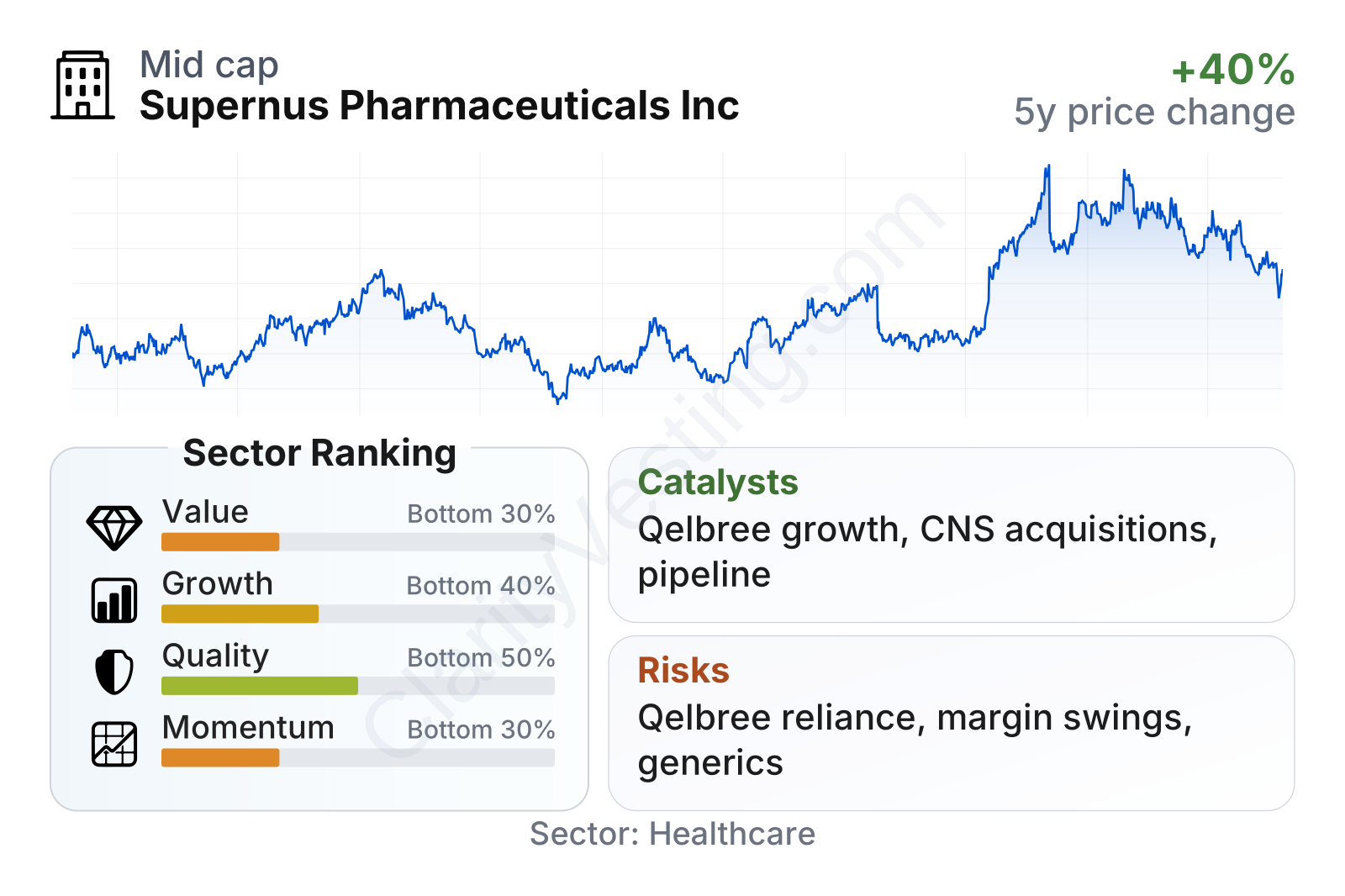
Supernus sits in the mid-cap range and its share price has historically moved less than the broader market, which is consistent with a beta well below 1. The stock’s longer-term performance has been solid, but recent momentum has weakened. Relative to the healthcare sector, the company currently screens weaker on value, growth, quality, and momentum, largely because recent profitability turned negative and free cash flow has come down from earlier peaks.
Growth
Supernus operates in a sector that remains attractive over the long run. Neurology and psychiatry are large treatment markets with persistent unmet medical needs, and demand is supported by aging populations, greater diagnosis rates, and the need for new therapies that improve convenience or reduce side effects. That said, growth in pharmaceuticals rarely follows a straight line. It depends on product launches, prescription adoption, payer coverage, patent durability, and the success of pipeline assets.
For Supernus, the main strategic logic is clear: replace declining legacy products with newer branded medicines and expand through label development, lifecycle management, and acquisitions. Qelbree is central to that plan. It gives the company exposure to the large ADHD market with a non-stimulant option, which matters because some patients do not respond well to stimulant treatments or prefer alternatives. The company has also been building its CNS platform beyond ADHD, which reduces reliance on any single older franchise.
Recent revenue growth has accelerated again after a weaker stretch in 2023 and early 2024. The latest year-over-year pace is well above the sector median, which suggests that the company is still capable of generating meaningful top-line expansion when its key brands perform well. The more difficult question is whether that sales growth can consistently translate into earnings growth.
Cash generation remains positive, but it is clearly below prior highs. That matters because for a specialty pharmaceutical company, cash flow funds acquisitions, product development, and commercial investment. A still-positive free cash flow profile gives Supernus flexibility, but the lower level compared with earlier periods shows less margin for error than before.
A meaningful catalyst is the company’s effort to broaden and deepen its CNS portfolio through business development and clinical progress. In recent years, Supernus has added assets and commercial products that fit its neurology focus, and this strategy can make sense for a company of its size because it can leverage an existing sales infrastructure rather than building entirely new capabilities. Another catalyst is continued prescription growth for Qelbree, especially if physician adoption broadens further across age groups and treatment settings.
Recent company updates also point to ongoing pipeline and portfolio activity rather than a business standing still. For a company like Supernus, even moderately successful execution across a few focused assets can materially change the earnings profile because the base is not enormous. That creates upside potential from successful product scaling, but also makes execution especially important.
Risks
This article is for informational purposes only and does not constitute financial advice. Some content is AI-generated. See Disclaimer


