Stock Analysis · Sulzer Ltd (SULZF)
Overview
Sulzer Ltd is a Swiss industrial engineering company focused on moving, processing, and separating fluids. In practical terms, it sells pumps, mixing systems, compressors, applicators, and separation equipment, and it also earns recurring revenue from servicing and upgrading installed equipment. Its products are used in water infrastructure, energy, chemicals, power generation, pulp and paper, and other process industries where reliability and energy efficiency matter.
The business is organized into a handful of operating divisions. Based on the latest annual reporting, revenue is mainly generated from the following activities, listed from largest to smallest:
- Flow Equipment: approximately 36% of revenue. This division supplies pumps, agitators, compressors, grinders, screens, and related equipment used in water, energy, and industrial applications.
- Services: approximately 32% of revenue. This includes maintenance, repair, retrofits, spare parts, and upgrades for pumps, turbines, compressors, motors, and other rotating equipment. This is an important recurring revenue stream because industrial assets need long operating lives and regular maintenance.
- Chemtech: approximately 22% of revenue. This business provides separation columns, trays, internals, static mixers, and mass-transfer technologies used in chemicals, refining, gas processing, and sustainable fuels applications.
- Applicator Systems: approximately 10% of revenue. This division makes precision dispensing and mixing systems used in adhesives and liquid application processes, especially for consumer and industrial manufacturing.
Sulzer’s revenue mix matters because it is not only a capital-equipment company. The service operation adds steadier demand and usually better visibility than one-off equipment orders. Geographically, the company is diversified across Europe, the Americas, and Asia, which reduces reliance on a single end market but still leaves it exposed to the broader industrial cycle.
Over the last several years, the company has improved the share of revenue that turns into operating profit. Revenue has risen gradually from about $3.2 billion in 2021 to around $3.6 billion in 2025, while operating income has expanded more quickly. That suggests management has not relied only on sales growth; margin improvement has also been a major driver.
The broad financial flow shows a useful pattern: sales growth has been moderate, but gross profit and operating income have increased faster than revenue since 2022. That points to a business becoming more efficient and better priced, with service activity and higher-value products likely helping profitability.
Key Figures
| Metric | Value | Sector ⓘ |
|---|---|---|
| Date | Oct 24, 2026 | |
| Context | ||
| Sector | Industrials | |
| Industry | Specialty Industrial Machinery | |
| Market Cap ⓘ | $7.02B | |
| Beta ⓘ | 0.84 | |
Value (Cheapness) | ||
| P/E Ratio ⓘ | 18.53 | 22.29 |
| P/B Ratio ⓘ | 5.46 | 1.98 |
| FCF Yield ⓘ | 5.66% | 6.26% |
| Dividend Yield ⓘ | 2.29% | 1.92% |
| EBIT / EV ⓘ | N/A | 4.83% |
| PEG ⓘ | 2.00 | |
Growth (Business expansion) | ||
| Revenue Growth ⓘ | -4.10% | 9.30% |
| RPS Growth (5Y CAGR) ⓘ | 3.16% | 7.76% |
| EPS Growth (5Y CAGR) ⓘ | -20.73% | -13.17% |
| BVPS Growth (5Y CAGR) ⓘ | 0.27% | 6.13% |
| Margin Growth (5Y Trend) ⓘ | 5.27% | 0.74% |
| FCF Growth (5Y CAGR) ⓘ | -1.87% | 10.79% |
| DPS Growth (5Y CAGR) ⓘ | 30.43% | 9.41% |
Quality (Business durability) | ||
| ROIC (Latest) ⓘ | 28.04% | 10.75% |
| ROA (Latest) ⓘ | 12.22% | 5.41% |
| ROIC (5Y Median) ⓘ | 9.21% | 9.37% |
| ROA (5Y Median) ⓘ | 5.77% | 4.95% |
| Net Debt / EBIT (Latest) ⓘ | 0.42 | 2.04 |
| Net Debt / EBIT (5Y Median) ⓘ | 0.56 | 2.27 |
| Net Debt / EBITDA (Latest) ⓘ | 0.33 | 1.39 |
| Net Debt / Assets ⓘ | 7.59% | 19.27% |
| EBITDA / Interest ⓘ | 29.34 | 9.58 |
| Operating Margin (Latest) ⓘ | 12.04% | 10.49% |
| Operating Margin (5Y Median) ⓘ | 10.19% | 10.30% |
| Debt to Equity (Latest) ⓘ | 91.54% | 64.82% |
| Profit Margin (Latest) ⓘ | 8.70% | 6.67% |
| Free Cash Flow (Latest) ⓘ | $397.71M | |
Momentum (Price trend) | ||
| 3Y Return ⓘ | +142.00% | +67.77% |
| 12M Return (excl. last month) ⓘ | -0.21% | +12.05% |
| 6M Return ⓘ | -8.69% | 0.00% |
| Price vs. 200-Day MA ⓘ | +27.26% | +0.67% |
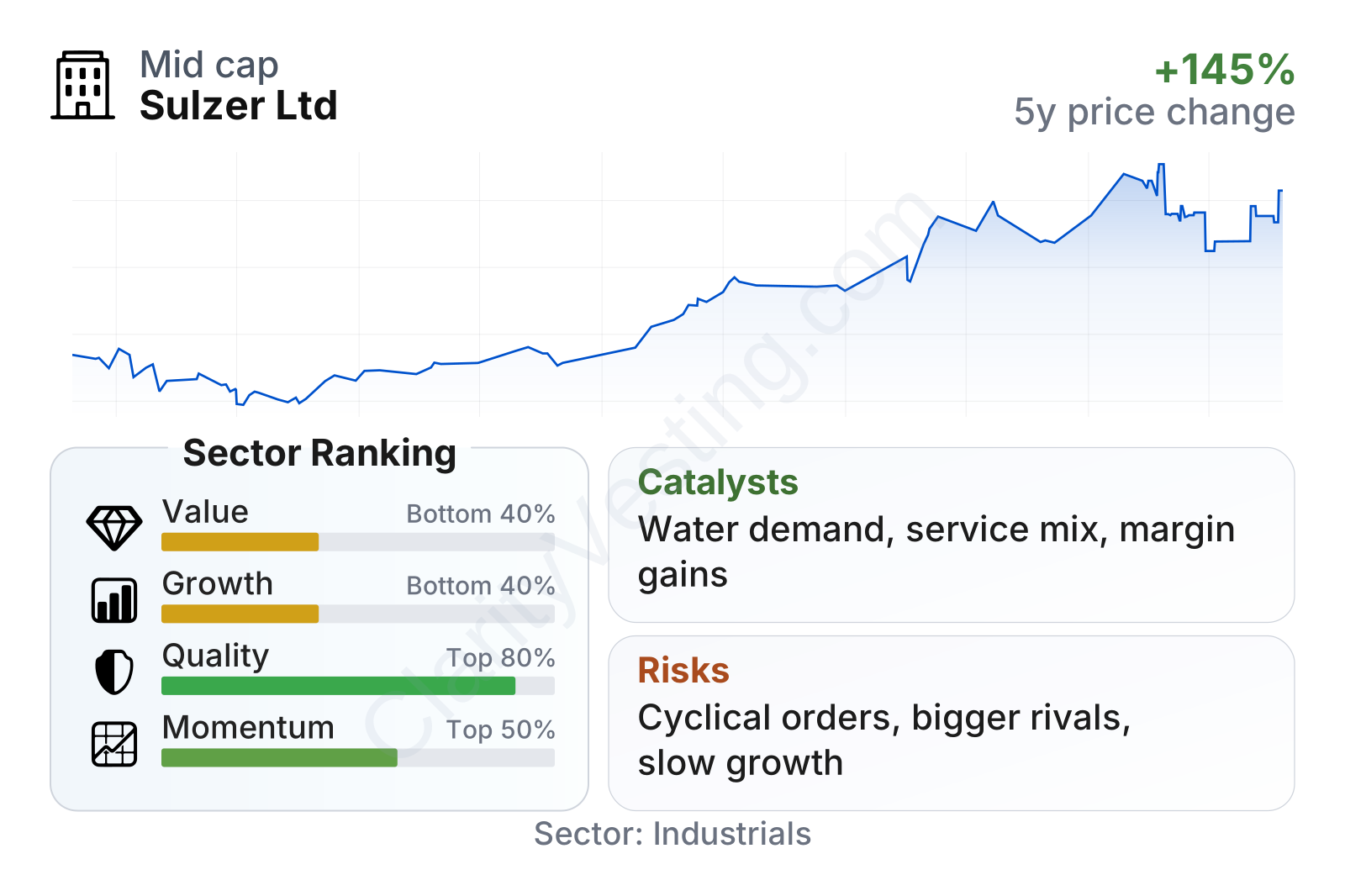
Sulzer looks financially solid for an industrial company of its size. Profitability is stronger than the sector median on several measures, with return on invested capital near 28%, return on assets above 12%, and an operating margin around 12%. The balance sheet also appears conservative in net terms: net debt is low relative to EBIT and EBITDA, and interest coverage is very strong. Growth indicators are less impressive, however. Recent revenue growth is negative year over year, five-year revenue-per-share growth is modest, and free cash flow growth has been uneven. The overall picture is a company with good quality and disciplined finances, but only moderate top-line momentum at this stage.
The stock performance has been strong over a multi-year period, roughly more than doubling since late 2021, even though the shorter-term trend has been weaker over the last several months. That combination usually means the market has rewarded the operational turnaround already, while becoming more cautious about how much improvement remains.
Growth
Sulzer operates in end markets that should remain relevant for many years, especially water infrastructure, wastewater treatment, energy efficiency, industrial maintenance, and process technologies tied to cleaner production. These are not fashionable software-like markets, but they are large, essential, and often supported by long-term capital spending needs. Water is especially important because aging infrastructure, stricter environmental standards, and population growth continue to drive demand for pumping and treatment systems.
The company’s strategy also makes sense for long-term expansion. A large installed base supports recurring service revenue, and service is generally less volatile than new equipment demand. At the same time, Sulzer can still grow through selective capital projects in flow equipment and through higher-value process technologies in Chemtech. This mix gives it exposure to both maintenance spending and new industrial investment.
Another visible catalyst is efficiency. Recent years show improving operating margins, suggesting management has been executing better on pricing, product mix, and cost control. In industrial businesses, even small margin gains can materially lift earnings and cash generation. Sulzer has also highlighted opportunities tied to decarbonization, such as technologies used in sustainable fuels, carbon-related process systems, and energy-efficient pumping and separation solutions.
Recent company communications have also pointed to healthy order intake in several businesses and continued demand in water and energy-related applications. That does not guarantee rapid growth, but it supports the case that Sulzer is positioned in practical industrial niches with ongoing investment needs rather than in a shrinking market.
Risks
This article is for informational purposes only and does not constitute financial advice. Some content is AI-generated. See Disclaimer


