Stock Analysis · Sun Hung Kai Properties Limited (SUHJF)
Overview
Sun Hung Kai Properties Limited is one of Hong Kong’s largest real estate groups. The company develops residential, commercial, and mixed-use properties, and it also keeps a very large portfolio of completed buildings that generate recurring rental income. In simple terms, it earns money from both selling properties and owning properties that tenants pay to use. That combination matters because property sales can be cyclical, while rental income is usually steadier.
The group’s business mix is centered on Hong Kong, with additional exposure to mainland China through development projects, offices, retail properties, hotels, and related businesses. Its portfolio includes shopping malls, office towers, residential developments, hotels, and some telecommunications and other related operations through subsidiaries and associated activities.
Based on the company’s recent annual reporting structure, the main revenue sources are broadly:
- Property sales: approximately 55% to 65% of revenue in recent periods. This includes development and sale of residential units, commercial space, and related projects.
- Property rental: approximately 25% to 35% of revenue. This comes mainly from leasing shopping malls, offices, logistics-related space, and other investment properties.
- Hotels, telecommunications, and other operations: approximately 5% to 15% of revenue combined. These activities are smaller than the core property segments but help diversify cash flow.
What stands out is not only the company’s size, but also the balance between development profits and recurring rent. That makes Sun Hung Kai Properties different from pure homebuilders that depend almost entirely on selling new projects.
The recent operating profile shows revenue recovering strongly in the latest year, while net income has held up better than gross profit. That suggests the business is still highly profitable, but margins have become more sensitive to project mix, costs, and the timing of property completions.
Key Figures
| Metric | Value | Sector ⓘ |
|---|---|---|
| Date | Oct 23, 2026 | |
| Context | ||
| Sector | Real Estate | |
| Industry | Real Estate - Development | |
| Market Cap ⓘ | $40.42B | |
| Beta ⓘ | 0.82 | |
Value (Cheapness) | ||
| P/E Ratio ⓘ | 14.68 | 17.85 |
| P/B Ratio ⓘ | 0.06 | 0.87 |
| FCF Yield ⓘ | 147.49% | 7.30% |
| Dividend Yield ⓘ | 30.93% | 4.83% |
| EBIT / EV ⓘ | 114.89% | 3.78% |
| PEG ⓘ | 1.21 | |
Growth (Business expansion) | ||
| Revenue Growth ⓘ | 4.30% | 5.35% |
| RPS Growth (5Y CAGR) ⓘ | 75.42% | 6.02% |
| EPS Growth (5Y CAGR) ⓘ | -20.86% | -10.65% |
| BVPS Growth (5Y CAGR) ⓘ | 69.87% | 0.43% |
| Margin Growth (5Y Trend) ⓘ | -11.63% | -0.69% |
| FCF Growth (5Y CAGR) ⓘ | 38.85% | 5.40% |
| DPS Growth (5Y CAGR) ⓘ | 56.14% | 5.07% |
Quality (Business durability) | ||
| ROIC (Latest) ⓘ | N/A | 5.69% |
| ROE (Latest) ⓘ | 6.59% | 7.37% |
| ROA (Latest) ⓘ | 5.00% | 2.85% |
| ROIC (5Y Median) ⓘ | 3.25% | 4.26% |
| ROE (5Y Median) ⓘ | 3.40% | 6.04% |
| ROA (5Y Median) ⓘ | 2.60% | 2.45% |
| Net Debt / EBIT (Latest) ⓘ | 1.21 | 7.55 |
| Net Debt / EBIT (5Y Median) ⓘ | 3.65 | 8.26 |
| Net Debt / EBITDA (Latest) ⓘ | 1.03 | 5.26 |
| Net Debt / Assets ⓘ | 8.27% | 37.45% |
| EBITDA / Interest ⓘ | 14.01 | 4.11 |
| Operating Margin (Latest) ⓘ | 32.06% | 33.86% |
| Operating Margin (5Y Median) ⓘ | 38.07% | 37.49% |
| Debt to Equity (Latest) ⓘ | 15.41% | 88.76% |
| Profit Margin (Latest) ⓘ | 22.75% | 18.94% |
| Free Cash Flow (Latest) ⓘ | $59.62B | |
Momentum (Price trend) | ||
| 3Y Return ⓘ | +58.18% | +36.33% |
| 12M Return (excl. last month) ⓘ | +17.58% | +4.32% |
| 6M Return ⓘ | -24.02% | -1.74% |
| Price vs. 200-Day MA ⓘ | -7.48% | -1.42% |
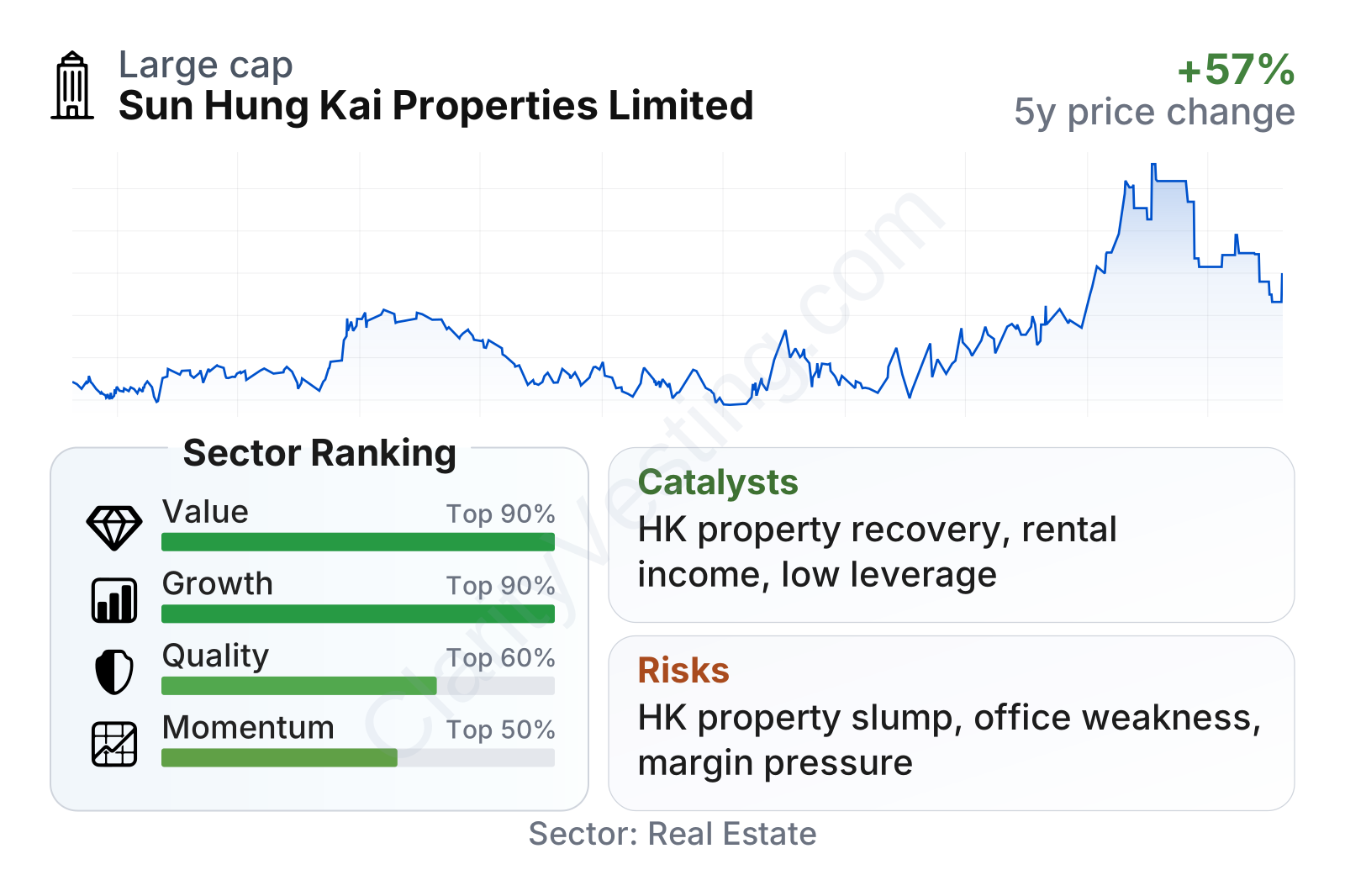
Sun Hung Kai Properties screens as unusually strong on valuation measures relative to many listed real estate peers. The earnings multiple is below the sector median, the dividend yield is much higher than average, and the balance sheet looks conservative for a property developer. Debt levels are low compared with sector norms, while interest coverage is strong, which is important in a business where leverage often creates major stress.
Profitability is solid rather than exceptional. Return on equity is slightly below the sector median, but return on assets is better than average, helped by the quality and scale of the asset base. Growth indicators are mixed: long-term revenue and book value progression look strong, while earnings growth has been less consistent and margins have softened from earlier levels. Market performance has also been uneven, with strong longer-term returns but weaker recent momentum after a sharp rebound earlier in 2026.
Growth
Sun Hung Kai Properties operates in a sector that is mature rather than fast-growing. Real estate development in Hong Kong is not a high-expansion industry in the way software or semiconductors can be. Growth is usually driven by land supply, project launches, interest rates, office and retail demand, and broader confidence in Hong Kong and mainland China. That said, prime urban real estate remains strategically important, and companies with strong land banks and established rental portfolios can still compound value over long periods.
The company’s strategy is coherent for that environment. It combines a premium land bank, large-scale project execution, and recurring rental income from investment properties. This structure gives it multiple ways to grow: launching new residential projects, benefiting from eventual improvement in transaction volumes, and increasing rent from prime commercial assets over time. For a long-duration business, that is generally more resilient than relying on one single segment.
Revenue generation has been volatile, which is common in property development because sales are often recognized when projects are completed and handed over. Even so, the broader trend points to a business that can produce meaningful growth when project timing is favorable. The latest year’s sharp revenue jump indicates that completions and recognized sales were particularly strong.
Dividends have also been uneven, which reflects the cyclical nature of property earnings and payout decisions. Still, the company has historically maintained a meaningful cash return profile, and the latest indicated yield remains far above the sector median. For a long-term analysis, the more important point is that dividends appear to be supported by a strong asset base and moderate leverage rather than by aggressive borrowing.
A key catalyst for future growth would be any sustained improvement in Hong Kong residential transactions and pricing after the multi-year property downturn. Lower financing pressure, policy support for market activity, and better sentiment toward Hong Kong commercial property could also help. Another potential tailwind is the company’s ability to monetize its large development pipeline while continuing to benefit from recurring rent from retail and office assets.
Recent company reporting also points to a rebound in annual revenue and stable financial capacity. That does not remove the cyclicality of the sector, but it does show the group still has the scale and financial flexibility to move through weaker periods and participate fully when conditions improve.
Risks
This article is for informational purposes only and does not constitute financial advice. Some content is AI-generated. See Disclaimer


