Stock Analysis · Subsea 7 SA (SUBCY)
Overview
Subsea 7 SA is an offshore energy engineering and construction company. In simple terms, it helps energy producers design, build, install, and maintain the equipment that sits on the seabed or connects offshore fields to processing and export systems. Its work includes subsea pipelines, umbilicals, risers, flowlines, heavy offshore installation, and life-of-field services. The company also has a growing position in offshore wind through fixed and floating foundation work, cable installation, and related marine services.
The business is global, with activity spread across the North Sea, Brazil, the U.S. Gulf of Mexico, West Africa, and other offshore basins. A large part of its competitive position comes from its fleet of specialized vessels, project execution know-how, and long relationships with major oil and gas companies.
Based on company reporting, revenue is mainly generated from the following activities:
- Subsea and Conventional projects: approximately 80% to 90% of revenue in recent years. This includes engineering, procurement, installation, and commissioning work for subsea developments, pipelines, and offshore structures.
- Renewables and Heavy Lifting: approximately 10% to 20% of revenue. This includes offshore wind installation work, foundation and cable-related services, and heavy marine operations.
- Life-of-field and inspection services: a smaller share, generally embedded within the larger project segments rather than always broken out separately. This covers maintenance, inspection, repair, and support services for producing offshore assets.
That mix matters because most earnings still depend on offshore oil and gas investment, while renewables provide an additional avenue for future contract awards and vessel utilization.
The visual breakdown also shows a notable change over the last few years: revenue has climbed from about $5.0 billion in 2021 to above $7.1 billion in 2025, while operating profit and net income improved much faster than sales. That points to better project mix, stronger execution, and a more favorable pricing environment after a weaker period earlier in the cycle.
Key Figures
| Metric | Value | Sector ⓘ |
|---|---|---|
| Date | Oct 17, 2026 | |
| Context | ||
| Sector | Energy | |
| Industry | Oil & Gas Equipment & Services | |
| Market Cap ⓘ | $10.74B | |
| Beta ⓘ | 0.66 | |
Value (Cheapness) | ||
| P/E Ratio ⓘ | 17.56 | 15.44 |
| P/B Ratio ⓘ | 2.47 | 1.73 |
| FCF Yield ⓘ | 15.42% | 8.20% |
| Dividend Yield ⓘ | 5.36% | 3.59% |
| EBIT / EV ⓘ | 10.25% | 7.46% |
| PEG ⓘ | 0.12 | |
Growth (Business expansion) | ||
| Revenue Growth ⓘ | 9.80% | 26.90% |
| RPS Growth (5Y CAGR) ⓘ | 9.22% | 6.90% |
| EPS Growth (5Y CAGR) ⓘ | 92.54% | -15.73% |
| BVPS Growth (5Y CAGR) ⓘ | 1.15% | 6.07% |
| Margin Growth (5Y Trend) ⓘ | 8.33% | 0.58% |
| FCF Growth (5Y CAGR) ⓘ | 75.17% | 1.86% |
| DPS Growth (5Y CAGR) ⓘ | 51.41% | 16.79% |
Quality (Business durability) | ||
| ROIC (Latest) ⓘ | 14.31% | 11.40% |
| ROA (Latest) ⓘ | 7.41% | 6.06% |
| ROIC (5Y Median) ⓘ | 0.97% | 10.30% |
| ROA (5Y Median) ⓘ | 0.52% | 5.42% |
| Net Debt / EBIT (Latest) ⓘ | -0.19 | 1.64 |
| Net Debt / EBIT (5Y Median) ⓘ | 0.83 | 1.83 |
| Net Debt / EBITDA (Latest) ⓘ | -0.11 | 1.08 |
| Net Debt / Assets ⓘ | -2.31% | 17.29% |
| EBITDA / Interest ⓘ | 19.46 | 9.64 |
| Operating Margin (Latest) ⓘ | 13.61% | 16.27% |
| Operating Margin (5Y Median) ⓘ | 3.19% | 20.39% |
| Debt to Equity (Latest) ⓘ | 19.70% | 54.76% |
| Profit Margin (Latest) ⓘ | 8.15% | 8.82% |
| Free Cash Flow (Latest) ⓘ | $1.66B | |
Momentum (Price trend) | ||
| 3Y Return ⓘ | +200.40% | +67.38% |
| 12M Return (excl. last month) ⓘ | +74.06% | +49.19% |
| 6M Return ⓘ | +12.45% | +7.07% |
| Price vs. 200-Day MA ⓘ | +15.10% | +9.56% |
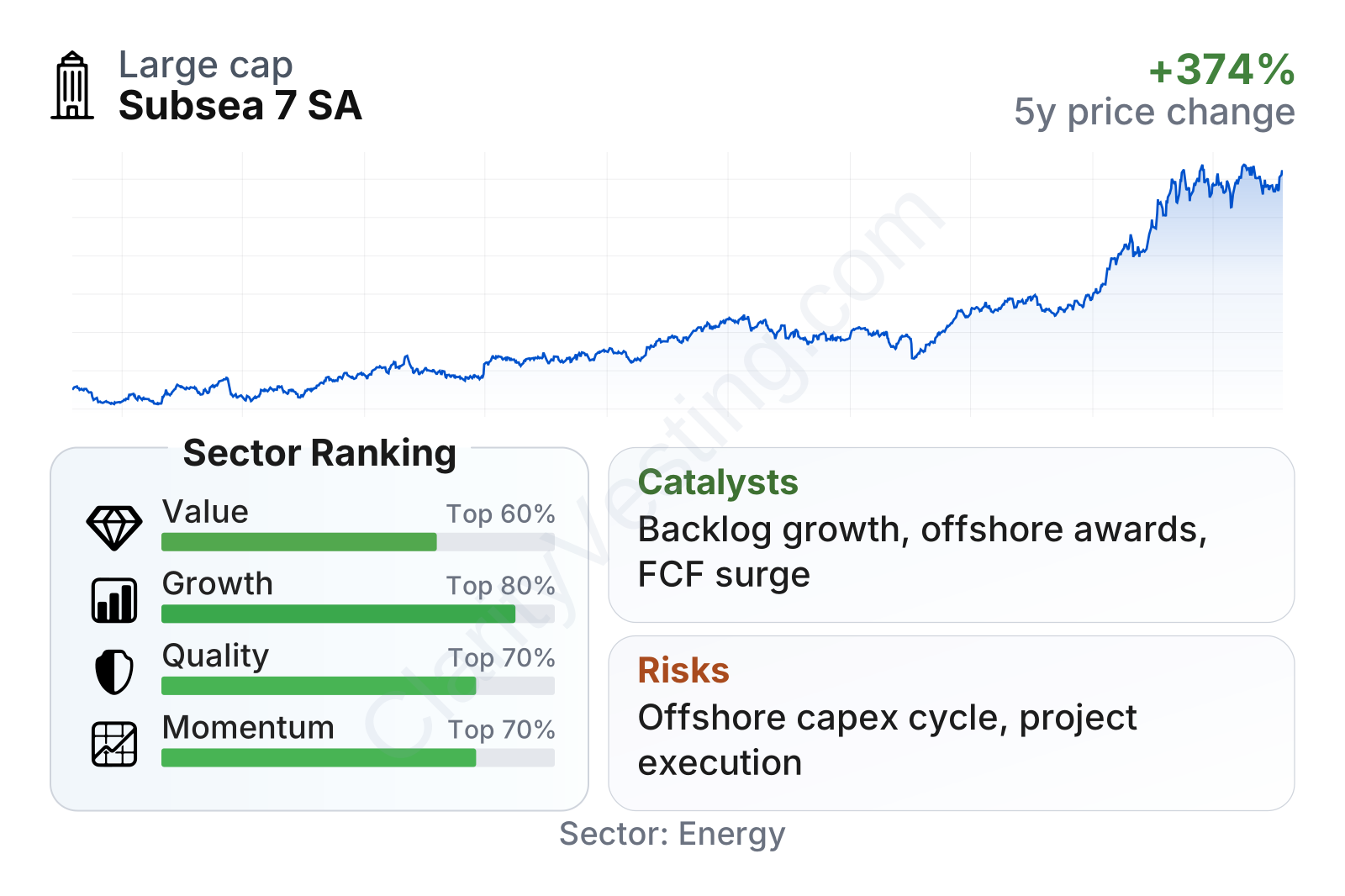
Subsea 7 stands out as a large offshore services company with relatively low share-price volatility for the energy sector, helped by a beta below 1. On valuation, the picture is mixed: earnings and book value multiples are somewhat above sector medians, but cash generation is clearly stronger than many peers, with free cash flow yield, dividend yield, and EBIT relative to enterprise value all comparing favorably. Growth and momentum indicators are also strong overall, especially over three years, while balance-sheet quality is a clear strength thanks to low leverage and net cash characteristics.
Growth
Subsea 7 operates in a part of the energy market that remains active because offshore oil and gas projects are long-life assets that large producers still need to replace reserves and sustain production. Deepwater developments have become more competitive in many basins, especially where existing infrastructure can lower project costs. That supports ongoing demand for subsea tie-backs, pipelines, and installation work.
The company’s strategy also makes industrial sense. It is focused on areas where technical complexity, vessel access, and project management capability create higher barriers to entry than in simpler oilfield services. In addition, its exposure to offshore wind and floating wind gives it a second growth lane, even if that business can be more uneven from year to year.
Revenue growth has not been perfectly smooth quarter to quarter, which is normal in a project business, but the broader direction has been positive. After a softer period in 2022, growth improved through 2023 and 2024, remained positive in 2025, and re-accelerated in early 2026. Over five years, revenue per share growth has been stronger than the sector median, which suggests the expansion is not only cyclical but also meaningful on a per-share basis.
An especially encouraging sign is cash generation. Trailing free cash flow has risen sharply from modest levels in 2022 and 2023 to well above $1.4 billion by early 2026. For a business that needs vessels and equipment, that kind of improvement matters because it gives management more flexibility for dividends, fleet investment, and protection during weaker periods.
Another important catalyst is backlog. Subsea 7’s business depends heavily on multi-year contract awards, and strong order intake can support revenue visibility well beyond the next quarter. Recent company communications have highlighted continued offshore project awards and progress in both conventional subsea work and energy transition activities. For long-term analysis, that is more important than short-term commodity price moves alone because contracted work tends to convert into revenue over several years.
There is also a structural angle to watch: offshore fields are increasingly developed through tie-backs and subsea systems that require specialized engineering rather than simple commodity service capacity. That favors companies with established execution records, and Subsea 7 is one of the best-known names in that niche.
Risks
This article is for informational purposes only and does not constitute financial advice. Some content is AI-generated. See Disclaimer


