Stock Analysis · Constellation Brands Inc (STZ)
Overview
Constellation Brands is a large U.S. beverage alcohol company best known for imported beer brands such as Modelo Especial, Corona Extra, and Pacifico, along with a portfolio of wine and spirits labels. Its business is focused on selling branded alcoholic beverages through retailers, bars, restaurants, and distributors, with the United States as its core market.
The company’s revenue mix is heavily concentrated in beer, which has become the main engine of the business after years of portfolio changes. Based on the latest annual reporting for fiscal 2026, the revenue breakdown is approximately:
- Beer: about 84% — imported Mexican beer brands, especially Modelo, Corona, Pacifico, and related line extensions.
- Wine and Spirits: about 16% — wine labels across price tiers and spirits brands, with a much smaller contribution than beer.
This concentration matters because the beer segment has stronger margins and better brand momentum than the rest of the company. Over the last several years, Constellation has increasingly looked like a premium imported beer business with a smaller secondary wine and spirits operation. The company’s financial flow also shows how important this mix shift has been: revenue has remained sizable even as cost control and margin recovery improved meaningfully in the most recent fiscal year.
The operating picture suggests a business that became more profitable again in fiscal 2026 after a much weaker fiscal 2025. Sales were lower year over year, but operating income and net income recovered sharply, showing that profitability was driven not only by volume but also by pricing, mix, and the absence of some prior charges that had hurt reported earnings.
Key Figures
| Metric | Value | Sector ⓘ |
|---|---|---|
| Date | Oct 17, 2026 | |
| Context | ||
| Sector | Consumer Defensive | |
| Industry | Beverages - Brewers | |
| Market Cap ⓘ | $21.39B | |
| Beta ⓘ | 0.43 | |
Value (Cheapness) | ||
| P/E Ratio ⓘ | 11.66 | 17.88 |
| P/B Ratio ⓘ | 2.52 | 1.29 |
| FCF Yield ⓘ | 8.60% | 12.39% |
| Dividend Yield ⓘ | 3.34% | 2.85% |
| EBIT / EV ⓘ | 9.36% | 6.43% |
| PEG ⓘ | 1.50 | |
Growth (Business expansion) | ||
| Revenue Growth ⓘ | 6.10% | 4.10% |
| RPS Growth (5Y CAGR) ⓘ | 2.95% | 6.18% |
| EPS Growth (5Y CAGR) ⓘ | -10.65% | -13.59% |
| BVPS Growth (5Y CAGR) ⓘ | -7.29% | 3.20% |
| Margin Growth (5Y Trend) ⓘ | 22.37% | -0.15% |
| FCF Growth (5Y CAGR) ⓘ | 1.68% | 4.10% |
| DPS Growth (5Y CAGR) ⓘ | 7.88% | 6.79% |
Quality (Business durability) | ||
| ROIC (Latest) ⓘ | 11.83% | 12.34% |
| ROA (Latest) ⓘ | 8.80% | 6.30% |
| ROIC (5Y Median) ⓘ | 1.31% | 10.49% |
| ROA (5Y Median) ⓘ | -0.15% | 5.44% |
| Net Debt / EBIT (Latest) ⓘ | 3.60 | 1.96 |
| Net Debt / EBIT (5Y Median) ⓘ | 16.23 | 2.35 |
| Net Debt / EBITDA (Latest) ⓘ | 3.15 | 1.38 |
| Net Debt / Assets ⓘ | 46.31% | 21.51% |
| EBITDA / Interest ⓘ | 9.58 | 9.46 |
| Operating Margin (Latest) ⓘ | 30.84% | 8.87% |
| Operating Margin (5Y Median) ⓘ | 8.27% | 9.53% |
| Debt to Equity (Latest) ⓘ | 120.13% | 72.35% |
| Profit Margin (Latest) ⓘ | 20.90% | 5.40% |
| Free Cash Flow (Latest) ⓘ | $1.84B | |
Momentum (Price trend) | ||
| 3Y Return ⓘ | -41.43% | +20.92% |
| 12M Return (excl. last month) ⓘ | -9.65% | +2.13% |
| 6M Return ⓘ | -21.68% | +1.26% |
| Price vs. 200-Day MA ⓘ | -10.03% | +1.39% |
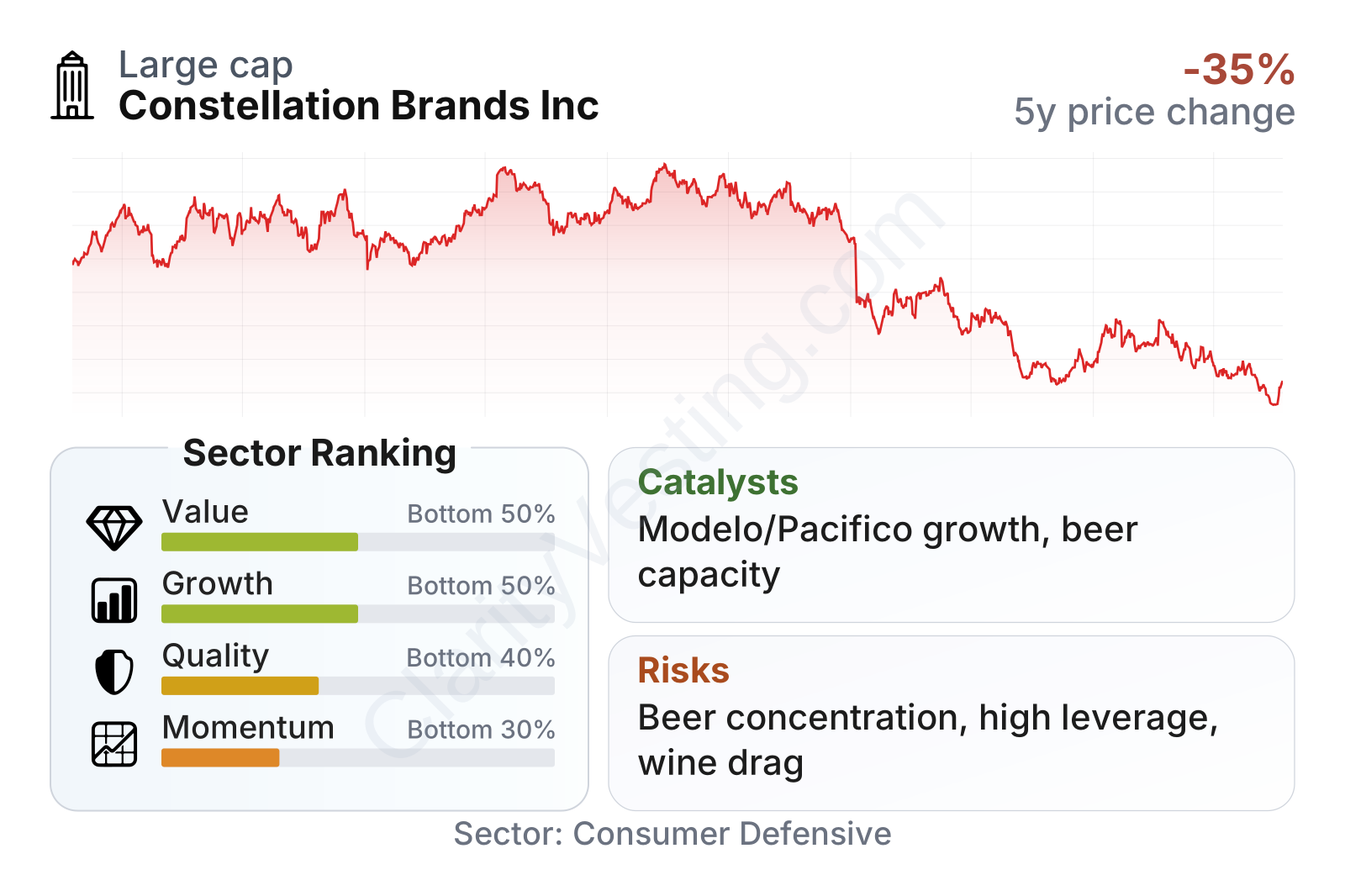
Constellation Brands is a large consumer staples company with relatively low share-price volatility, as shown by its beta below 0.5. On valuation, the stock screens cheaper than the sector on earnings, with a P/E around 11 versus a sector median near 18, but it does not look broadly cheap on every measure because book value and cash flow multiples are less favorable. Profitability remains a standout feature: operating margin is around 31% and profit margin around 21%, both well above sector norms. The weaker areas are balance-sheet leverage, medium-term growth compared with peers, and recent stock momentum, which has trailed much of the sector.
Growth
The company operates in a mature but resilient industry rather than a fast-expanding one. Alcohol consumption in developed markets is not a classic high-growth theme, yet premium imported beer has been one of the more attractive pockets of the beverage space. Constellation’s strategy is built around that reality: lean into high-demand Mexican import brands, support premiumization, expand distribution, and use pricing power where brand strength allows it.
A major reason the growth case still exists is the positioning of Modelo and Pacifico in the U.S. beer market. Modelo Especial has risen into a leading position in U.S. beer, benefiting from consumer migration toward imported and premium brands. That gives Constellation exposure to a category with better demand characteristics than mainstream domestic beer, which has been under pressure for years. Pacifico has also been one of the faster-growing brands in the portfolio, adding another runway inside the beer segment.
Revenue growth has not been smooth recently. The latest year-over-year pattern shows weakness through much of fiscal 2026 before returning to positive territory in the most recent period. That suggests the company is navigating a softer patch rather than following a straight-line expansion path. Even so, its latest year-over-year growth rate remains ahead of the sector median, which indicates the business still has pockets of relative strength.
Cash generation is another support for the long-term growth profile. Even after fluctuations, Constellation continues to produce substantial free cash flow, giving it room to fund brewery capacity, pay dividends, and manage debt. That flexibility is especially important in branded beverages, where supply availability and marketing support can shape market-share outcomes over several years.
Free cash flow has remained solid over time, generally in the range expected of a large branded beverage company. The latest trailing figure is below the strongest recent years, but the broader pattern still points to a business capable of converting earnings into cash. That is important because future growth in beer depends not just on demand, but also on having enough production and logistics capacity to keep products on shelves.
One notable strategic catalyst is continued investment in Mexican beer capacity. Constellation has been expanding and optimizing production to support its import beer portfolio, and over time that can remove a practical ceiling on growth. The company has also continued reshaping the wine and spirits portfolio, which may help improve focus and profitability even if that segment remains slower growing than beer.
Risks
This article is for informational purposes only and does not constitute financial advice. Some content is AI-generated. See Disclaimer


