Stock Analysis · Starwood Property Trust Inc (STWD)
Overview
Starwood Property Trust is a large mortgage REIT, which means it is a real estate company built mainly around lending, financing, and owning selected property-related assets rather than operating buildings like a traditional landlord. The company works across commercial real estate lending, infrastructure lending, property ownership, and servicing businesses. Its platform is managed by Starwood Capital Group, a well-known real estate investment firm, which gives it access to industry relationships, deal sourcing, and underwriting experience.
In simple terms, Starwood Property Trust makes money primarily by providing loans backed by real estate, collecting interest income, earning fees from servicing and securitization activities, and generating income from certain owned properties and infrastructure investments. Based on the company’s recent business mix described in public filings, revenue and earnings are primarily tied to lending operations, with smaller contributions from property ownership and servicing-related activities.
The business mix is best understood through its operating segments:
- Commercial and residential lending: the core business and the largest earnings driver. This includes originating, acquiring, financing, and managing first mortgages, mezzanine loans, and other real estate debt investments. This segment has typically represented the clear majority of the company’s capital deployment and earnings base.
- Infrastructure lending: loans backed by infrastructure assets such as power and energy-related projects. This has become an important diversification tool beyond office and other traditional commercial property categories.
- Property segment: direct ownership of real estate assets, including stabilized properties and properties acquired through lending relationships or other transactions.
- Servicing and securitization: income from special servicing, primary servicing, and related fee businesses tied to commercial mortgage-backed securities and loan portfolios.
Looking at the broad economic flow of the business, total revenue rose meaningfully from 2021 through 2024 before easing in 2025, while operating income stayed strong. The bigger swing item has been interest expense, which climbed sharply as rates moved higher and remained a major influence on net income. That pattern matters because Starwood’s business model depends on earning more on loans and assets than it pays on financing.
Key Figures
| Metric | Value | Sector ⓘ |
|---|---|---|
| Date | Oct 17, 2026 | |
| Context | ||
| Sector | Real Estate | |
| Industry | REIT - Mortgage | |
| Market Cap ⓘ | $4.70B | |
| Beta ⓘ | 1.05 | |
Value (Cheapness) | ||
| P/E Ratio ⓘ | 20.63 | 17.38 |
| P/B Ratio ⓘ | 0.80 | 0.85 |
| FCF Yield ⓘ | 9.33% | 7.38% |
| Dividend Yield ⓘ | 15.38% | 4.85% |
| EBIT / EV ⓘ | 5.73% | 3.78% |
| PEG ⓘ | 1.74 | |
Growth (Business expansion) | ||
| Revenue Growth ⓘ | 13.40% | 5.30% |
| RPS Growth (5Y CAGR) ⓘ | 8.64% | 6.02% |
| EPS Growth (5Y CAGR) ⓘ | -26.75% | -11.37% |
| BVPS Growth (5Y CAGR) ⓘ | -3.86% | 0.45% |
| Margin Growth (5Y Trend) ⓘ | 13.81% | -0.22% |
| FCF Growth (5Y CAGR) ⓘ | N/A | 5.40% |
| DPS Growth (5Y CAGR) ⓘ | 1.54% | 5.02% |
Quality (Business durability) | ||
| ROIC (Latest) ⓘ | 7.34% | 5.69% |
| ROE (Latest) ⓘ | 3.81% | 7.56% |
| ROA (Latest) ⓘ | 0.37% | 2.85% |
| ROIC (5Y Median) ⓘ | 10.76% | 4.22% |
| ROE (5Y Median) ⓘ | 6.99% | 6.03% |
| ROA (5Y Median) ⓘ | 0.55% | 2.44% |
| Net Debt / EBIT (Latest) ⓘ | 14.21 | 7.59 |
| Net Debt / EBIT (5Y Median) ⓘ | 12.02 | 8.40 |
| Net Debt / EBITDA (Latest) ⓘ | 13.16 | 5.27 |
| Net Debt / Assets ⓘ | 38.21% | 37.76% |
| EBITDA / Interest ⓘ | 1.32 | 4.10 |
| Operating Margin (Latest) ⓘ | 81.14% | 35.29% |
| Operating Margin (5Y Median) ⓘ | 90.33% | 37.31% |
| Debt to Equity (Latest) ⓘ | 364.58% | 88.87% |
| Profit Margin (Latest) ⓘ | 38.16% | 19.61% |
| Free Cash Flow (Latest) ⓘ | $438.59M | |
Momentum (Price trend) | ||
| 3Y Return ⓘ | -10.39% | +30.75% |
| 12M Return (excl. last month) ⓘ | -16.77% | +4.36% |
| 6M Return ⓘ | -26.03% | -2.52% |
| Price vs. 200-Day MA ⓘ | -20.60% | -2.34% |
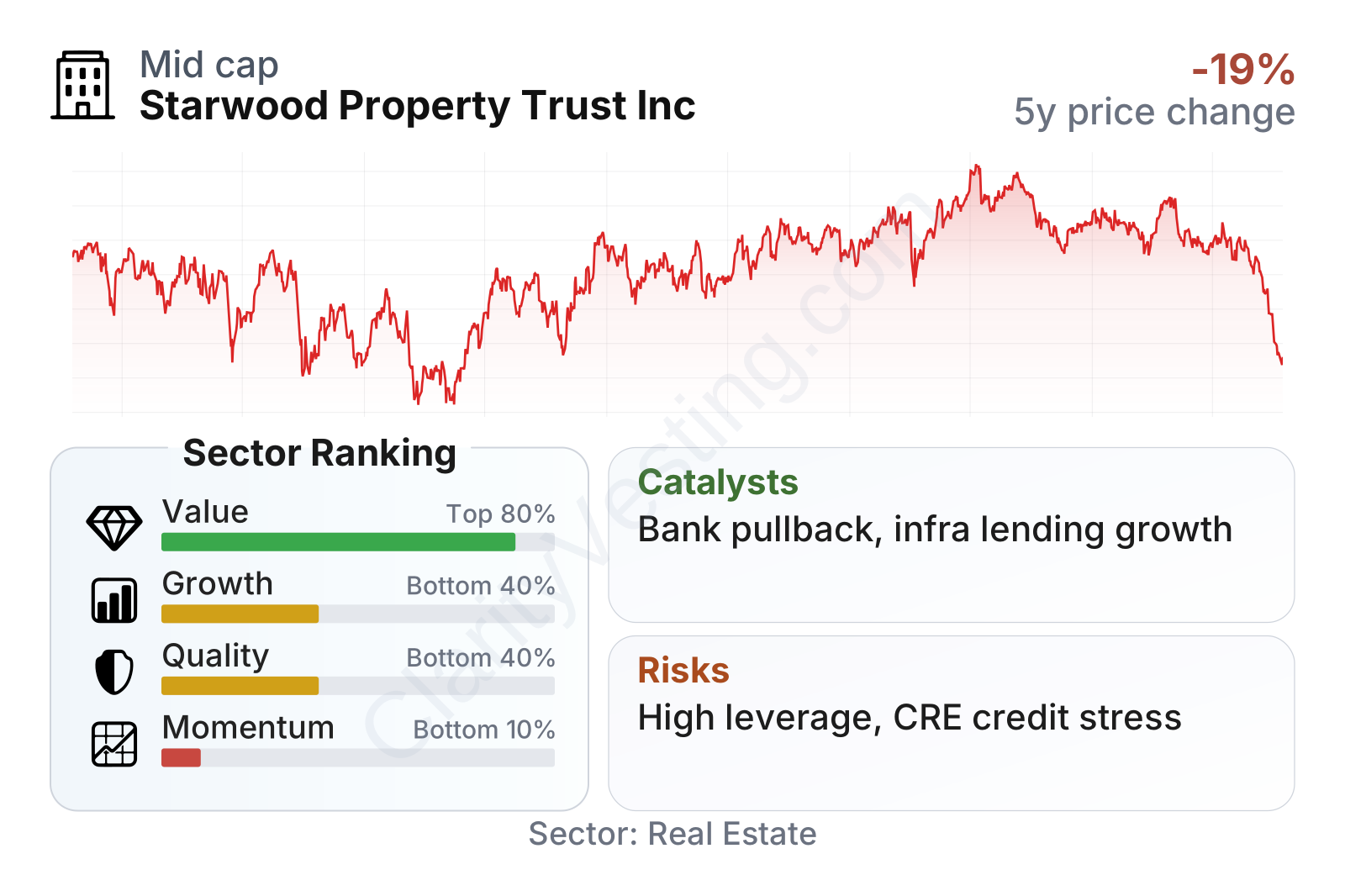
Starwood Property Trust sits in the mid-cap range and its share-price volatility is close to the broader market. On valuation, the picture is mixed: the stock trades around sector norms on price-to-book, but at a higher earnings multiple than the sector median. Its free cash flow yield and dividend yield stand out as elevated, which helps explain market interest even though price momentum has been weak. The factor summary is also mixed: value looks comparatively strong, while growth, quality, and especially momentum rank lower against the broader real estate group.
The stock price history shows a business that has been resilient but not consistently rewarded by the market. Shares recovered from the 2022 decline and later moved higher, but recent trading has softened again. That uneven performance reflects an important point for long-term analysis: Starwood’s underlying income generation has remained meaningful, yet the market has been cautious about leverage, real estate credit conditions, and earnings durability.
Growth
Starwood operates in a sector that should remain relevant for years because real estate financing is a permanent need. Property owners, developers, and infrastructure sponsors continue to require private capital, especially when traditional banks become more selective. That creates space for large alternative lenders with established origination and underwriting capabilities. In that sense, the company is positioned in a part of real estate that can benefit when borrowers need flexible funding and when bank retrenchment creates financing gaps.
The company’s strategy is sensible for future growth because it is not limited to one narrow niche. Its platform spans commercial real estate debt, infrastructure debt, servicing, and direct property exposure. That diversification can help offset weakness in any single asset class. The infrastructure lending business is especially notable because it broadens exposure beyond office-heavy commercial property concerns and aligns with long-duration capital needs in energy and essential assets.
Revenue per share increased strongly from 2021 through 2023, then pulled back in 2024 and 2025. That still leaves a positive five-year growth trend, but it also shows that expansion has not been linear. The recent slowdown suggests the company is navigating a more difficult lending environment, not a simple straight-line growth cycle.
The dividend per share has been comparatively steady, with only modest growth over the past five years. That stability is important because mortgage REITs are often judged by the consistency of their distributions. The current yield is unusually high relative to the sector, which indicates strong income generation on paper but also shows that the market is assigning a meaningful risk premium.
A practical catalyst for Starwood is the possibility that a more normalized interest-rate environment could improve financing spreads, loan activity, and asset valuations. Another potential tailwind is ongoing stress in commercial real estate refinancing, which can create opportunities for lenders with capital, scale, and experience. If banks stay cautious, private credit platforms such as Starwood may continue to capture attractive lending opportunities. Recent company communications have also emphasized portfolio management, repayments, and capital recycling, all of which can support fresh originations if credit conditions remain workable.
Risks
This article is for informational purposes only and does not constitute financial advice. Some content is AI-generated. See Disclaimer


