Stock Analysis · Sterling Infrastructure Inc (STRL)
Overview
Sterling Infrastructure Inc is a U.S. construction and infrastructure company focused on specialized, higher-value projects rather than broad commodity-style construction. Over time, the business has shifted away from lower-margin heavy civil work and toward segments with better profitability, especially data center site development, e-commerce and warehouse-related projects, manufacturing facilities, and residential concrete foundations in attractive housing markets.
The company reports results through three main business segments. Based on recent annual reporting, the revenue mix is approximately as follows:
- E-Infrastructure Solutions: about 45% to 50% of revenue. This segment includes large site development work for data centers, warehouses, distribution facilities, manufacturing plants, and other mission-critical or industrial projects.
- Transportation Solutions: about 30% to 35% of revenue. This includes highway, road, bridge, airport, rail, and related public infrastructure projects, largely for state and local agencies.
- Building Solutions: about 20% to 25% of revenue. This business mainly provides residential and commercial concrete foundations and related site work, with a meaningful presence in fast-growing Sun Belt markets.
That mix matters because the fastest-growing part of Sterling has been the E-Infrastructure business, which is tied to powerful end markets such as cloud computing, artificial intelligence-related data center construction, logistics facilities, and U.S. manufacturing investment. Transportation adds diversification through public-sector work, while Building Solutions provides exposure to population growth and housing activity in selected regions.
Another notable change is profitability. Over the last several years, revenue has grown, but margins have improved even more sharply. This suggests Sterling is not simply taking on more projects; it is becoming more selective and focusing on work that earns better returns.
The business has expanded revenue steadily since 2021, but the more striking improvement has been in operating income and net income, which have grown much faster than sales. That points to a better project mix, stronger execution, and tighter cost control.
Key Figures
| Metric | Value | Sector ⓘ |
|---|---|---|
| Date | Oct 24, 2026 | |
| Context | ||
| Sector | Industrials | |
| Industry | Engineering & Construction | |
| Market Cap ⓘ | $12.61B | |
| Beta ⓘ | 1.86 | |
Value (Cheapness) | ||
| P/E Ratio ⓘ | 29.70 | 22.29 |
| P/B Ratio ⓘ | 9.71 | 1.98 |
| FCF Yield ⓘ | 3.81% | 6.26% |
| Dividend Yield ⓘ | N/A | 1.92% |
| EBIT / EV ⓘ | 3.95% | 4.83% |
| PEG ⓘ | 0.63 | |
Growth (Business expansion) | ||
| Revenue Growth ⓘ | 90.10% | 9.30% |
| RPS Growth (5Y CAGR) ⓘ | 13.43% | 7.76% |
| EPS Growth (5Y CAGR) ⓘ | 28.69% | -13.17% |
| BVPS Growth (5Y CAGR) ⓘ | 30.75% | 6.13% |
| Margin Growth (5Y Trend) ⓘ | 9.55% | 0.74% |
| FCF Growth (5Y CAGR) ⓘ | 34.06% | 10.79% |
| DPS Growth (5Y CAGR) ⓘ | -6.85% | 9.41% |
Quality (Business durability) | ||
| ROIC (Latest) ⓘ | 32.28% | 10.75% |
| ROA (Latest) ⓘ | 14.99% | 5.41% |
| ROIC (5Y Median) ⓘ | 17.66% | 9.37% |
| ROA (5Y Median) ⓘ | 8.47% | 4.95% |
| Net Debt / EBIT (Latest) ⓘ | -0.21 | 2.04 |
| Net Debt / EBIT (5Y Median) ⓘ | -0.10 | 2.27 |
| Net Debt / EBITDA (Latest) ⓘ | -0.18 | 1.39 |
| Net Debt / Assets ⓘ | -4.00% | 19.27% |
| EBITDA / Interest ⓘ | 42.53 | 9.58 |
| Operating Margin (Latest) ⓘ | 17.98% | 10.49% |
| Operating Margin (5Y Median) ⓘ | 11.15% | 10.30% |
| Debt to Equity (Latest) ⓘ | 24.81% | 64.82% |
| Profit Margin (Latest) ⓘ | 12.55% | 6.67% |
| Free Cash Flow (Latest) ⓘ | $480.59M | |
Momentum (Price trend) | ||
| 3Y Return ⓘ | +489.69% | +67.77% |
| 12M Return (excl. last month) ⓘ | +42.30% | +12.05% |
| 6M Return ⓘ | -12.66% | 0.00% |
| Price vs. 200-Day MA ⓘ | -24.92% | +0.67% |
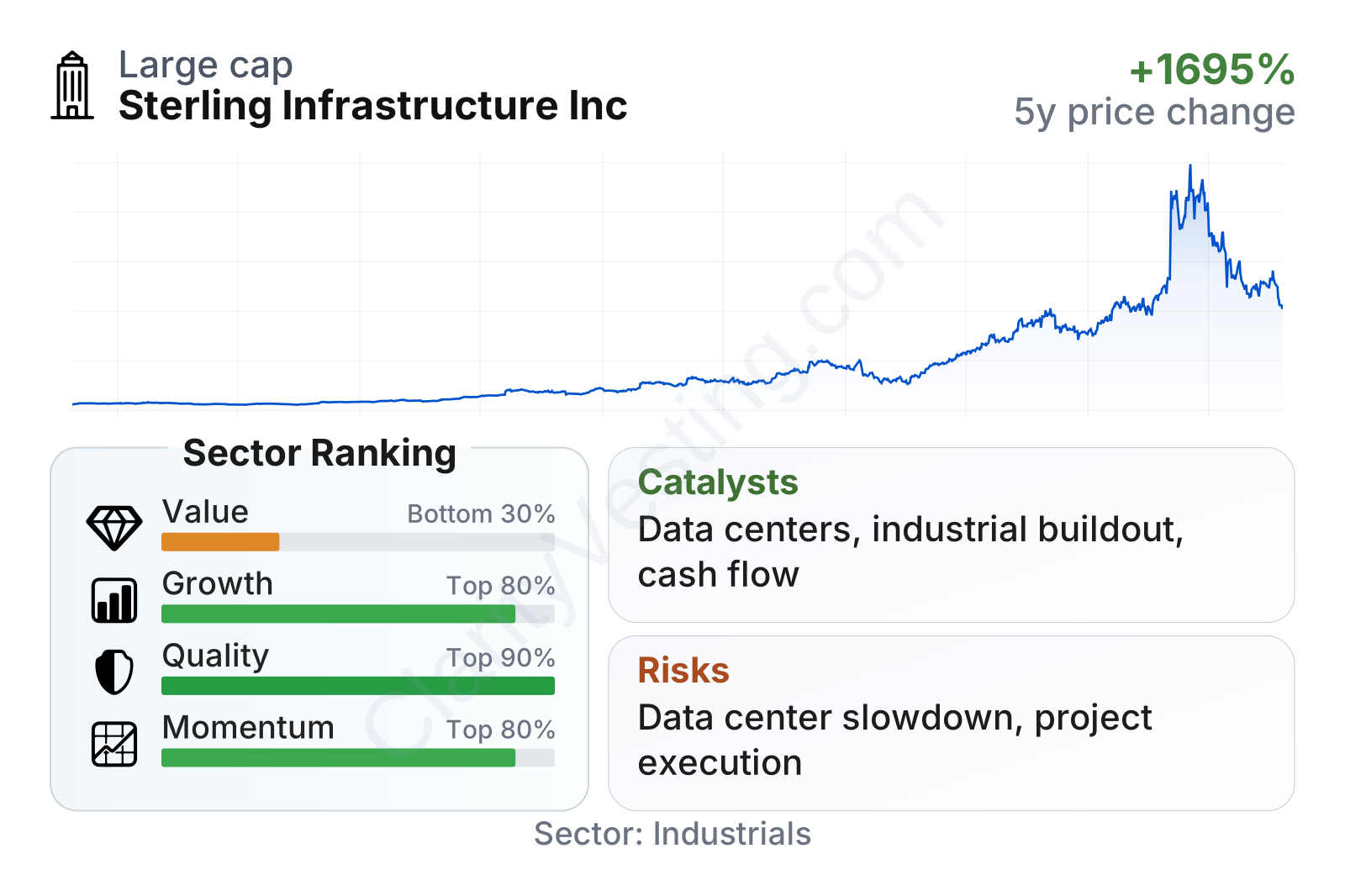
Sterling stands out for quality and growth relative to most companies in its sector. Profitability metrics are strong, returns on capital are well above industry norms, and the balance sheet looks conservative. The weaker area is valuation: the stock trades at clear premiums on earnings, book value, and free cash flow versus the sector median, which means the market is already recognizing much of the company’s recent progress.
Growth
Sterling operates in parts of construction and infrastructure that currently have favorable long-term demand drivers. The most important one is digital infrastructure. Data center development in the United States has accelerated as cloud providers, enterprise customers, and artificial intelligence workloads require more computing capacity. Sterling benefits earlier in the construction chain because these facilities need extensive land preparation, utilities, drainage, concrete, and site execution before the buildings become operational.
A second growth driver is domestic industrial investment. Large manufacturing projects, including reshoring-related facilities, semiconductor-linked construction, and logistics expansion, continue to support demand for complex site work. A third support comes from public infrastructure budgets in transportation, where multi-year funding programs can create a durable pipeline for roads, bridges, and airport-related work.
The company’s strategy appears coherent for this environment. Management has spent several years moving toward specialized projects where execution skill matters more and price competition matters less. That helps explain why margins and returns have improved so much. Instead of chasing the largest possible backlog at any price, Sterling has increasingly emphasized project quality.
Recent growth has been unusually strong, with year-over-year revenue expansion accelerating sharply in the latest reported periods. That kind of surge is difficult to sustain forever, but it does show that demand in Sterling’s chosen niches remains very strong.
Cash generation has also improved substantially over the last few years. Free cash flow has climbed from relatively modest levels to several hundred million dollars on a trailing basis. For a construction company, this is important because accounting earnings can sometimes look healthy while cash conversion weakens. Sterling’s recent profile suggests the opposite: the company has been turning operational gains into meaningful cash.
Recent company communications have also highlighted continued momentum in data center and mission-critical site development, which remains the clearest near- to medium-term catalyst. If that demand stays elevated, Sterling could continue benefiting from a favorable mix of large, technically demanding projects.
Risks
This article is for informational purposes only and does not constitute financial advice. Some content is AI-generated. See Disclaimer


