Stock Analysis · Strategic Education Inc (STRA)
Overview
Strategic Education Inc. is an education company focused on post-secondary learning, especially programs designed for working adults, career changers, and employers seeking workforce development. The company operates primarily through two university systems in the United States—Strayer University and Capella University—and also has an education technology and services business that supports employer partnerships, corporate learning, and international education activities.
Its business is tied to a simple idea: helping students gain degrees, certificates, and job-relevant skills in flexible formats, with a heavy emphasis on online delivery. That makes the company less dependent on physical campus expansion than a traditional university operator and more connected to long-term trends such as adult reskilling, employer-sponsored education, and digital learning.
The main sources of revenue are concentrated in U.S. higher education, with the rest coming from education services and employer-related offerings. Based on recent company reporting, the mix is approximately:
- U.S. Higher Education: about 85% to 90% of revenue. This includes tuition and related revenue from Strayer University and Capella University, serving students in undergraduate, graduate, and professional programs.
- Education Technology Services and Australia/New Zealand: about 10% to 15% of revenue. This includes employer-affiliated education pathways, workforce upskilling solutions, and international education operations.
Over the last several years, revenue has moved from a decline phase back into growth, while profitability improved more sharply than sales. That suggests management has not only stabilized enrollment trends but also tightened operations.
The business mix has stayed fairly stable, but the earnings structure has improved noticeably. Revenue has risen from just above $1.1 billion in 2023 to roughly $1.27 billion in 2025, while net income more than doubled over that period. The most important takeaway is that recent profit growth has come from both higher revenue and better cost discipline.
Key Figures
| Metric | Value | Sector ⓘ |
|---|---|---|
| Date | Oct 17, 2026 | |
| Context | ||
| Sector | Consumer Defensive | |
| Industry | Education & Training Services | |
| Market Cap ⓘ | $1.82B | |
| Beta ⓘ | 0.47 | |
Value (Cheapness) | ||
| P/E Ratio ⓘ | 13.67 | 17.88 |
| P/B Ratio ⓘ | 1.09 | 1.29 |
| FCF Yield ⓘ | 9.98% | 12.39% |
| Dividend Yield ⓘ | 2.93% | 2.85% |
| EBIT / EV ⓘ | 11.05% | 6.43% |
| PEG ⓘ | 0.62 | |
Growth (Business expansion) | ||
| Revenue Growth ⓘ | 4.90% | 4.10% |
| RPS Growth (5Y CAGR) ⓘ | 4.33% | 6.18% |
| EPS Growth (5Y CAGR) ⓘ | 6.54% | -13.59% |
| BVPS Growth (5Y CAGR) ⓘ | 0.38% | 3.20% |
| Margin Growth (5Y Trend) ⓘ | 4.22% | -0.15% |
| FCF Growth (5Y CAGR) ⓘ | 4.10% | 4.10% |
| DPS Growth (5Y CAGR) ⓘ | 0.75% | 6.79% |
Quality (Business durability) | ||
| ROIC (Latest) ⓘ | 8.24% | 12.34% |
| ROA (Latest) ⓘ | 6.43% | 6.30% |
| ROIC (5Y Median) ⓘ | 4.54% | 10.49% |
| ROA (5Y Median) ⓘ | 3.26% | 5.44% |
| Net Debt / EBIT (Latest) ⓘ | -0.09 | 1.96 |
| Net Debt / EBIT (5Y Median) ⓘ | 0.40 | 2.35 |
| Net Debt / EBITDA (Latest) ⓘ | -0.07 | 1.38 |
| Net Debt / Assets ⓘ | -0.82% | 21.51% |
| EBITDA / Interest ⓘ | N/A | 9.46 |
| Operating Margin (Latest) ⓘ | 14.40% | 8.87% |
| Operating Margin (5Y Median) ⓘ | 9.98% | 9.53% |
| Debt to Equity (Latest) ⓘ | 6.53% | 72.35% |
| Profit Margin (Latest) ⓘ | 10.46% | 5.40% |
| Free Cash Flow (Latest) ⓘ | $181.42M | |
Momentum (Price trend) | ||
| 3Y Return ⓘ | +10.37% | +20.92% |
| 12M Return (excl. last month) ⓘ | +1.60% | +2.13% |
| 6M Return ⓘ | +5.04% | +1.26% |
| Price vs. 200-Day MA ⓘ | +2.85% | +1.39% |
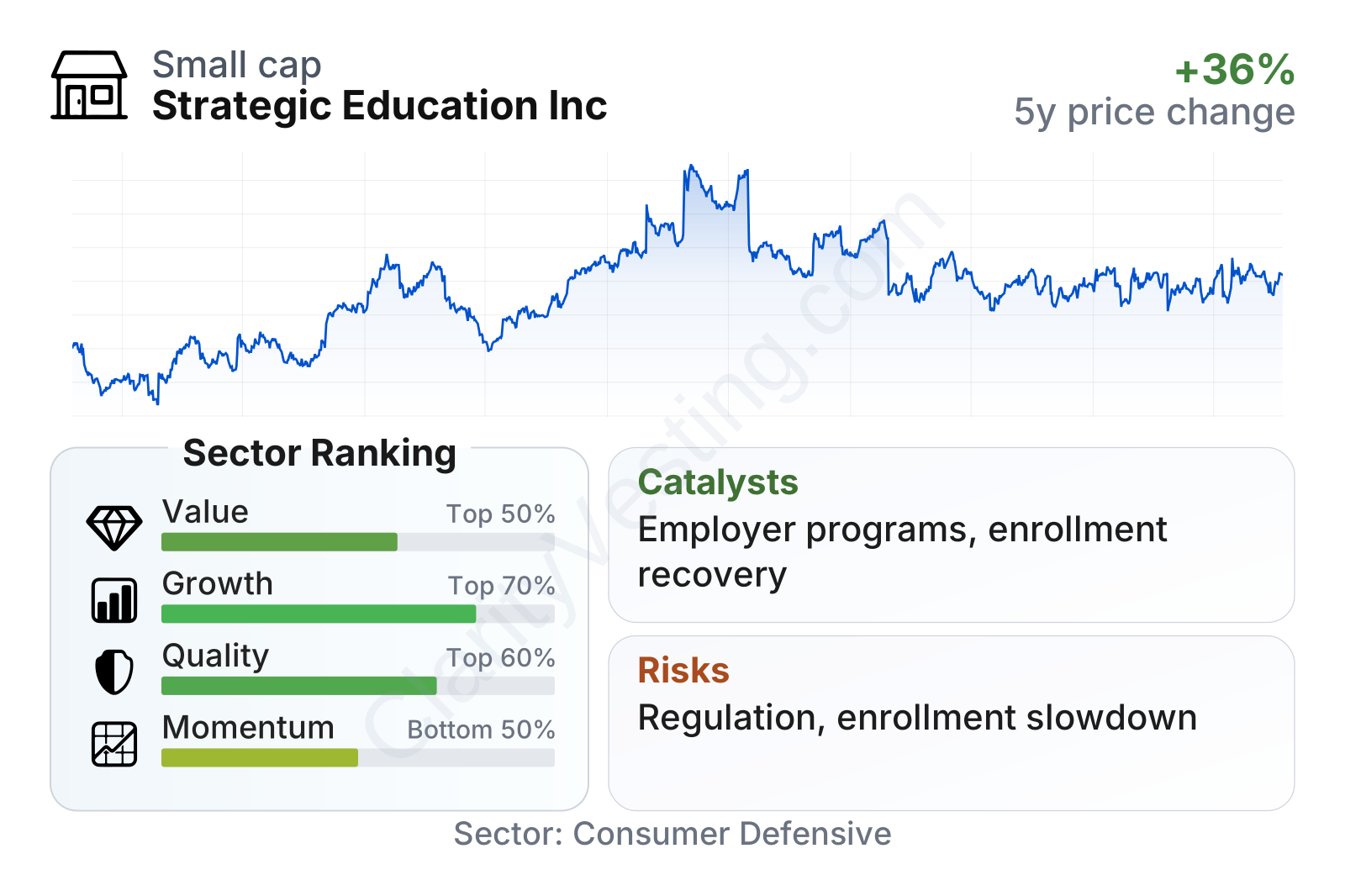
Strategic Education is a mid-sized company with a relatively low share-price volatility profile, as shown by its beta well below 1. On valuation, it screens cheaper than the sector on earnings and book value, while operating earnings relative to enterprise value look stronger than the sector median. Growth is positive but not exceptional across every measure: recent revenue growth is ahead of the sector median, yet longer-term revenue-per-share growth is somewhat slower. Quality is mixed in a constructive way—returns on capital are not elite, but margins, balance sheet strength, and cash generation are clearly solid. Overall, the profile points to a financially disciplined company with moderate growth and stronger-than-average profitability.
Growth
Education and training remain attractive long-term markets because labor needs keep changing. Employers increasingly want workers with specific, measurable skills, while adults often need flexible online programs that fit around jobs and family life. Strategic Education is positioned directly in that part of the market. Its focus on online and employer-linked learning gives it exposure to structural demand rather than relying only on the traditional college-age population.
A central part of the company’s strategy is to connect universities with employer benefits and career advancement. That matters because corporate education partnerships can lower student acquisition costs, improve retention, and make programs feel more practical to students. The company has also invested in healthcare, business, technology, and other career-oriented fields where demand tends to be more durable.
Recent revenue trends support the view that the business has regained momentum. After a weak period in 2022 and early 2023, year-over-year growth turned positive and stayed positive. Growth has cooled from the stronger rebound phase seen in late 2023 and early 2024, but it remains in positive territory, recently around the mid-single-digit range. That is not explosive expansion, yet it does suggest a healthier base business.
Cash generation has improved even more clearly than revenue. Trailing free cash flow climbed from a subdued level in 2023 to a much stronger level by 2026, reaching roughly $170 million to $180 million. For a business like this, that matters because steady free cash flow can support dividends, technology investment, and selective acquisitions without requiring heavy borrowing.
Potential catalysts are fairly easy to identify. If enrollment continues to improve at Strayer and Capella, even modestly, the company can benefit from operating leverage because much of its platform is already in place. Expansion of employer-affiliated education programs is another important opportunity, especially if companies continue using tuition assistance and workforce development as retention tools. In addition, healthcare and professional education remain areas where adult learners often see a direct return from further study, which can support demand even when consumer budgets are tighter.
Recent company updates have continued to emphasize enrollment trends, employer partnerships, and disciplined capital allocation. None of these on their own guarantee a major jump in results, but together they support a credible growth path built on execution rather than speculation.
Risks
This article is for informational purposes only and does not constitute financial advice. Some content is AI-generated. See Disclaimer


