Stock Analysis · Stoke Therapeutics Inc (STOK)
Overview
Stoke Therapeutics is a clinical-stage biotechnology company focused on RNA medicine. Its approach is built around increasing protein production from the healthy copy of a gene when a disease is caused by having too little of a needed protein. The company calls this platform TANGO, short for targeted augmentation of nuclear gene output. In simple terms, Stoke is trying to treat genetic diseases by helping the body make more of a useful protein from the gene copy that still works.
The company’s lead focus is Dravet syndrome, a rare and severe form of epilepsy. Its main program, zorevunersen, is designed to increase production of the SCN1A protein, which is central to this disease. Stoke is also advancing earlier programs in autosomal dominant optic atrophy and has highlighted broader platform potential across other haploinsufficiency disorders, meaning diseases caused by insufficient gene expression.
Unlike a commercial pharmaceutical company, Stoke does not yet depend on product sales. Its revenue has mainly come from collaboration, licensing, and milestone-related arrangements rather than recurring medicine sales. Based on recent reported periods, revenue is concentrated in a small number of partnership-related streams.
- Collaboration and license revenue: approximately 100% of current revenue. This generally includes upfront payments, research support, option-related payments, and milestone recognition tied to partners.
- Product revenue: 0%. Stoke does not currently market an approved product.
- Other revenue sources: minimal or none disclosed as a meaningful recurring category.
This revenue profile is important for long-term analysis: near-term financial results can swing sharply depending on milestone timing, accounting recognition, and partnership activity rather than a stable customer base.
The business mix has shifted noticeably over the last few years. Revenue remained modest for several years while research spending stayed high, then jumped in 2025 because of partnership-related income. Even after that improvement, the company still operates with a development-stage cost structure led by research and development.
Key Figures
| Metric | Value | Sector ⓘ |
|---|---|---|
| Date | Oct 03, 2026 | |
| Context | ||
| Sector | Healthcare | |
| Industry | Biotechnology | |
| Market Cap ⓘ | $1.68B | |
| Beta ⓘ | 1.23 | |
Value (Cheapness) | ||
| P/E Ratio ⓘ | N/A | 24.06 |
| P/B Ratio ⓘ | 4.97 | 3.08 |
| FCF Yield ⓘ | -10.77% | 3.07% |
| Dividend Yield ⓘ | N/A | 2.05% |
| EBIT / EV ⓘ | -15.06% | 0.63% |
| PEG ⓘ | N/A | |
Growth (Business expansion) | ||
| Revenue Growth ⓘ | -32.50% | 7.50% |
| RPS Growth (5Y CAGR) ⓘ | 148.51% | 8.70% |
| EPS Growth (5Y CAGR) ⓘ | -10.44% | -18.20% |
| BVPS Growth (5Y CAGR) ⓘ | 0.10% | 3.95% |
| Margin Growth (5Y Trend) ⓘ | N/A | -0.58% |
| FCF Growth (5Y CAGR) ⓘ | N/A | 0.88% |
| DPS Growth (5Y CAGR) ⓘ | N/A | 6.80% |
Quality (Business durability) | ||
| ROIC (Latest) ⓘ | -46.68% | 3.29% |
| ROA (Latest) ⓘ | -55.13% | 3.02% |
| ROIC (5Y Median) ⓘ | -35.72% | 4.75% |
| ROA (5Y Median) ⓘ | -35.60% | 1.93% |
| Net Debt / EBIT (Latest) ⓘ | N/A | 1.33 |
| Net Debt / EBIT (5Y Median) ⓘ | N/A | 1.83 |
| Net Debt / EBITDA (Latest) ⓘ | N/A | 0.99 |
| Net Debt / Assets ⓘ | -27.24% | 5.33% |
| EBITDA / Interest ⓘ | N/A | 9.63 |
| Operating Margin (Latest) ⓘ | -759.71% | 9.25% |
| Operating Margin (5Y Median) ⓘ | -841.24% | 7.80% |
| Debt to Equity (Latest) ⓘ | 0.78% | 28.99% |
| Profit Margin (Latest) ⓘ | N/A | 3.60% |
| Free Cash Flow (Latest) ⓘ | -$180.68M | |
Momentum (Price trend) | ||
| 3Y Return ⓘ | +604.88% | +37.48% |
| 12M Return (excl. last month) ⓘ | +56.33% | +20.85% |
| 6M Return ⓘ | -18.69% | +9.73% |
| Price vs. 200-Day MA ⓘ | -17.92% | +4.69% |
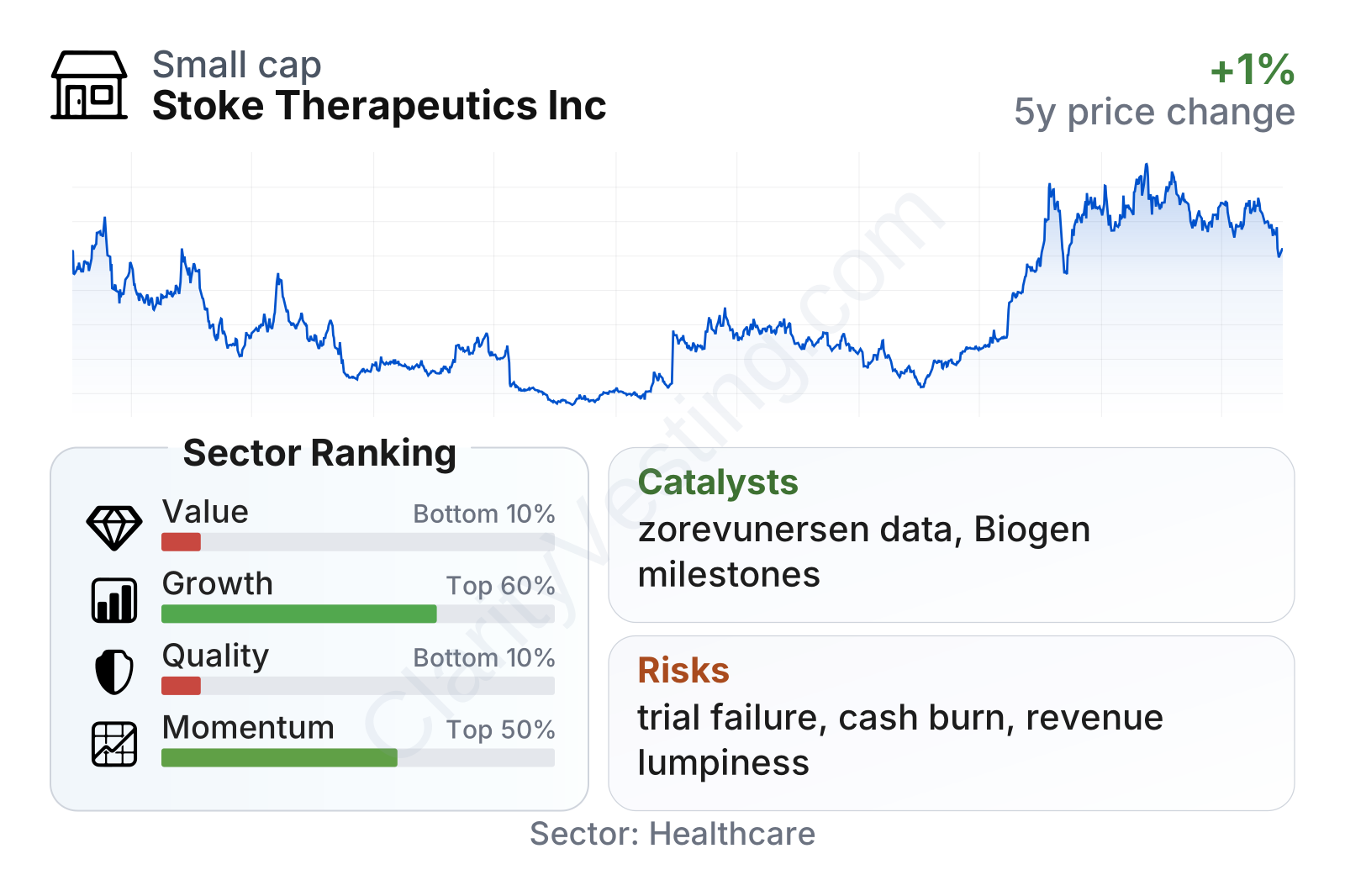
Stoke is a mid-sized biotech by market value, with share-price behavior that has been much more volatile than the average large established healthcare company. The overall factor picture is mixed: growth and momentum rank around the middle to better-than-middle of the healthcare universe, while value and quality metrics sit near the bottom. That pattern is typical of a company whose future depends more on clinical and regulatory progress than on current earnings power.
The stock’s longer-term performance has been strong, but the path has been uneven, with very large swings over short periods. That reflects a market that reacts heavily to trial updates, partnership announcements, and changing expectations for lead programs.
Growth
Stoke operates in a part of healthcare that continues to attract attention: precision genetic medicine for rare diseases. This is a growing area because rare neurologic and inherited conditions often have limited treatment options, and successful medicines can command meaningful pricing and market exclusivity. The company’s strategy also makes sense conceptually. Rather than replacing genes outright, it aims to boost output from the functioning copy already present, which could be a targeted way to address certain inherited disorders.
The biggest growth driver is zorevunersen in Dravet syndrome. If later-stage data remain supportive, this program could become Stoke’s first commercial product and the proof point for its entire platform. A positive outcome would matter beyond one medicine because it would validate the broader idea behind TANGO and could support additional partnerships or pipeline expansion.
Another growth pillar is external collaboration. In 2024 and 2025, Stoke announced major partnership activity, including a broad collaboration with Biogen centered on zorevunersen outside certain territories. For a company of Stoke’s size, that kind of agreement can do three things at once: bring in non-dilutive capital, validate the science, and reduce execution pressure for future commercialization in larger markets.
Revenue growth has been highly irregular, which is normal for a pre-commercial biotech with collaboration-based income. There was a sharp surge around late 2024 and especially in 2025, followed by steep declines in 2026 as comparisons became much tougher. That does not necessarily signal a collapse in underlying business value, but it does show why headline revenue trends are less informative here than pipeline progress and cash runway.
Cash generation shows the same pattern. Free cash flow briefly turned positive when partnership payments came in, then moved deeply negative again as development spending continued. This reinforces a central point for long-term analysis: Stoke’s growth case rests on clinical advancement and strategic deals, not on self-funded operations at this stage.
Recent company updates have continued to keep attention on zorevunersen development, trial enrollment progress, and regulatory interactions. These are the types of events that can materially expand Stoke’s opportunity set because they influence both probability of approval and the size of future partnership economics.
Risks
This article is for informational purposes only and does not constitute financial advice. Some content is AI-generated. See Disclaimer