Stock Analysis · Scorpio Tankers Inc (STNG)
Overview
Scorpio Tankers Inc is a marine transportation company focused on moving refined petroleum products around the world. In simple terms, it does not produce oil; it owns and operates ships that carry fuels and other oil-derived products between refineries, storage hubs, and end markets. Its fleet is concentrated in product tankers, which are the vessels used to transport gasoline, diesel, jet fuel, naphtha, and similar cargoes.
The business makes money mainly from chartering its ships. Freight rates can vary sharply depending on global fuel demand, refinery activity, vessel supply, trade routes, and geopolitical disruptions. That means results can be very strong during tight shipping markets and much weaker when rates normalize.
Based on the company’s filings, Scorpio Tankers’ revenue is overwhelmingly tied to voyage and time-charter equivalent earnings from its product tanker fleet. A simple way to think about revenue sources is:
- Medium Range product tankers: the largest contributor, likely around 40% to 50% of fleet earning capacity. These vessels typically carry refined products on regional and inter-regional routes.
- LR2 tankers: likely around 20% to 30%. These larger vessels are often used on longer-haul refined product trades and can also carry some other clean petroleum cargoes.
- Handymax tankers: likely around 15% to 25%. They serve smaller ports and more flexible routes.
- LR1 tankers: likely around 10% to 20%. These ships sit between MR and LR2 sizes and are used in medium- to long-haul refined product transportation.
- Other revenue: a small share from ancillary items such as pool arrangements, reimbursements, and vessel-related services, generally well below 10%.
One notable financial shift in recent years has been the jump from losses in 2021 to very high profitability in 2022 through 2024, followed by lower but still solid earnings in 2025. Revenue came down from the 2022 peak, but interest expense also fell materially as the balance sheet improved, helping preserve earnings power.
Key Figures
| Metric | Value | Sector ⓘ |
|---|---|---|
| Date | Oct 17, 2026 | |
| Context | ||
| Sector | Energy | |
| Industry | Oil & Gas Midstream | |
| Market Cap ⓘ | $4.44B | |
| Beta ⓘ | -0.18 | |
Value (Cheapness) | ||
| P/E Ratio ⓘ | 5.53 | 15.44 |
| P/B Ratio ⓘ | 1.26 | 1.73 |
| FCF Yield ⓘ | 14.74% | 8.20% |
| Dividend Yield ⓘ | 1.97% | 3.59% |
| EBIT / EV ⓘ | 30.11% | 7.46% |
| PEG ⓘ | 2.46 | |
Growth (Business expansion) | ||
| Revenue Growth ⓘ | 77.50% | 26.90% |
| RPS Growth (5Y CAGR) ⓘ | 18.01% | 6.90% |
| EPS Growth (5Y CAGR) ⓘ | -9.92% | -15.73% |
| BVPS Growth (5Y CAGR) ⓘ | 18.12% | 6.07% |
| Margin Growth (5Y Trend) ⓘ | 61.23% | 0.58% |
| FCF Growth (5Y CAGR) ⓘ | 99.72% | 1.86% |
| DPS Growth (5Y CAGR) ⓘ | 41.03% | 16.79% |
Quality (Business durability) | ||
| ROIC (Latest) ⓘ | 17.32% | 11.40% |
| ROA (Latest) ⓘ | 18.84% | 6.06% |
| ROIC (5Y Median) ⓘ | 16.10% | 10.30% |
| ROA (5Y Median) ⓘ | 12.45% | 5.42% |
| Net Debt / EBIT (Latest) ⓘ | -1.25 | 1.64 |
| Net Debt / EBIT (5Y Median) ⓘ | 1.22 | 1.83 |
| Net Debt / EBITDA (Latest) ⓘ | -1.05 | 1.08 |
| Net Debt / Assets ⓘ | -23.95% | 17.29% |
| EBITDA / Interest ⓘ | 14.19 | 9.64 |
| Operating Margin (Latest) ⓘ | 73.30% | 16.27% |
| Operating Margin (5Y Median) ⓘ | 52.66% | 20.39% |
| Debt to Equity (Latest) ⓘ | 20.03% | 54.76% |
| Profit Margin (Latest) ⓘ | 67.16% | 8.82% |
| Free Cash Flow (Latest) ⓘ | $655.27M | |
Momentum (Price trend) | ||
| 3Y Return ⓘ | +66.95% | +67.38% |
| 12M Return (excl. last month) ⓘ | +49.19% | +49.19% |
| 6M Return ⓘ | +18.28% | +7.07% |
| Price vs. 200-Day MA ⓘ | +15.39% | +9.56% |
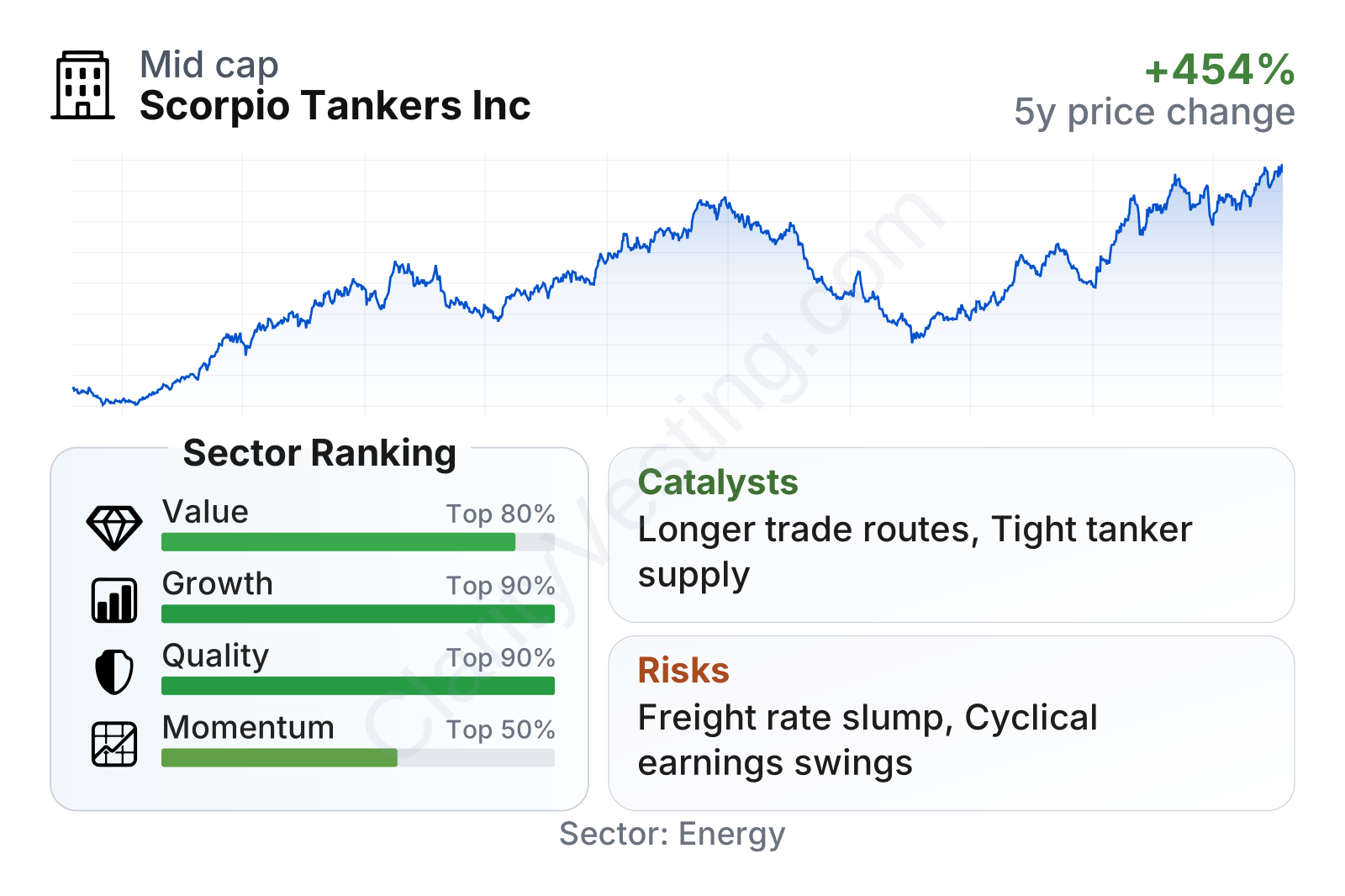
Scorpio Tankers stands out on growth and quality metrics relative to much of the energy sector. Profitability, returns on capital, and cash generation have all been unusually strong for a shipping company, while leverage has fallen to a much lower level than it carried a few years ago. On valuation measures, the shares still screen as inexpensive versus sector medians, although that needs to be interpreted carefully because tanker earnings can be highly cyclical.
The stock’s path has also been volatile. It rose sharply from 2022 into 2024, then experienced a large reset before recovering again in 2026. That pattern is typical for shipping businesses: the market often reacts quickly to changes in freight-rate expectations rather than treating earnings as stable and permanent.
Growth
Scorpio Tankers operates in a sector that is not a classic steady-growth industry, but it can enjoy powerful upcycles. Demand for refined product shipping depends on global consumption of transportation fuels, refinery dislocations, and the distance cargoes need to travel. In recent years, refinery closures in some regions, new refinery capacity in others, and changing trade flows have increased “ton-miles,” which is important because longer routes support more ship demand even if cargo volumes do not rise dramatically.
The company’s strategy has made sense for this environment. It has focused on a modern product tanker fleet, operational scale, and balance-sheet repair. That combination matters: newer ships are generally more attractive to charterers, and lower debt gives the company more room to endure weaker rate periods without the same level of financial pressure it faced earlier in the decade.
Revenue growth has been very uneven, which is normal in tanker shipping. After an exceptional surge in 2022, growth turned negative in several later periods as the market cooled from extreme highs. More recently, growth has turned positive again, with year-over-year revenue acceleration well above the sector median. That suggests the business is still highly responsive to stronger freight conditions.
Cash generation remains an important part of the case. Free cash flow rose dramatically from early 2022 levels and, while below the earlier peak, has remained meaningful. This has supported debt reduction, dividends, and share repurchases. In shipping, strong cash flow during favorable markets can create lasting value if management uses it to reduce financial risk instead of expanding too aggressively at the wrong point in the cycle.
A visible catalyst is the continued reshaping of global refined-product trade routes. Sanctions, regional supply realignment, and refinery shifts have helped keep cargo distances elevated. Another supportive factor is vessel supply: product tanker fleet growth has been relatively constrained compared with many past cycles, which can support rates if demand stays healthy. Recent company communications have also emphasized ongoing shareholder returns and fleet positioning, reinforcing that management is trying to translate favorable market conditions into stronger per-share outcomes.
Risks
This article is for informational purposes only and does not constitute financial advice. Some content is AI-generated. See Disclaimer


