Stock Analysis · Scottish Mortgage Investment Trust PLC (STMZF)
Overview
Scottish Mortgage Investment Trust PLC is not an operating company that sells products or services directly to consumers. It is a large publicly listed investment trust managed by Baillie Gifford. Its purpose is to invest shareholders’ money in a portfolio of businesses around the world that management believes can grow significantly over many years. In practice, that means owning stakes in public and private companies across areas such as technology, digital platforms, health care innovation, electric vehicles, semiconductors, and other growth-oriented industries.
The trust is unusual because it combines listed stocks with a meaningful allocation to private companies. That gives it access to businesses before they reach public markets, but it also makes valuation less straightforward than for a traditional stock fund. The portfolio is global, with a strong bias toward companies using new technology or changing large markets.
Its economic engine is different from a normal corporation. Revenue and profit mainly come from changes in the value of its investment portfolio rather than from recurring sales. The broad sources are:
- Net gains or losses on investments: by far the dominant driver, typically the vast majority of results in any given year. This reflects changes in the market value of listed holdings and the revaluation of private holdings.
- Dividend income from portfolio companies: a much smaller contribution. This includes cash dividends received from investee companies.
- Interest and other income: limited in size, generally tied to cash balances or portfolio-related items.
Because Scottish Mortgage is an investment trust, the most important business measure is usually the change in net asset value, or NAV, rather than conventional sales growth. That is the clearest indicator of whether the underlying portfolio is creating value over time.
The trust’s reported results can swing sharply from profit to loss depending on market conditions. That volatility is normal for a portfolio concentrated in growth companies, especially when private-company valuations and technology shares move quickly.
Key Figures
| Metric | Value | Sector ⓘ |
|---|---|---|
| Date | Oct 17, 2026 | |
| Context | ||
| Sector | Financial Services | |
| Industry | Asset Management | |
| Market Cap ⓘ | $29.27B | |
| Beta ⓘ | 0.84 | |
Value (Cheapness) | ||
| P/E Ratio ⓘ | N/A | 12.26 |
| P/B Ratio ⓘ | N/A | 1.23 |
| FCF Yield ⓘ | N/A | 10.40% |
| Dividend Yield ⓘ | 0.21% | 3.02% |
| EBIT / EV ⓘ | -30.22% | 8.14% |
| PEG ⓘ | N/A | |
Growth (Business expansion) | ||
| Revenue Growth ⓘ | -53.00% | 9.35% |
| RPS Growth (5Y CAGR) ⓘ | N/A | 12.19% |
| EPS Growth (5Y CAGR) ⓘ | 31.59% | -9.53% |
| BVPS Growth (5Y CAGR) ⓘ | N/A | 4.99% |
| Margin Growth (5Y Trend) ⓘ | N/A | -3.86% |
| FCF Growth (5Y CAGR) ⓘ | N/A | 4.81% |
| DPS Growth (5Y CAGR) ⓘ | N/A | 8.79% |
Quality (Business durability) | ||
| ROIC (Latest) ⓘ | N/A | 9.49% |
| ROE (Latest) ⓘ | N/A | 13.90% |
| ROA (Latest) ⓘ | N/A | 1.55% |
| ROIC (5Y Median) ⓘ | N/A | 7.86% |
| ROE (5Y Median) ⓘ | 14.29% | 12.17% |
| ROA (5Y Median) ⓘ | N/A | 1.30% |
| Net Debt / EBIT (Latest) ⓘ | N/A | 0.96 |
| Net Debt / EBIT (5Y Median) ⓘ | N/A | 0.73 |
| Net Debt / EBITDA (Latest) ⓘ | N/A | 0.92 |
| Operating Margin (Latest) ⓘ | N/A | 22.30% |
| Operating Margin (5Y Median) ⓘ | N/A | 24.63% |
| Debt to Equity (Latest) ⓘ | N/A | 58.56% |
| Profit Margin (Latest) ⓘ | 97.38% | 26.57% |
| Free Cash Flow (Latest) ⓘ | N/A | |
Momentum (Price trend) | ||
| 3Y Return ⓘ | +158.59% | +88.33% |
| 12M Return (excl. last month) ⓘ | +30.51% | +19.38% |
| 6M Return ⓘ | +7.47% | +4.75% |
| Price vs. 200-Day MA ⓘ | +12.77% | +3.50% |
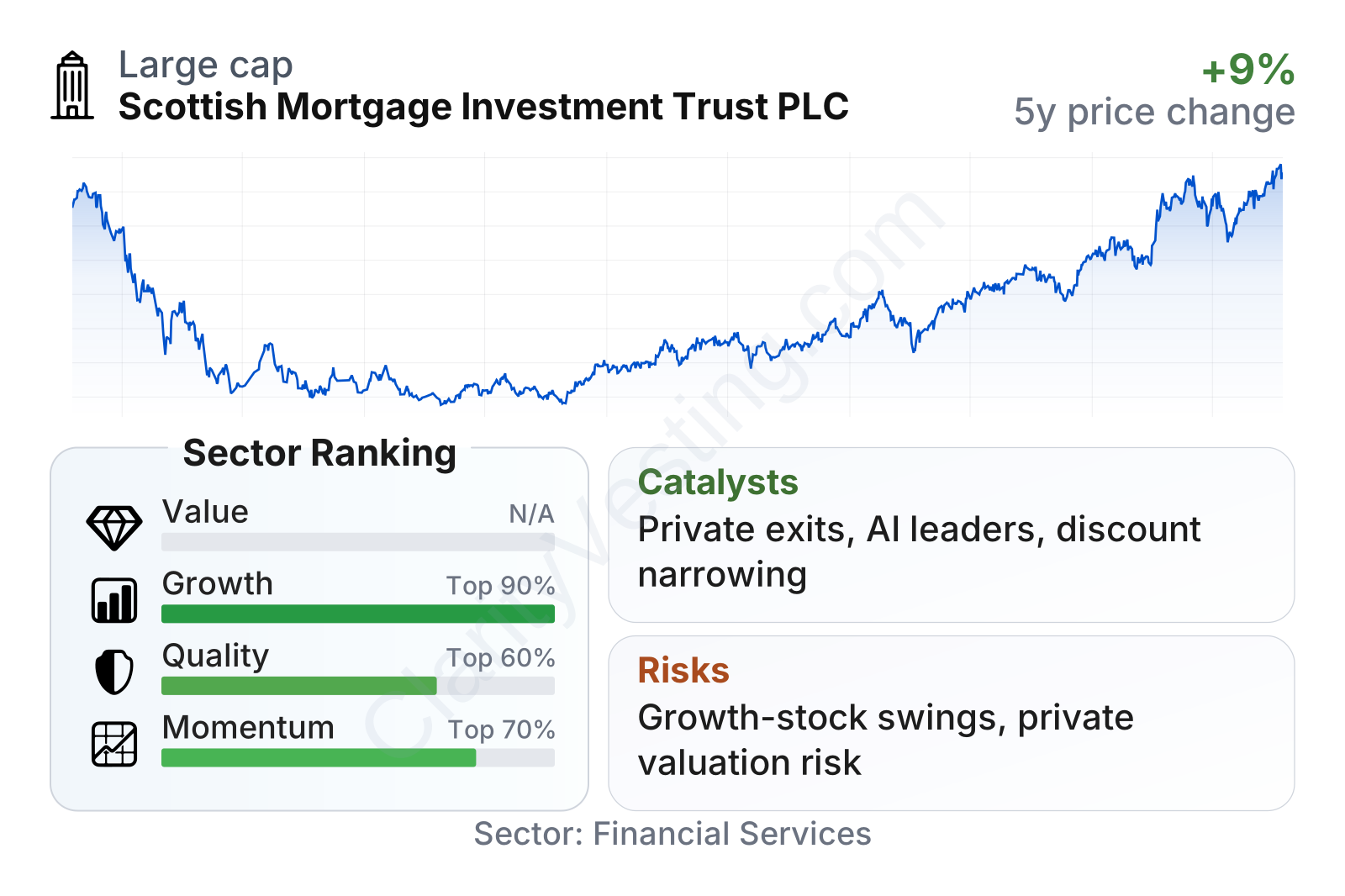
Scottish Mortgage is a very large investment trust by market value, and its recent market behavior has been stronger than much of the broader financial sector sample. Momentum measures are above sector medians over 6 months, 12 months, and 3 years, which fits the strong rebound visible in the share price after the deep 2022–2023 decline.
On growth and quality, the picture is mixed but still broadly constructive. Five-year earnings-per-share growth has been strong, and long-run return on equity sits above the sector median, which suggests the trust has created value over time despite large short-term swings. At the same time, near-term revenue comparisons look weak because reported income for an investment trust depends heavily on mark-to-market gains and losses, so a negative year-over-year change is less informative here than it would be for a normal operating business.
The income profile is also different from many financial stocks. The dividend yield is low, and conventional operating earnings measures are not very meaningful because portfolio revaluations dominate the accounts. In other words, Scottish Mortgage is best understood as a vehicle for long-duration capital appreciation rather than income generation.
Growth
Scottish Mortgage operates in a part of the market tied to long-term structural growth rather than to one industry cycle. Its portfolio is built around themes such as artificial intelligence infrastructure, digital commerce, advanced chips, cloud software, biotechnology, space-related technology, and transportation electrification. These are all areas that continue to attract large amounts of capital and customer demand globally, even if sentiment moves in waves.
The strategy makes sense for future growth if two conditions hold: first, the underlying companies continue expanding their businesses; second, public markets remain willing to recognize that growth in valuations over time. The trust’s approach is deliberately patient and concentrated. That can amplify long-term upside when holdings execute well, because winners can become a meaningful share of the portfolio instead of being trimmed too early.
A major catalyst is its exposure to private companies alongside listed names. If some of those private businesses mature successfully, are revalued upward, or eventually list on public exchanges, Scottish Mortgage could benefit in a way that more traditional public-equity funds cannot. Another catalyst is the continued recovery in global growth-stock valuations after the sharp de-rating that followed the 2021 peak.
The recent earnings path also shows that profitability has recovered from the most difficult part of the growth-stock downturn. For an investment trust, that usually reflects stronger portfolio performance rather than improvement in an operating margin. If the current market environment remains supportive for innovative companies, that trend can continue.
Recent company updates have continued to emphasize a portfolio centered on large global winners and earlier-stage disruptors. The trust has also kept using its closed-end structure as an advantage, because it does not face daily redemptions and can therefore hold less liquid private investments more comfortably than an open-ended fund.
Risks
This article is for informational purposes only and does not constitute financial advice. Some content is AI-generated. See Disclaimer


