Stock Analysis · Steel Dynamics Inc (STLD)
Overview
Steel Dynamics is one of the largest steel producers in the United States. The company makes and processes steel used in construction, manufacturing, transportation, energy, and industrial equipment. Its business model is broader than simply melting scrap into steel: it also fabricates finished steel products, recycles ferrous and nonferrous metals, and operates a meaningful aluminum platform that adds another industrial growth avenue.
The company reports its business through several operating segments. Based on recent annual reporting, revenue is led by steel operations, followed by metals recycling, then steel fabrication, with aluminum still smaller in current sales but strategically important as new capacity ramps up.
- Steel Operations: approximately 70% to 75% of revenue. This includes flat roll steel, structural steel, rails, engineered special bar quality products, merchant bar, and other value-added steel products.
- Metals Recycling Operations: approximately 15% to 20% of revenue. This segment collects, processes, and sells ferrous and nonferrous scrap, which also supports the company’s own electric arc furnace steel mills.
- Steel Fabrication Operations: approximately 8% to 12% of revenue. This mainly includes joists, decking, and other fabricated steel products used in non-residential construction.
- Aluminum Operations: currently a small share of revenue. It includes recycled aluminum slab and related products, with growth expected as operations scale.
That mix matters because Steel Dynamics is more integrated than many people assume. Its recycling network helps secure scrap supply, its mills convert that material into steel, and its fabrication units serve end markets directly. This can support cost control and make the business more resilient than a pure commodity producer, even though it remains exposed to swings in steel pricing and industrial demand.
Over the last several years, the company’s revenue and profit pool have clearly come off the exceptional 2021-2022 steel cycle highs, but the business has remained solidly profitable. Costs have stayed tightly managed relative to revenue, while interest expense has remained modest for a company of this size.
Key Figures
| Metric | Value | Sector ⓘ |
|---|---|---|
| Date | Oct 23, 2026 | |
| Context | ||
| Sector | Basic Materials | |
| Industry | Steel | |
| Market Cap ⓘ | $34.38B | |
| Beta ⓘ | 1.49 | |
Value (Cheapness) | ||
| P/E Ratio ⓘ | 17.72 | 16.92 |
| P/B Ratio ⓘ | 3.50 | 1.66 |
| FCF Yield ⓘ | 3.18% | 5.83% |
| Dividend Yield ⓘ | 0.84% | 2.07% |
| EBIT / EV ⓘ | 7.64% | 6.38% |
| PEG ⓘ | 10.91 | |
Growth (Business expansion) | ||
| Revenue Growth ⓘ | 34.80% | 11.25% |
| RPS Growth (5Y CAGR) ⓘ | 8.28% | 4.49% |
| EPS Growth (5Y CAGR) ⓘ | -15.82% | -15.24% |
| BVPS Growth (5Y CAGR) ⓘ | 17.78% | 5.49% |
| Margin Growth (5Y Trend) ⓘ | -14.58% | -1.54% |
| FCF Growth (5Y CAGR) ⓘ | -19.56% | 0.37% |
| DPS Growth (5Y CAGR) ⓘ | 17.46% | 5.91% |
Quality (Business durability) | ||
| ROIC (Latest) ⓘ | 13.21% | 9.59% |
| ROA (Latest) ⓘ | 11.44% | 4.92% |
| ROIC (5Y Median) ⓘ | 20.88% | 7.91% |
| ROA (5Y Median) ⓘ | 16.86% | 3.92% |
| Net Debt / EBIT (Latest) ⓘ | 1.15 | 1.36 |
| Net Debt / EBIT (5Y Median) ⓘ | 0.53 | 1.69 |
| Net Debt / EBITDA (Latest) ⓘ | 0.94 | 0.93 |
| Net Debt / Assets ⓘ | 18.36% | 13.69% |
| EBITDA / Interest ⓘ | 25.24 | 12.38 |
| Operating Margin (Latest) ⓘ | 12.80% | 13.24% |
| Operating Margin (5Y Median) ⓘ | 16.77% | 11.82% |
| Debt to Equity (Latest) ⓘ | 42.71% | 40.30% |
| Profit Margin (Latest) ⓘ | 8.82% | 6.38% |
| Free Cash Flow (Latest) ⓘ | $1.09B | |
Momentum (Price trend) | ||
| 3Y Return ⓘ | +152.90% | +73.47% |
| 12M Return (excl. last month) ⓘ | +70.27% | +27.59% |
| 6M Return ⓘ | +5.96% | -4.02% |
| Price vs. 200-Day MA ⓘ | +8.73% | -0.65% |
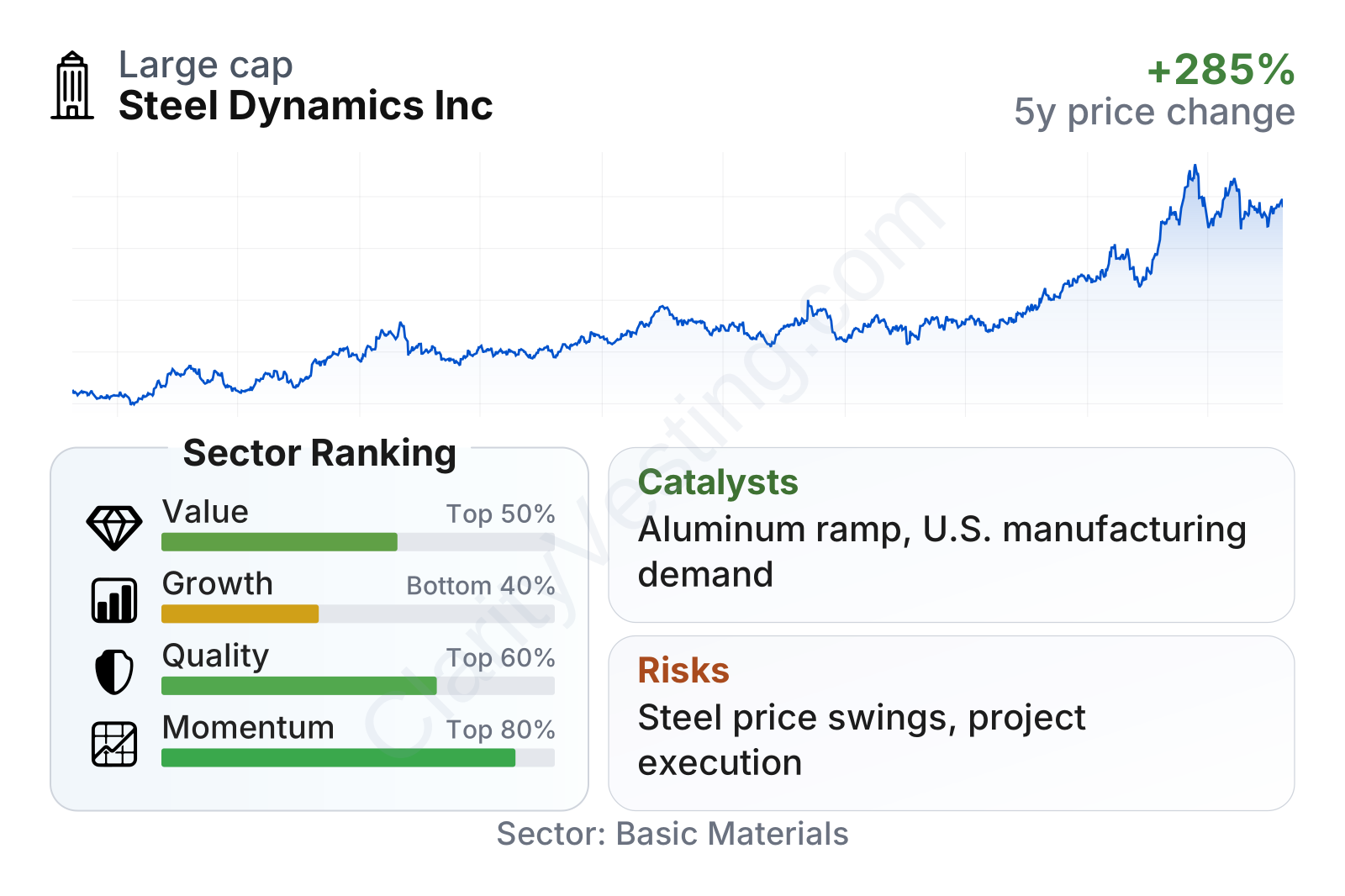
Steel Dynamics is now a large-cap industrial materials company with above-average share price volatility, reflected in a beta near 1.5. On valuation, the picture is mixed: the earnings multiple is close to the sector norm, but the price-to-book ratio is notably richer, suggesting the market places a premium on its asset quality and operating history. Quality metrics remain favorable, with returns on capital and assets above sector medians and interest coverage comfortably strong. Growth metrics are less flattering because current earnings and cash flow are still being compared with unusually strong prior-cycle results, even though recent revenue momentum has improved. Share performance has been strong relative to much of the sector.
Growth
Steel is not a fast-growth industry in the way software or semiconductors are, but parts of the market can still expand meaningfully when a producer gains share, moves into higher-value products, or adds capacity in the right niches. Steel Dynamics has pursued exactly that kind of strategy. It has historically focused on electric arc furnace steelmaking, which is generally more flexible and less carbon-intensive than traditional blast furnace production. That positioning fits a long-term industrial trend toward lower-emissions metal production and greater use of recycled inputs.
Its growth case is less about broad industry expansion and more about execution. The company has been building out higher-value flat roll capacity, coating and finishing capabilities, and aluminum operations. Aluminum is especially notable because it opens another market tied to packaging, automotive, and industrial demand, while also building on Steel Dynamics’ metals recycling expertise. If this platform scales efficiently, it could make the company less dependent on any single steel product line.
Recent sales momentum has improved sharply after a weaker period in 2023 and much of 2024. Year-over-year revenue was negative for several quarters as steel prices normalized from prior peaks, but growth turned positive again and accelerated into 2026, reaching the mid-30% range most recently. That rebound suggests stronger shipment volumes, firmer pricing, new capacity contributions, or a combination of all three. Even so, long-term readers should remember that steel revenue can swing quickly with market conditions.
Cash generation has also been volatile, which is normal for a capital-intensive cyclical producer. Free cash flow was very strong earlier in the cycle, turned negative during a heavier investment and weaker margin phase, and then recovered back into positive territory. That pattern is important: it shows the company still produces meaningful cash, but also that expansion projects and changing working capital can temporarily pressure results. For a long-term view, the key question is whether new assets produce returns above their cost, and Steel Dynamics’ historical return on invested capital suggests a generally disciplined approach.
One of the stronger catalysts in the current setup is U.S. industrial policy and domestic manufacturing investment. Large projects tied to infrastructure, reshoring, energy, and manufacturing construction can support demand for structural steel, flat roll products, and fabricated components. The company’s U.S.-focused footprint is well aligned with that environment. Recent company updates have also pointed to continued progress in its aluminum expansion and value-added steel initiatives, both of which could widen its addressable market over time.
Risks
This article is for informational purposes only and does not constitute financial advice. Some content is AI-generated. See Disclaimer


