Stock Analysis · Scentre Group (STGPF)
Overview
Scentre Group is an Australia-based real estate company focused on large shopping centers under the Westfield brand in Australia and New Zealand. It owns, develops, and operates a portfolio of destination malls that combine retail, dining, entertainment, services, and increasingly mixed-use elements such as office space, residential projects, and digital advertising. For long-term analysis, the key point is that this is not a broad property landlord spread across many formats: it is a concentrated owner of high-quality retail destinations in prime urban markets.
The business makes money mainly from rent and occupancy-related income paid by tenants in its centers. Based on its annual reporting structure, the revenue mix is dominated by recurring property income, while smaller portions come from services and project-related activities tied to managing, developing, and marketing the assets.
- Lease and occupancy income: approximately 80% to 90% of revenue. This includes base rent, percentage rent in some cases, and recoveries tied to the use of retail space by stores, dining venues, entertainment operators, and service providers.
- Property outgoings and recoveries: approximately 5% to 10%. These amounts generally relate to costs passed through to tenants for operating and maintaining the centers.
- Services, media, and other property-related income: approximately 5% to 10%. This can include center management activities, casual mall leasing, brand partnerships, and advertising or promotional income generated within the centers.
What stands out is the operating profile: revenue has climbed from roughly $2.3 billion in 2021 to about $2.7 billion by 2025, while gross profit has also moved higher. The more volatile part of the income statement has been below the operating line, where financing costs and property-related valuation movements can make statutory earnings swing sharply from year to year.
The overall picture is a business with durable top-line cash generation from premium physical retail assets, but one whose reported profit can move around because real estate accounting and interest expense matter a great deal.
Key Figures
| Metric | Value | Sector ⓘ |
|---|---|---|
| Date | Oct 17, 2026 | |
| Context | ||
| Sector | Real Estate | |
| Industry | REIT - Retail | |
| Market Cap ⓘ | $12.42B | |
| Beta ⓘ | 0.90 | |
Value (Cheapness) | ||
| P/E Ratio ⓘ | 9.50 | 17.38 |
| P/B Ratio ⓘ | 0.45 | 0.85 |
| FCF Yield ⓘ | 12.44% | 7.38% |
| Dividend Yield ⓘ | 7.62% | 4.85% |
| EBIT / EV ⓘ | N/A | 3.78% |
| PEG ⓘ | 9.17 | |
Growth (Business expansion) | ||
| Revenue Growth ⓘ | -8.30% | 5.30% |
| RPS Growth (5Y CAGR) ⓘ | 15.09% | 6.02% |
| EPS Growth (5Y CAGR) ⓘ | N/A | -11.37% |
| BVPS Growth (5Y CAGR) ⓘ | 10.04% | 0.45% |
| Margin Growth (5Y Trend) ⓘ | 32.92% | -0.22% |
| FCF Growth (5Y CAGR) ⓘ | N/A | 5.40% |
| DPS Growth (5Y CAGR) ⓘ | 14.97% | 5.02% |
Quality (Business durability) | ||
| ROIC (Latest) ⓘ | N/A | 5.69% |
| ROE (Latest) ⓘ | 16.65% | 7.56% |
| ROA (Latest) ⓘ | 8.88% | 2.85% |
| ROIC (5Y Median) ⓘ | 4.97% | 4.22% |
| ROE (5Y Median) ⓘ | 4.69% | 6.03% |
| ROA (5Y Median) ⓘ | 2.38% | 2.44% |
| Net Debt / EBIT (Latest) ⓘ | N/A | 7.59 |
| Net Debt / EBIT (5Y Median) ⓘ | 8.81 | 8.40 |
| Net Debt / EBITDA (Latest) ⓘ | N/A | 5.27 |
| Net Debt / Assets ⓘ | 39.79% | 37.76% |
| EBITDA / Interest ⓘ | N/A | 4.10 |
| Operating Margin (Latest) ⓘ | N/A | 35.29% |
| Operating Margin (5Y Median) ⓘ | 68.32% | 37.31% |
| Debt to Equity (Latest) ⓘ | 72.42% | 88.87% |
| Profit Margin (Latest) ⓘ | 76.53% | 19.61% |
| Free Cash Flow (Latest) ⓘ | $1.55B | |
Momentum (Price trend) | ||
| 3Y Return ⓘ | +71.41% | +30.75% |
| 12M Return (excl. last month) ⓘ | -0.19% | +4.36% |
| 6M Return ⓘ | +0.21% | -2.52% |
| Price vs. 200-Day MA ⓘ | +8.26% | -2.34% |
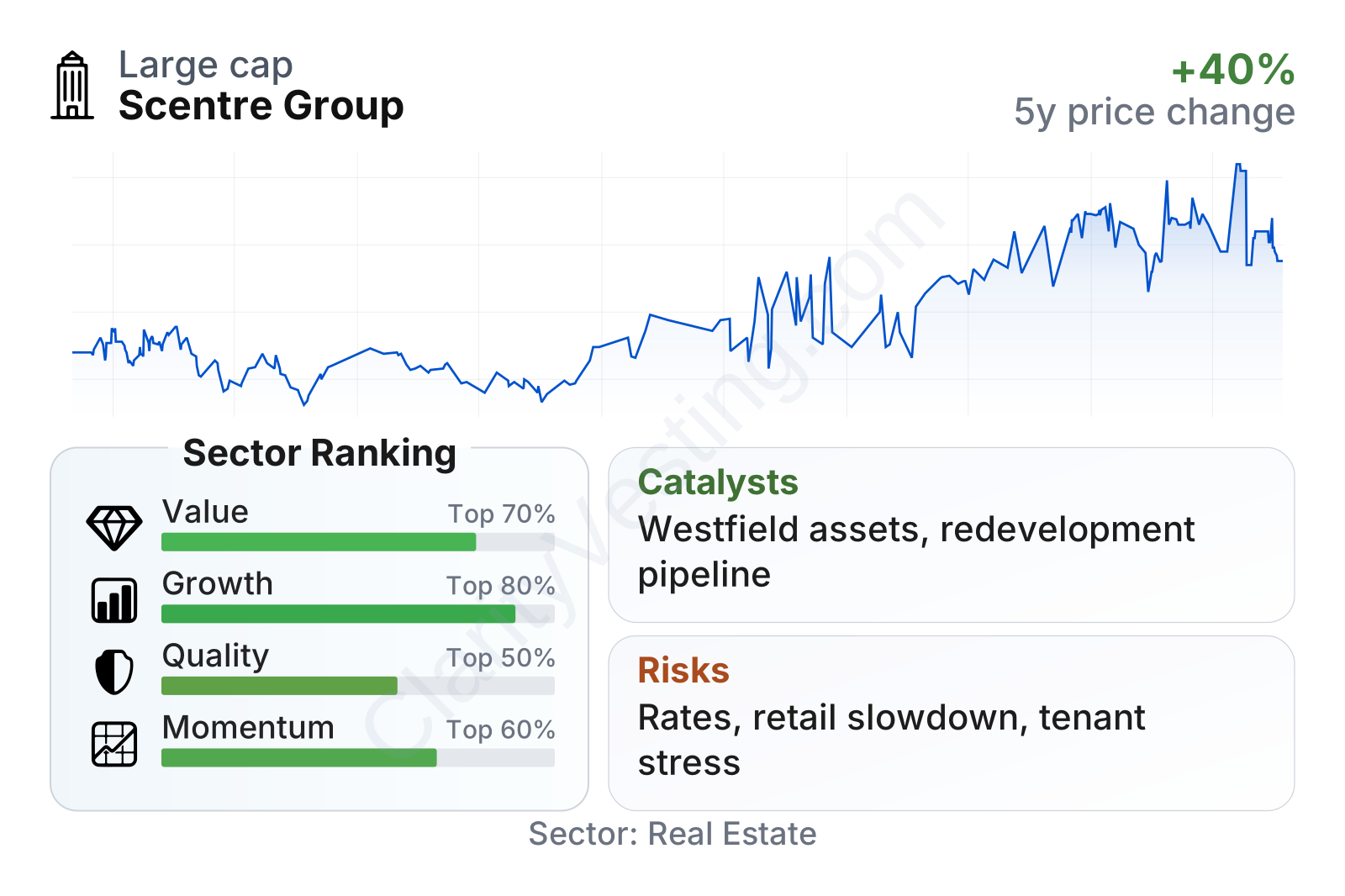
Scentre Group is a large retail REIT with a relatively low share-price volatility profile, as shown by a beta below 1. On valuation, it screens cheaper than the sector on both earnings and book value measures, while its free cash flow yield and dividend yield are above sector medians. Quality is mixed but still solid overall: returns on equity and assets are stronger than many peers, profit margin is unusually high for the group, and debt to equity is below the sector median. Growth indicators look uneven in the short term because recent year-over-year revenue slipped, yet the longer five-year trends in revenue per share, book value per share, margins, and dividends remain notably stronger than the sector. Price performance has also been favorable over multi-year and recent six-month periods, even though the last twelve-month trend has been more subdued.
Growth
Scentre Group operates in a sector that is no longer viewed as a simple secular growth market. Traditional mall real estate faces pressure from e-commerce, changing consumer habits, and occasional retailer failures. However, the higher end of the market has proven more resilient than weaker malls. Prime centers in dense cities still attract strong foot traffic because they function as multi-purpose destinations rather than just shopping venues. That makes Scentre Group’s niche more durable than retail real estate in general.
The company’s strategy for future growth is sensible within that context. Instead of chasing rapid expansion into unfamiliar categories, it has focused on extracting more value from existing flagship assets. That includes redevelopment, remixing tenants toward stronger categories, adding lifestyle and entertainment uses, lifting sales productivity, and using surplus land for mixed-use projects. This approach can support rent growth without relying entirely on opening many new properties.
The longer-term revenue trend per share has been encouraging. Even with some short-term fluctuations, the broader direction over the last five years points to stronger monetization of the portfolio and better operating performance than the typical retail REIT in its sector.
The dividend pattern also suggests a recovery and normalization after earlier disruption. There was a visible dip, but the latest level is materially above prior years, which fits with stronger cash generation and a more stable operating environment for major shopping centers.
One of the clearest catalysts is the quality of the underlying portfolio. Westfield-branded centers tend to attract premium tenants and high customer volumes, which can support leasing spreads, specialty sales, and occupancy. Another catalyst is redevelopment: adding offices, apartments, hotels, health services, or entertainment around successful malls can raise the value of land that may be underused in a purely retail format. A further support is that physical retail has been regaining relevance in categories where experience, convenience, and immediate fulfillment matter.
Recent company reporting has also pointed to continued operational momentum in leasing and asset performance, with management emphasizing the strength of its destination centers and development pipeline. For a landlord like Scentre Group, this matters because modest improvements in occupancy, tenant mix, and rent can flow through meaningfully when the asset base is large.
Risks
This article is for informational purposes only and does not constitute financial advice. Some content is AI-generated. See Disclaimer


