Stock Analysis · STERIS plc (STE)
Overview
STERIS plc is a healthcare company focused on infection prevention, contamination control, and surgical support. In simple terms, it helps hospitals, laboratories, pharmaceutical manufacturers, and medical device companies keep instruments, facilities, and products clean, sterile, and ready for use. Its business sits in a part of healthcare that is essential rather than optional: surgeries, sterilization, and regulated production processes still need to happen in strong and weak economic environments.
The company reports revenue through three main segments. Based on its latest annual reporting for fiscal 2026, the mix is approximately:
- Healthcare – about 57%: sterilizers, washers, surgical tables and lights, endoscopy support, consumables, maintenance, and other services used mainly by hospitals and outpatient care providers.
- Applied Sterilization Technologies – about 24%: outsourced sterilization and laboratory testing services for medical device and pharmaceutical customers.
- Life Sciences – about 19%: contamination control products, sterilization systems, cleanroom and bioprocess support, and related services for pharmaceutical, biotech, and research customers.
This is a diversified model inside a specialized niche. STERIS earns money not only from equipment sales, but also from recurring sources such as consumables, service contracts, and outsourced sterilization work. That matters because recurring revenue tends to make results steadier over time than a business that depends only on large one-time equipment purchases.
The business mix has also been improving in scale. Over the last several years, revenue has moved materially higher, while operating income and net income have grown faster than sales. Interest expense has fallen at the same time, which suggests that earlier acquisition-related balance sheet pressure has eased.
Key Figures
| Metric | Value | Sector ⓘ |
|---|---|---|
| Date | Oct 24, 2026 | |
| Context | ||
| Sector | Healthcare | |
| Industry | Medical Devices | |
| Market Cap ⓘ | $21.59B | |
| Beta ⓘ | 0.93 | |
Value (Cheapness) | ||
| P/E Ratio ⓘ | 27.51 | 25.42 |
| P/B Ratio ⓘ | 3.16 | 3.08 |
| FCF Yield ⓘ | 4.29% | 3.12% |
| Dividend Yield ⓘ | 1.12% | 1.85% |
| EBIT / EV ⓘ | 5.20% | 0.56% |
| PEG ⓘ | 1.74 | |
Growth (Business expansion) | ||
| Revenue Growth ⓘ | 7.30% | 7.50% |
| RPS Growth (5Y CAGR) ⓘ | 8.78% | 8.60% |
| EPS Growth (5Y CAGR) ⓘ | -28.07% | -17.73% |
| BVPS Growth (5Y CAGR) ⓘ | 2.26% | 3.72% |
| Margin Growth (5Y Trend) ⓘ | 7.86% | -0.57% |
| FCF Growth (5Y CAGR) ⓘ | 25.08% | 0.96% |
| DPS Growth (5Y CAGR) ⓘ | 10.23% | 6.69% |
Quality (Business durability) | ||
| ROIC (Latest) ⓘ | 9.35% | 3.17% |
| ROA (Latest) ⓘ | 7.61% | 2.98% |
| ROIC (5Y Median) ⓘ | 10.65% | 4.56% |
| ROA (5Y Median) ⓘ | 3.46% | 1.87% |
| Net Debt / EBIT (Latest) ⓘ | 1.37 | 1.34 |
| Net Debt / EBIT (5Y Median) ⓘ | 3.46 | 1.86 |
| Net Debt / EBITDA (Latest) ⓘ | 0.96 | 1.00 |
| Net Debt / Assets ⓘ | 14.55% | 5.06% |
| EBITDA / Interest ⓘ | 26.90 | 9.55 |
| Operating Margin (Latest) ⓘ | 18.87% | 9.25% |
| Operating Margin (5Y Median) ⓘ | 16.49% | 7.33% |
| Debt to Equity (Latest) ⓘ | 28.37% | 26.68% |
| Profit Margin (Latest) ⓘ | 13.33% | 3.34% |
| Free Cash Flow (Latest) ⓘ | $925.60M | |
Momentum (Price trend) | ||
| 3Y Return ⓘ | +11.49% | +51.61% |
| 12M Return (excl. last month) ⓘ | -15.46% | +19.90% |
| 6M Return ⓘ | +4.51% | +10.10% |
| Price vs. 200-Day MA ⓘ | +3.38% | +6.44% |
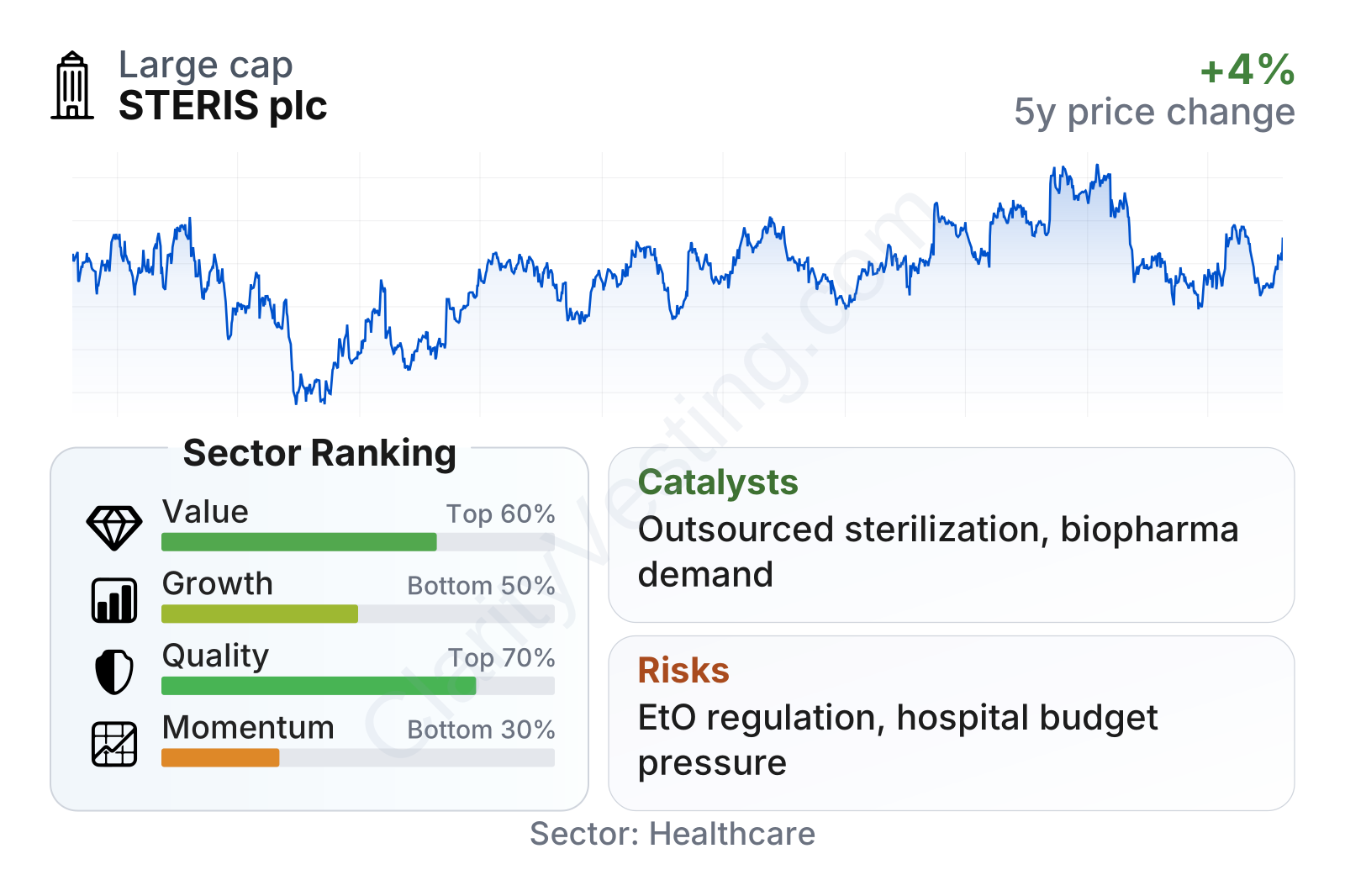
STERIS is a large healthcare equipment and services company with relatively low share-price volatility, as reflected by a beta below 1. On valuation, it sits close to the healthcare sector median on earnings, while free cash flow yield and EBIT relative to enterprise value look stronger than many peers. Quality measures are one of the company’s better areas: returns on capital and assets are comfortably above sector medians, margins are clearly stronger than the typical healthcare name, and debt levels are now near sector norms rather than stretched. The weakest area is recent share-price momentum, which has lagged the sector even as the underlying business has continued to produce solid cash flow.
Growth
STERIS operates in parts of healthcare that benefit from durable long-term demand. More surgeries, aging populations, stricter infection-control standards, growth in outpatient procedures, and continued investment in pharmaceutical and biotech manufacturing all support the need for sterilization and contamination-control solutions. These are not fashionable markets, but they are structurally important and difficult to remove from the healthcare system.
The company’s strategy also makes sense for long-range expansion because it combines equipment, service, consumables, and outsourced processing. That creates multiple ways to grow with the same customer. A hospital may first buy sterilization equipment, then add maintenance and consumables. A medical device company may rely on recurring outsourced sterilization. A pharmaceutical manufacturer may need cleanroom and contamination-control support as production capacity grows. This broad relationship model can deepen customer ties and support repeat revenue.
Recent growth has normalized after the large swings tied to acquisitions and post-pandemic comparisons, but the current pattern still points to a healthy business. Year-over-year revenue growth has recently been running in the high-single-digit range, which is broadly in line with the sector median. That is not hypergrowth, yet it is meaningful for a company operating in mature but essential healthcare infrastructure categories.
Cash generation is an important positive point. Free cash flow has risen sharply over the last few years and is now close to $1 billion on a trailing basis. That trend is especially useful because it gives the company flexibility to invest, pursue bolt-on acquisitions, reduce debt, and continue increasing its dividend. Over five years, free cash flow growth has been far stronger than the sector median, which helps offset a less impressive earnings-per-share growth record distorted by earlier integration and financing effects.
A visible catalyst is the continued expansion of outsourced sterilization demand. Many medical device manufacturers prefer specialized external providers rather than building every capability in-house, especially when regulatory standards are strict and scale matters. STERIS is well positioned here through its global sterilization network. Another catalyst is ongoing demand from biopharma and life sciences customers, where contamination control remains a critical operational requirement.
Recent company reporting also points to progress in margin expansion and improved profitability, which can be just as important as revenue growth. When a business can combine modest top-line growth with better margins, earnings and cash flow often improve at a faster pace than sales alone.
Risks
This article is for informational purposes only and does not constitute financial advice. Some content is AI-generated. See Disclaimer


