Stock Analysis · Stewart Information Services Corp (STC)
Overview
Stewart Information Services Corp is a real-estate transaction company best known for title insurance. When a home or commercial property is bought, sold, or refinanced, Stewart helps verify ownership records, identify liens or legal issues, and insure the parties involved against defects in title. The company also provides closing and settlement services, mortgage-related services, and a growing set of technology tools for real-estate professionals, lenders, and other industry participants.
Its business is closely tied to property transaction activity. That means revenue tends to rise when housing turnover, refinancing, and commercial real-estate deals are healthy, and it tends to weaken when mortgage rates are high or deal volumes slow. Stewart operates mainly in the United States, with a mix of direct operations and agency relationships.
Based on recent company reporting, Stewart’s main revenue sources are concentrated in its title segment, with a much smaller contribution from ancillary real-estate services.
- Title insurance and related title services: approximately 90% to 95%. This includes title policies, escrow and closing services, search, examination, and other services tied to residential and commercial real-estate transactions.
- Ancillary services: approximately 5% to 10%. This includes valuation, default-related services, appraisal management, credit and other mortgage services, and technology-enabled offerings supporting lenders and real-estate workflows.
The recent financial pattern shows a business that was hit hard by the housing slowdown in 2022 and 2023, then began rebuilding. Revenue and earnings improved in 2024 and again in 2025, but margins remained below earlier-cycle highs, which is important for judging the company’s longer-term earnings power.
The profit flow illustrates that revenue has recovered from the 2023 trough, but selling and administrative costs still absorb a large share of sales. That helps explain why net income has improved meaningfully from the low point without yet returning to the stronger levels seen earlier in the cycle.
Key Figures
| Metric | Value | Sector ⓘ |
|---|---|---|
| Date | Oct 17, 2026 | |
| Context | ||
| Sector | Financial Services | |
| Industry | Insurance - Property & Casualty | |
| Market Cap ⓘ | $1.55B | |
| Beta ⓘ | 1.05 | |
Value (Cheapness) | ||
| P/E Ratio ⓘ | 11.15 | 12.26 |
| P/B Ratio ⓘ | 0.97 | 1.23 |
| FCF Yield ⓘ | 9.69% | 10.40% |
| Dividend Yield ⓘ | 4.12% | 3.02% |
| EBIT / EV ⓘ | 8.71% | 8.14% |
| PEG ⓘ | 3.71 | |
Growth (Business expansion) | ||
| Revenue Growth ⓘ | 24.30% | 9.35% |
| RPS Growth (5Y CAGR) ⓘ | -4.64% | 12.19% |
| EPS Growth (5Y CAGR) ⓘ | -25.62% | -9.53% |
| BVPS Growth (5Y CAGR) ⓘ | -7.87% | 4.99% |
| Margin Growth (5Y Trend) ⓘ | -7.11% | -3.86% |
| FCF Growth (5Y CAGR) ⓘ | -21.62% | 4.81% |
| DPS Growth (5Y CAGR) ⓘ | 10.55% | 8.79% |
Quality (Business durability) | ||
| ROIC (Latest) ⓘ | 7.52% | 9.49% |
| ROE (Latest) ⓘ | 8.64% | 13.90% |
| ROA (Latest) ⓘ | 4.39% | 1.55% |
| ROIC (5Y Median) ⓘ | 6.86% | 7.86% |
| ROE (5Y Median) ⓘ | 7.64% | 12.17% |
| ROA (5Y Median) ⓘ | 3.86% | 1.30% |
| Net Debt / EBIT (Latest) ⓘ | 2.41 | 0.96 |
| Net Debt / EBIT (5Y Median) ⓘ | 2.48 | 0.73 |
| Net Debt / EBITDA (Latest) ⓘ | 1.84 | 0.92 |
| Operating Margin (Latest) ⓘ | 6.47% | 22.30% |
| Operating Margin (5Y Median) ⓘ | 6.17% | 24.63% |
| Debt to Equity (Latest) ⓘ | 46.35% | 58.56% |
| Profit Margin (Latest) ⓘ | 4.12% | 26.57% |
| Free Cash Flow (Latest) ⓘ | $149.97M | |
Momentum (Price trend) | ||
| 3Y Return ⓘ | +34.24% | +88.33% |
| 12M Return (excl. last month) ⓘ | -7.84% | +19.38% |
| 6M Return ⓘ | -19.06% | +4.75% |
| Price vs. 200-Day MA ⓘ | -19.98% | +3.50% |
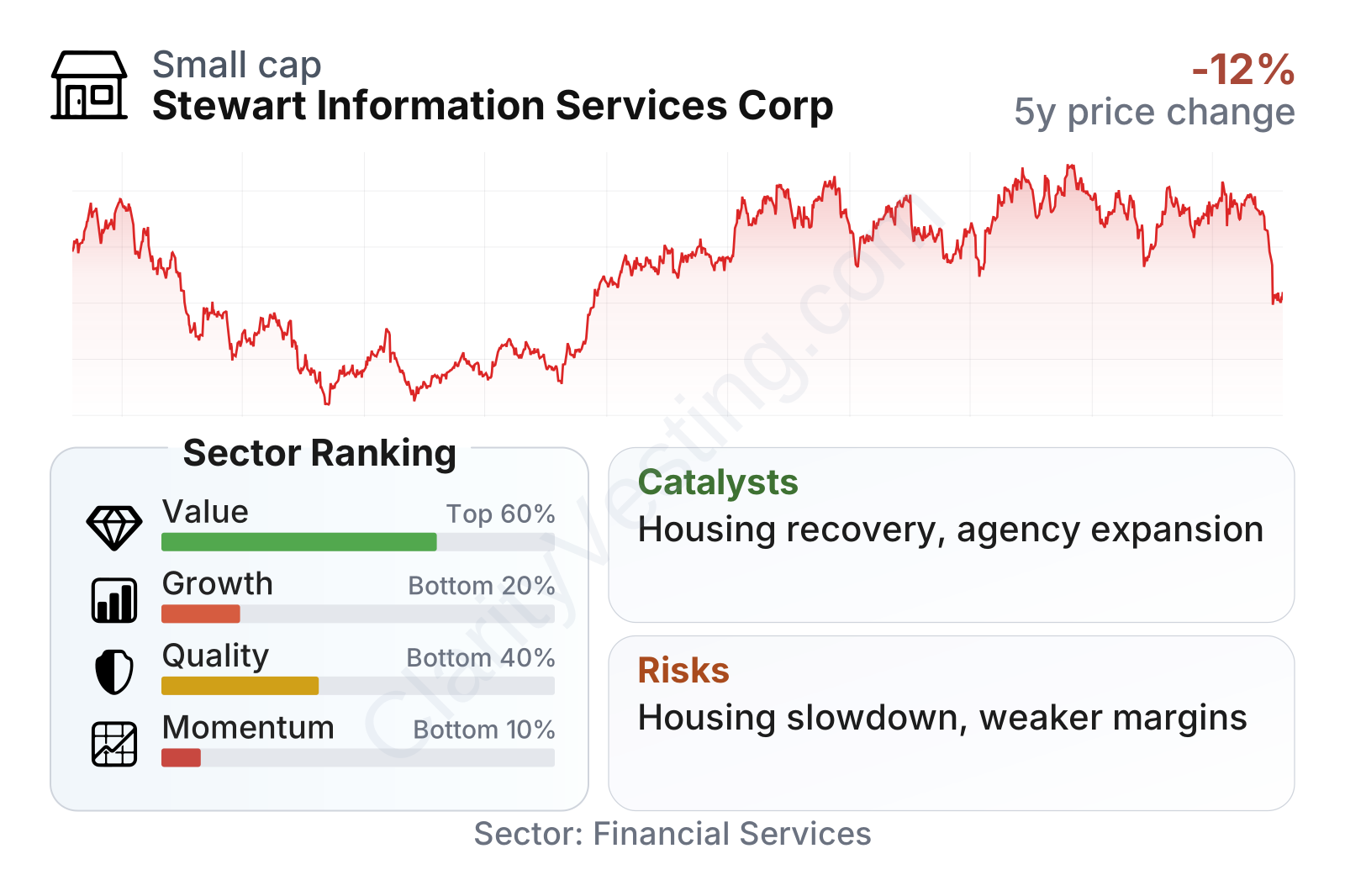
Stewart is a mid-sized financial-services company with a market value around the low single-digit billions of dollars and a share-price volatility close to the broader market. The current profile is mixed: valuation looks roughly in line to slightly below the sector on earnings and book value, the dividend yield is above the sector median, and cash generation is solid. The weaker side is growth quality over a five-year view, where earnings, book value per share, and free cash flow have been inconsistent. Share-price momentum has also lagged, reflecting that the market is still treating the recovery with some caution.
Growth
Stewart operates in a sector that is not a structural high-growth industry in the usual sense, but it can still produce meaningful growth when real-estate transactions recover. Title insurance benefits from basic long-term drivers such as household formation, housing turnover, migration, and commercial property activity. In the shorter term, the biggest variable is interest rates: lower or more stable rates can stimulate home sales and refinancing, which directly supports order volumes.
The company’s strategy appears sensible for this type of business. Stewart has been expanding its agency network, strengthening commercial title capabilities, and investing in technology to improve efficiency and customer workflow integration. That matters because title insurance is partly a scale business: underwriters that can spread compliance, technology, and operating costs across larger transaction volumes usually have more resilience through the cycle.
There is also a case for measured market-share progress. Stewart is smaller than the largest title underwriters, so it still has room to expand with independent agents, lenders, and commercial clients if execution remains steady. In periods when transaction volume improves, even moderate share gains can have an outsized effect on earnings because a meaningful part of the cost base is fixed.
Earnings per share show how cyclical the business is. After a very strong 2021, profits dropped sharply during the housing downturn, then began recovering in 2024 and 2025. That rebound is encouraging, but the earlier decline was deep enough that the company still needs stronger and more durable margin improvement to demonstrate a full-cycle growth profile.
Book value per share fell materially from 2021 levels and then stabilized before improving again. That pattern suggests the balance-sheet base has been rebuilding, but not in a smooth compounding way. For a title insurer, book value matters because it reflects capital strength and the company’s ability to support underwriting activity over time.
One recent opportunity to watch is the broader normalization of housing activity after the rate shock of the last few years. If mortgage conditions become more supportive and commercial transactions continue to recover, Stewart could benefit from both higher volumes and better operating leverage. Continued technology rollout and agency channel expansion could add a second layer of growth beyond the market backdrop itself.
Risks
This article is for informational purposes only and does not constitute financial advice. Some content is AI-generated. See Disclaimer


