Stock Analysis · Strabag SE (STBBF)
Overview
Strabag SE is a large European construction and infrastructure group. It plans, builds, and in some cases operates projects across building construction, civil engineering, transportation infrastructure, and specialized services. Its work includes roads, rail, tunnels, bridges, offices, housing, industrial sites, and environmental or utility-related projects. The company is especially active in German-speaking Europe and Central and Eastern Europe, with additional exposure to other international markets.
Its revenue base is diversified across construction activities rather than depending on one narrow niche. Based on recent annual reporting, the main sources of revenue are approximately:
- Building construction and civil engineering: about 55% to 65% of revenue. This includes residential, commercial, industrial, and public-sector buildings as well as structural engineering projects.
- Transportation infrastructure: about 20% to 30%. This typically covers roads, highways, rail infrastructure, asphalt, and related transport networks.
- Special divisions and other services: about 10% to 20%. This can include tunneling, environmental engineering, real estate-related activities, building services, and concession or infrastructure support activities.
Geographically, Strabag is heavily tied to Europe, which matters because public infrastructure budgets, housing activity, and industrial investment in the region strongly influence results. The business model is built around a large order backlog and multi-year project execution, which can provide visibility but also exposes the company to cost overruns and project timing swings.
Over the last several years, revenue has moved upward overall, while earnings have been more variable, which is normal in construction. A notable positive trend is that net income and operating income improved meaningfully by 2024 and remained solid into 2025, while interest expense stayed relatively modest. That combination suggests that recent profitability has come more from better operating execution than from aggressive leverage.
Key Figures
| Metric | Value | Sector ⓘ |
|---|---|---|
| Date | Oct 24, 2026 | |
| Context | ||
| Sector | Industrials | |
| Industry | Engineering & Construction | |
| Market Cap ⓘ | $14.15B | |
| Beta ⓘ | 0.41 | |
Value (Cheapness) | ||
| P/E Ratio ⓘ | 12.56 | 22.29 |
| P/B Ratio ⓘ | 2.53 | 1.98 |
| FCF Yield ⓘ | 8.04% | 6.26% |
| Dividend Yield ⓘ | 2.43% | 1.92% |
| EBIT / EV ⓘ | N/A | 4.83% |
| PEG ⓘ | N/A | |
Growth (Business expansion) | ||
| Revenue Growth ⓘ | 15.00% | 9.30% |
| RPS Growth (5Y CAGR) ⓘ | 1.50% | 7.76% |
| EPS Growth (5Y CAGR) ⓘ | 18.27% | -13.17% |
| BVPS Growth (5Y CAGR) ⓘ | 4.87% | 6.13% |
| Margin Growth (5Y Trend) ⓘ | 0.38% | 0.74% |
| FCF Growth (5Y CAGR) ⓘ | 10.46% | 10.79% |
| DPS Growth (5Y CAGR) ⓘ | -26.13% | 9.41% |
Quality (Business durability) | ||
| ROIC (Latest) ⓘ | N/A | 10.75% |
| ROA (Latest) ⓘ | 5.97% | 5.41% |
| ROIC (5Y Median) ⓘ | 9.39% | 9.37% |
| ROA (5Y Median) ⓘ | 4.81% | 4.95% |
| Net Debt / EBIT (Latest) ⓘ | -3.20 | 2.04 |
| Net Debt / EBIT (5Y Median) ⓘ | -3.52 | 2.27 |
| Net Debt / EBITDA (Latest) ⓘ | -1.90 | 1.39 |
| Net Debt / Assets ⓘ | -17.63% | 19.27% |
| EBITDA / Interest ⓘ | N/A | 9.58 |
| Operating Margin (Latest) ⓘ | 4.94% | 10.49% |
| Operating Margin (5Y Median) ⓘ | 4.49% | 10.30% |
| Debt to Equity (Latest) ⓘ | 8.64% | 64.82% |
| Profit Margin (Latest) ⓘ | 4.72% | 6.67% |
| Free Cash Flow (Latest) ⓘ | $1.14B | |
Momentum (Price trend) | ||
| 3Y Return ⓘ | +329.84% | +67.77% |
| 12M Return (excl. last month) ⓘ | +21.34% | +12.05% |
| 6M Return ⓘ | +16.92% | 0.00% |
| Price vs. 200-Day MA ⓘ | +15.52% | +0.67% |
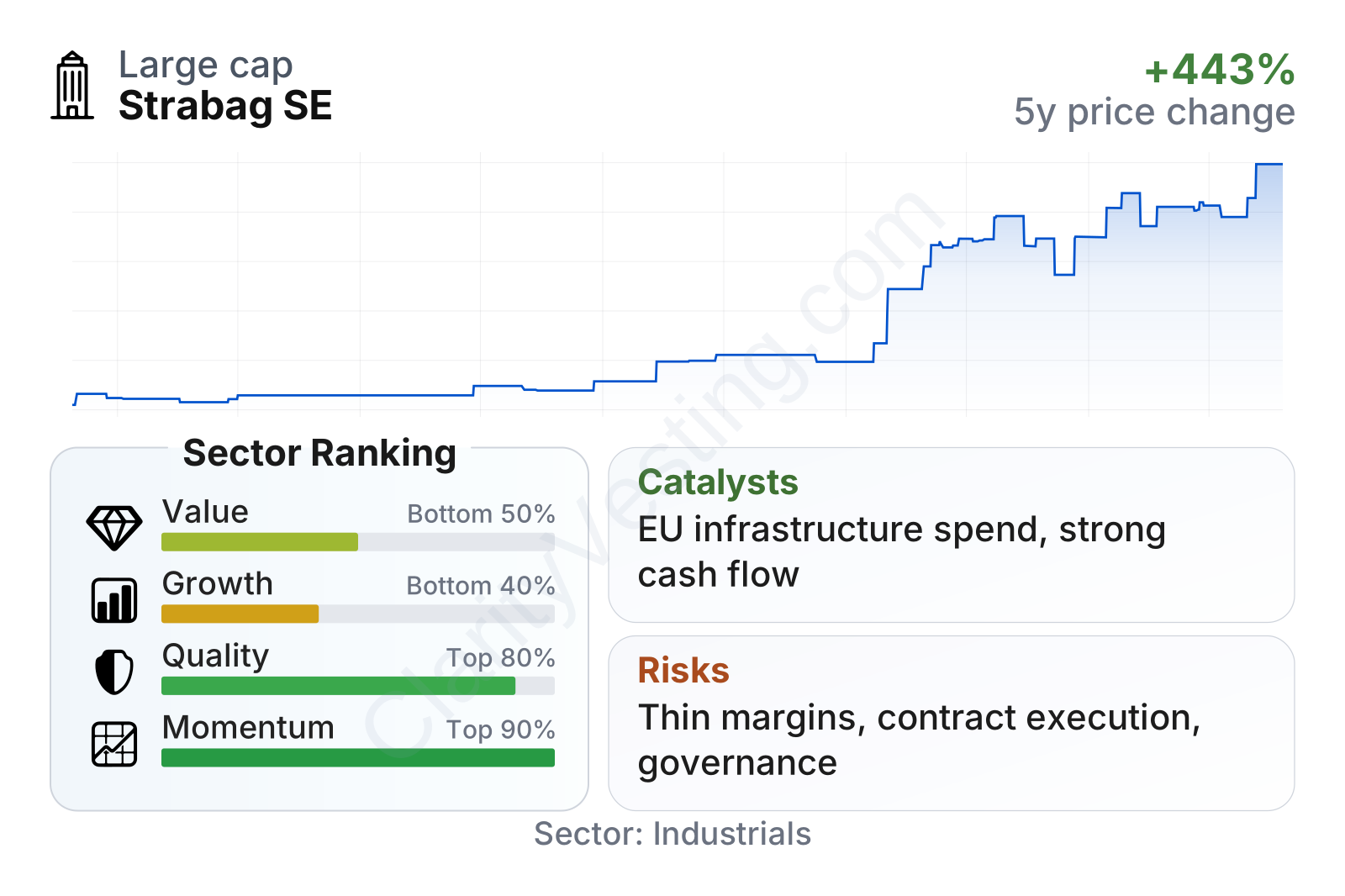
Strabag sits in the large-cap range for its niche and has had an unusually strong share-price run over the last three years, far ahead of the broader sector. At the same time, the stock still screens as inexpensive on earnings versus the sector median, while free cash flow yield and dividend yield are also above typical sector levels. Quality indicators are helped by a very conservative balance sheet, including low debt and a net cash position, although operating and profit margins remain below many industrial peers.
Growth measures are more mixed than the recent price performance may suggest. Near-term revenue growth has been healthy, but longer-term revenue per share growth has been more modest, which fits the profile of a mature construction group rather than a high-growth industrial compounder.
Growth
Construction is not a classic high-growth industry, but several parts of Strabag’s end markets have favorable long-term support. Europe needs ongoing investment in transport networks, energy systems, public infrastructure, environmental remediation, and building renovation. These themes can create durable demand even when private real estate cycles are uneven.
Strabag’s strategy makes sense for this environment because it is broad rather than narrowly concentrated. A contractor with capabilities across roads, rail, buildings, tunneling, and specialized engineering is better positioned to capture public works and large integrated projects. Scale also matters in procurement, staffing, and bidding for technically complex contracts.
Recent revenue momentum looks stronger than the company’s longer-term average. That is encouraging, but it should be viewed in context: construction growth often comes in waves tied to project awards, public budgets, and weather-related execution timing. For long-term analysis, the more important point is whether revenue converts into cash and acceptable margins.
Free cash flow is a notable bright spot. The company is generating cash at a level that stands out positively for the sector, which is important because accounting profits in construction can sometimes be less informative than actual cash generation. Strong cash production gives management more flexibility for dividends, selective investment, and resilience during softer markets.
One practical catalyst is Europe’s continued infrastructure modernization, including rail, transport corridors, energy-related works, and public building upgrades. Another is the push for renovation and more efficient buildings, which can support demand even when new private development slows. The company’s large operating footprint across multiple European countries also reduces dependence on a single local cycle.
Recent corporate developments have also kept attention on Strabag because changes in ownership structure and the disposal of previously restricted shares can improve trading liquidity and remove an overhang that had complicated the equity narrative. That does not change the construction business itself, but it can affect how the market values the company over time.
Risks
This article is for informational purposes only and does not constitute financial advice. Some content is AI-generated. See Disclaimer


