Stock Analysis · SSR Mining Inc (SSRM)
Overview
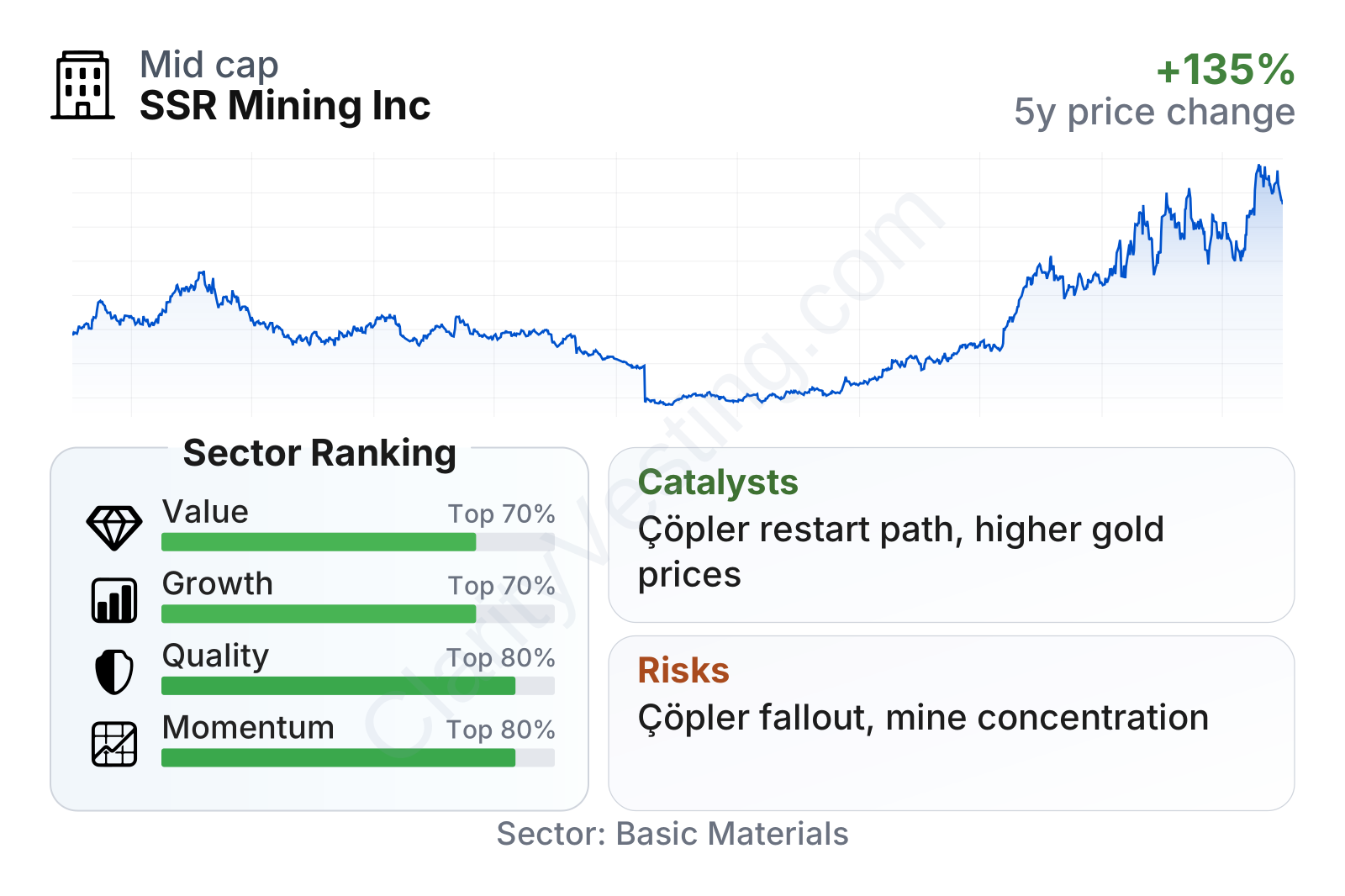
SSR Mining Inc is a precious-metals producer focused mainly on gold, with additional revenue from silver, lead, and zinc. The company operates mines and development assets across the Americas and Turkey. In practical terms, it digs ore out of the ground, processes it, and sells refined metal or metal-bearing concentrate to commercial buyers. That makes SSR Mining highly exposed to metal prices, mine performance, and operating discipline.
Its revenue mix changes from year to year depending on production levels and the prices of each metal, but gold is clearly the dominant source. Based on the company’s recent reporting profile, the business can be understood this way:
- Gold: about 80% to 90% of revenue. This comes primarily from the Marigold mine in Nevada and Çöpler in Türkiye, with additional contribution from Seabee in Canada when operating normally.
- Silver: about 5% to 10% of revenue. This is mainly linked to the Puna operation in Argentina, which is centered on silver production.
- Lead and zinc: about 3% to 8% of revenue. These are by-products, mainly sold from Puna as concentrate alongside silver-related output.
Geographically, SSR Mining is diversified compared with a single-mine operator, but it is still a relatively concentrated miner because a few core assets drive most of its economic value. That concentration matters: when one large mine underperforms, the effect on revenue, profit, and market sentiment can be significant.
The financial flow over the last several years also shows how cyclical the business can be. Revenue and gross profit recovered strongly in 2025 after a weak 2024, while operating income and net income swung from losses back to healthy profits. That pattern is common in mining, where production interruptions, remediation costs, and changing metal prices can sharply move results from one year to the next.
Key Figures
| Metric | Value | Sector ⓘ |
|---|---|---|
| Date | Oct 03, 2026 | |
| Context | ||
| Sector | Basic Materials | |
| Industry | Gold | |
| Market Cap ⓘ | $6.92B | |
| Beta ⓘ | 0.98 | |
Value (Cheapness) | ||
| P/E Ratio ⓘ | 12.71 | 17.61 |
| P/B Ratio ⓘ | 2,054.93 | 1.77 |
| FCF Yield ⓘ | 5.01% | 5.87% |
| Dividend Yield ⓘ | 0.09% | 2.06% |
| EBIT / EV ⓘ | 14.68% | 6.43% |
| PEG ⓘ | 0.02 | |
Growth (Business expansion) | ||
| Revenue Growth ⓘ | 9.50% | 11.30% |
| RPS Growth (5Y CAGR) ⓘ | 4.29% | 4.46% |
| EPS Growth (5Y CAGR) ⓘ | 31.42% | -13.11% |
| BVPS Growth (5Y CAGR) ⓘ | -1.60% | 5.51% |
| Margin Growth (5Y Trend) ⓘ | -1.37% | -1.57% |
| FCF Growth (5Y CAGR) ⓘ | -13.74% | 0.55% |
| DPS Growth (5Y CAGR) ⓘ | N/A | 6.02% |
Quality (Business durability) | ||
| ROIC (Latest) ⓘ | 18.20% | 9.31% |
| ROA (Latest) ⓘ | 9.07% | 4.94% |
| ROIC (5Y Median) ⓘ | 5.84% | 7.91% |
| ROA (5Y Median) ⓘ | 3.71% | 3.93% |
| Net Debt / EBIT (Latest) ⓘ | -0.00 | 1.40 |
| Net Debt / EBIT (5Y Median) ⓘ | -1.22 | 1.70 |
| Net Debt / EBITDA (Latest) ⓘ | -0.00 | 0.91 |
| Net Debt / Assets ⓘ | -39.52% | 13.69% |
| EBITDA / Interest ⓘ | 109.00 | 11.93 |
| Operating Margin (Latest) ⓘ | 42.39% | 13.07% |
| Operating Margin (5Y Median) ⓘ | 22.64% | 11.86% |
| Debt to Equity (Latest) ⓘ | 2.71% | 40.43% |
| Profit Margin (Latest) ⓘ | 12.30% | 6.57% |
| Free Cash Flow (Latest) ⓘ | $346.73M | |
Momentum (Price trend) | ||
| 3Y Return ⓘ | +152.45% | +65.06% |
| 12M Return (excl. last month) ⓘ | +94.95% | +36.05% |
| 6M Return ⓘ | +13.44% | +1.89% |
| Price vs. 200-Day MA ⓘ | +13.66% | +1.03% |
SSR Mining sits in the mid-sized range for public mining companies and has shown a strong stock-price rebound after the severe drop seen in 2024. The broader picture from the latest metrics is mixed but improving: profitability and balance-sheet quality look stronger than much of the sector, while growth measures are less consistent because recent results are rebounding from a disrupted period rather than following a smooth upward path. Valuation measures also point to a business that is not being priced like a high-growth company, even after the recovery in the share price.
Growth
Gold mining is part of a mature industry, but the sector can still offer long-term growth when companies extend mine lives, bring suspended assets back into production, and benefit from stronger metal prices. For SSR Mining, the main growth question is not whether gold demand will suddenly surge, but whether the company can restore stable production and convert higher gold prices into cash flow. In that sense, it operates in a sector with durable relevance: gold remains important for jewelry, central-bank reserves, and as a store of value during periods of inflation, geopolitical stress, or financial uncertainty.
SSR Mining’s strategy makes industrial sense. The company already owns producing assets, has operational experience across several jurisdictions, and entered 2026 with a very light debt load. That gives it more flexibility than many peers. The most important medium-term growth lever is the normalization of its asset base after the disruption tied to Çöpler. If that mine returns in a durable and well-regulated way, the company’s production profile could look materially stronger than it did during the downturn.
Revenue growth has been highly volatile rather than steady. There was a sharp contraction through 2024, followed by a powerful rebound in 2025 and continued year-over-year growth into 2026, though at a slower pace more recently. That suggests the business is moving out of a stressed phase, but it also shows why SSR Mining cannot be evaluated like a predictable industrial company with smooth annual expansion.
Cash generation has also improved meaningfully. Free cash flow turned strongly positive again by 2026 after swinging between positive and negative territory in prior periods. That matters because cash flow is what funds remediation, sustaining capital, exploration, and any future capital returns without relying heavily on debt or equity issuance. A miner with recovering free cash flow and almost no net debt has more room to absorb setbacks than one already financially stretched.
A major catalyst has been the much stronger gold-price environment. When gold prices rise, producers with operating mines often see a disproportionate impact on earnings and cash flow because many operating costs do not increase as fast as revenue. Another catalyst is any regulatory progress, operational restart planning, or reserve-life improvement at key assets. Exploration success near existing mines can also be valuable because it is usually cheaper to add ounces near infrastructure already in place than to build an entirely new mine.
Risks
This article is for informational purposes only and does not constitute financial advice. Some content is AI-generated. See Disclaimer