Stock Analysis · Swiss Re Ltd (SSREY)
Overview
Swiss Re is one of the world’s largest reinsurance groups. Reinsurance is insurance for insurance companies: when primary insurers want to reduce the financial impact of large claims such as hurricanes, earthquakes, industrial accidents, health claims, or mortality shocks, they transfer part of that risk to groups like Swiss Re. The company also provides corporate insurance through its commercial insurance arm and offers insurance-linked services and risk knowledge to help clients price and manage complex exposures.
Its business is broadly diversified across property and casualty reinsurance, life and health reinsurance, and corporate solutions. That matters because demand drivers are not identical across these activities: natural catastrophe protection depends on weather losses and pricing cycles, life and health depends more on mortality, morbidity, and aging trends, while commercial insurance follows corporate risk spending and underwriting discipline.
Based on Swiss Re’s recent reporting structure, the main sources of revenue and insurance service result are approximately:
- Property & Casualty Reinsurance: about 50% to 55%. This is the largest activity and includes protection against natural catastrophes, specialty risks, casualty lines, and other non-life exposures ceded by insurers.
- Life & Health Reinsurance: about 25% to 30%. This segment covers mortality, longevity, disability, and health-related risks for insurers and pension-related clients.
- Corporate Solutions: about 15% to 20%. This unit writes commercial insurance for large and mid-sized companies, including property, liability, engineering, and specialty lines.
- Other activities and investment-related items: generally a small remainder. These include administrative items, internal allocations, and contributions tied to the investment portfolio and group functions.
One of the clearest features of Swiss Re’s model is that earnings depend not only on underwriting discipline but also on investment income from the large pool of assets backing insurance liabilities. In recent years, the company has combined firmer reinsurance pricing with stronger recurring investment income, which helped profit recover after a weaker 2022.
The multi-year income flow shows a business that remained very large and relatively stable in revenue, but with profits that were much more cyclical. The key improvement since 2022 has been a strong rebound in net income and operating income, suggesting better underwriting conditions and more favorable portfolio economics rather than simple top-line expansion alone.
Key Figures
| Metric | Value | Sector ⓘ |
|---|---|---|
| Date | Oct 03, 2026 | |
| Context | ||
| Sector | Financial Services | |
| Industry | Insurance - Reinsurance | |
| Market Cap ⓘ | $48.97B | |
| Beta ⓘ | 0.35 | |
Value (Cheapness) | ||
| P/E Ratio ⓘ | 10.09 | 12.60 |
| P/B Ratio ⓘ | 2.04 | 1.23 |
| FCF Yield ⓘ | 12.20% | 10.16% |
| Dividend Yield ⓘ | 4.86% | 2.96% |
| EBIT / EV ⓘ | N/A | 7.77% |
| PEG ⓘ | 0.79 | |
Growth (Business expansion) | ||
| Revenue Growth ⓘ | -5.20% | 9.50% |
| RPS Growth (5Y CAGR) ⓘ | 0.45% | 12.10% |
| EPS Growth (5Y CAGR) ⓘ | N/A | -9.45% |
| BVPS Growth (5Y CAGR) ⓘ | 0.66% | 5.01% |
| Margin Growth (5Y Trend) ⓘ | 8.28% | -4.07% |
| FCF Growth (5Y CAGR) ⓘ | -7.26% | 4.96% |
| DPS Growth (5Y CAGR) ⓘ | 3.32% | 8.79% |
Quality (Business durability) | ||
| ROIC (Latest) ⓘ | N/A | 9.60% |
| ROE (Latest) ⓘ | 36.48% | 13.84% |
| ROA (Latest) ⓘ | 6.78% | 1.53% |
| ROIC (5Y Median) ⓘ | 12.78% | 7.86% |
| ROE (5Y Median) ⓘ | 14.39% | 12.20% |
| ROA (5Y Median) ⓘ | 1.78% | 1.29% |
| Net Debt / EBIT (Latest) ⓘ | N/A | 0.91 |
| Net Debt / EBIT (5Y Median) ⓘ | 1.20 | 0.74 |
| Net Debt / EBITDA (Latest) ⓘ | N/A | 0.97 |
| Operating Margin (Latest) ⓘ | N/A | 22.12% |
| Operating Margin (5Y Median) ⓘ | 9.82% | 24.39% |
| Debt to Equity (Latest) ⓘ | 38.62% | 60.37% |
| Profit Margin (Latest) ⓘ | 11.89% | 26.62% |
| Free Cash Flow (Latest) ⓘ | $5.97B | |
Momentum (Price trend) | ||
| 3Y Return ⓘ | +92.86% | +89.23% |
| 12M Return (excl. last month) ⓘ | +0.61% | +17.35% |
| 6M Return ⓘ | +6.05% | +10.00% |
| Price vs. 200-Day MA ⓘ | +4.44% | +3.73% |
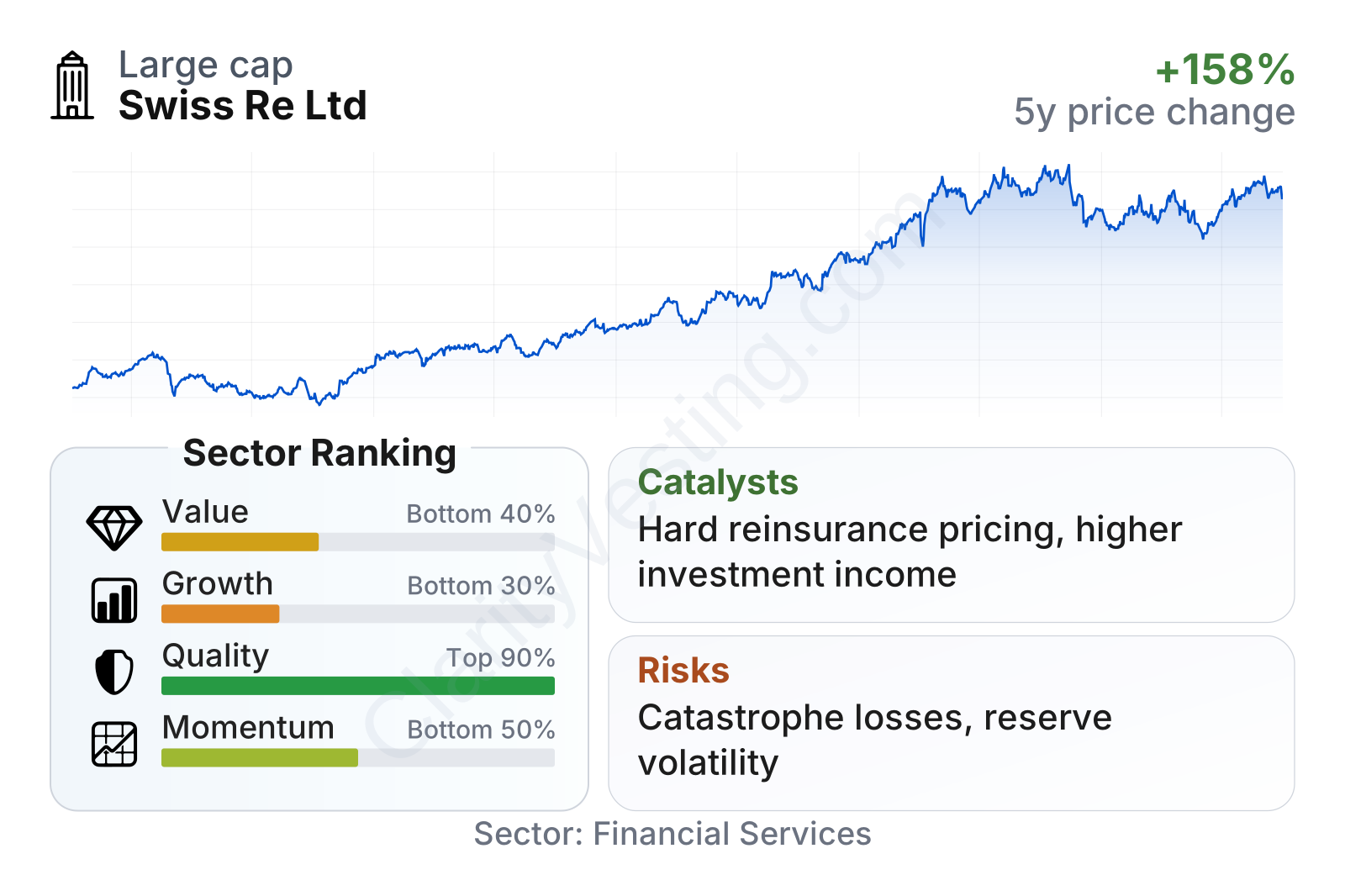
Swiss Re is a very large insurer-reinsurer with a market value around the low tens of billions of dollars and a notably low beta, indicating that its share price has historically moved less than the broader market. The overall profile is mixed in a useful way: quality metrics are very strong relative to the sector, while growth metrics are weaker and valuation is not especially cheap on book value.
The most striking points are high profitability ratios versus the sector, a solid dividend yield near 5%, and free cash flow generation that compares well with peers. At the same time, revenue growth has recently been negative and long-term growth in book value per share has been modest. This is consistent with the nature of reinsurance: it is often more about underwriting discipline, capital strength, and pricing cycles than fast, steady expansion.
Growth
Swiss Re operates in a sector with durable long-term demand. Climate-related catastrophe losses, rising insured values, cyber risk, supply-chain complexity, medical cost pressure, and aging populations all increase the need for risk transfer. In plain terms, the world is becoming harder to insure, and that tends to support the role of large global reinsurers with deep capital, data, and modeling capabilities.
The company’s strategy also fits that backdrop. Management has emphasized underwriting discipline, tighter terms and conditions, selective growth in preferred lines, and capital efficiency rather than chasing premium volume at any price. For a reinsurer, that is usually more important than rapid revenue expansion, because badly priced growth can destroy value very quickly after major loss events.
Earnings per share illustrate that point well. After a soft 2022, profits rebounded sharply in 2023 and remained strong through 2024 and 2025. That pattern suggests Swiss Re has benefited from improved pricing and better margins across its risk portfolio. For a long-term reader, the main takeaway is that earnings power has recently stepped up, even though it can still fluctuate from year to year.
Book value per share has also recovered from the sharp drop seen in 2022. That matters because book value is a key anchor for insurers and reinsurers: it reflects the capital base that supports underwriting. The more recent upward move points to repaired balance-sheet strength and retained earnings, even if the five-year compounding rate still looks modest compared with many financial peers.
A meaningful catalyst is the continued need for reinsurance capacity after several years of elevated catastrophe losses. When industry capital is constrained and clients still need coverage, pricing usually improves. Swiss Re is well positioned to benefit because scale and global diversification matter when insurers choose long-term reinsurance partners. Another support is higher recurring investment income, as reinsurers can reinvest portions of their portfolios at better yields than they could during the very low-rate period.
Recent company communications have also pointed to strong underlying business momentum in core reinsurance lines and continued focus on profitability targets. For a company like Swiss Re, that is more important than headline premium growth alone, because future value creation depends heavily on whether pricing stays above loss trends and capital costs.
Risks
This article is for informational purposes only and does not constitute financial advice. Some content is AI-generated. See Disclaimer


