Stock Analysis · Swiss Re AG (SSREF)
Overview
Swiss Re AG is one of the world’s largest reinsurance groups. Reinsurance is often described as insurance for insurance companies: primary insurers sell policies to households and businesses, then pass part of that risk to firms like Swiss Re. This helps insurers protect themselves against very large losses from natural catastrophes, life and health claims, and major corporate risks. Swiss Re also provides corporate insurance through its commercial insurance arm and offers insurance-linked services and risk data through smaller specialty activities.
The business is diversified across property and casualty reinsurance, life and health reinsurance, and commercial insurance. In practical terms, that means Swiss Re earns premiums and fees for taking on risk, managing claims volatility, and providing capital and underwriting capacity where clients need it most. Its customer base includes insurers, corporations, and public-sector entities around the world.
Based on recent annual reporting, Swiss Re’s main revenue sources are approximately the following:
- Property & Casualty Reinsurance: about 50% to 55% of insurance revenue. This includes catastrophe cover, specialty risks, and other non-life exposures written for insurance companies.
- Life & Health Reinsurance: about 20% to 25%. This covers mortality, longevity, morbidity, and health-related reinsurance for life and health insurers.
- Commercial Insurance: about 20% to 25%. This comes mainly from corporate and specialty insurance through Swiss Re Corporate Solutions.
- Other and central activities: typically a low-single-share portion of group revenue. This includes fee-based and administrative items as well as corporate center effects.
That mix matters for long-term analysis because it gives Swiss Re exposure to several large insurance markets rather than one narrow line of business. At the same time, reinsurance remains a cyclical industry shaped by pricing, claims experience, and investment income.
The profit profile has improved meaningfully since the weak 2022 period. Revenue has been broadly stable to rising over the last several years, while net income recovered sharply in 2023 and stayed strong through 2024 and 2025. That suggests better underwriting conditions, improved pricing, and a more favorable earnings base than during the earlier downturn.
Key Figures
| Metric | Value | Sector ⓘ |
|---|---|---|
| Date | Oct 03, 2026 | |
| Context | ||
| Sector | Financial Services | |
| Industry | Insurance - Reinsurance | |
| Market Cap ⓘ | $50.84B | |
| Beta ⓘ | 0.35 | |
Value (Cheapness) | ||
| P/E Ratio ⓘ | 10.48 | 12.60 |
| P/B Ratio ⓘ | 2.59 | 1.23 |
| FCF Yield ⓘ | 11.62% | 10.16% |
| Dividend Yield ⓘ | 4.65% | 2.96% |
| EBIT / EV ⓘ | N/A | 7.77% |
| PEG ⓘ | 0.78 | |
Growth (Business expansion) | ||
| Revenue Growth ⓘ | -5.20% | 9.50% |
| RPS Growth (5Y CAGR) ⓘ | 5.04% | 12.10% |
| EPS Growth (5Y CAGR) ⓘ | 133.75% | -9.45% |
| BVPS Growth (5Y CAGR) ⓘ | 3.70% | 5.01% |
| Margin Growth (5Y Trend) ⓘ | 7.73% | -4.07% |
| FCF Growth (5Y CAGR) ⓘ | -6.30% | 4.96% |
| DPS Growth (5Y CAGR) ⓘ | 8.05% | 8.79% |
Quality (Business durability) | ||
| ROIC (Latest) ⓘ | N/A | 9.60% |
| ROE (Latest) ⓘ | 36.79% | 13.84% |
| ROA (Latest) ⓘ | 6.83% | 1.53% |
| ROIC (5Y Median) ⓘ | 12.78% | 7.86% |
| ROE (5Y Median) ⓘ | 16.67% | 12.20% |
| ROA (5Y Median) ⓘ | 2.04% | 1.29% |
| Net Debt / EBIT (Latest) ⓘ | N/A | 0.91 |
| Net Debt / EBIT (5Y Median) ⓘ | 1.20 | 0.74 |
| Net Debt / EBITDA (Latest) ⓘ | N/A | 0.97 |
| Operating Margin (Latest) ⓘ | N/A | 22.12% |
| Operating Margin (5Y Median) ⓘ | 9.82% | 24.39% |
| Debt to Equity (Latest) ⓘ | 38.62% | 60.37% |
| Profit Margin (Latest) ⓘ | 11.89% | 26.62% |
| Free Cash Flow (Latest) ⓘ | $5.91B | |
Momentum (Price trend) | ||
| 3Y Return ⓘ | +98.48% | +89.23% |
| 12M Return (excl. last month) ⓘ | +0.07% | +17.35% |
| 6M Return ⓘ | +11.54% | +10.00% |
| Price vs. 200-Day MA ⓘ | +6.41% | +3.73% |
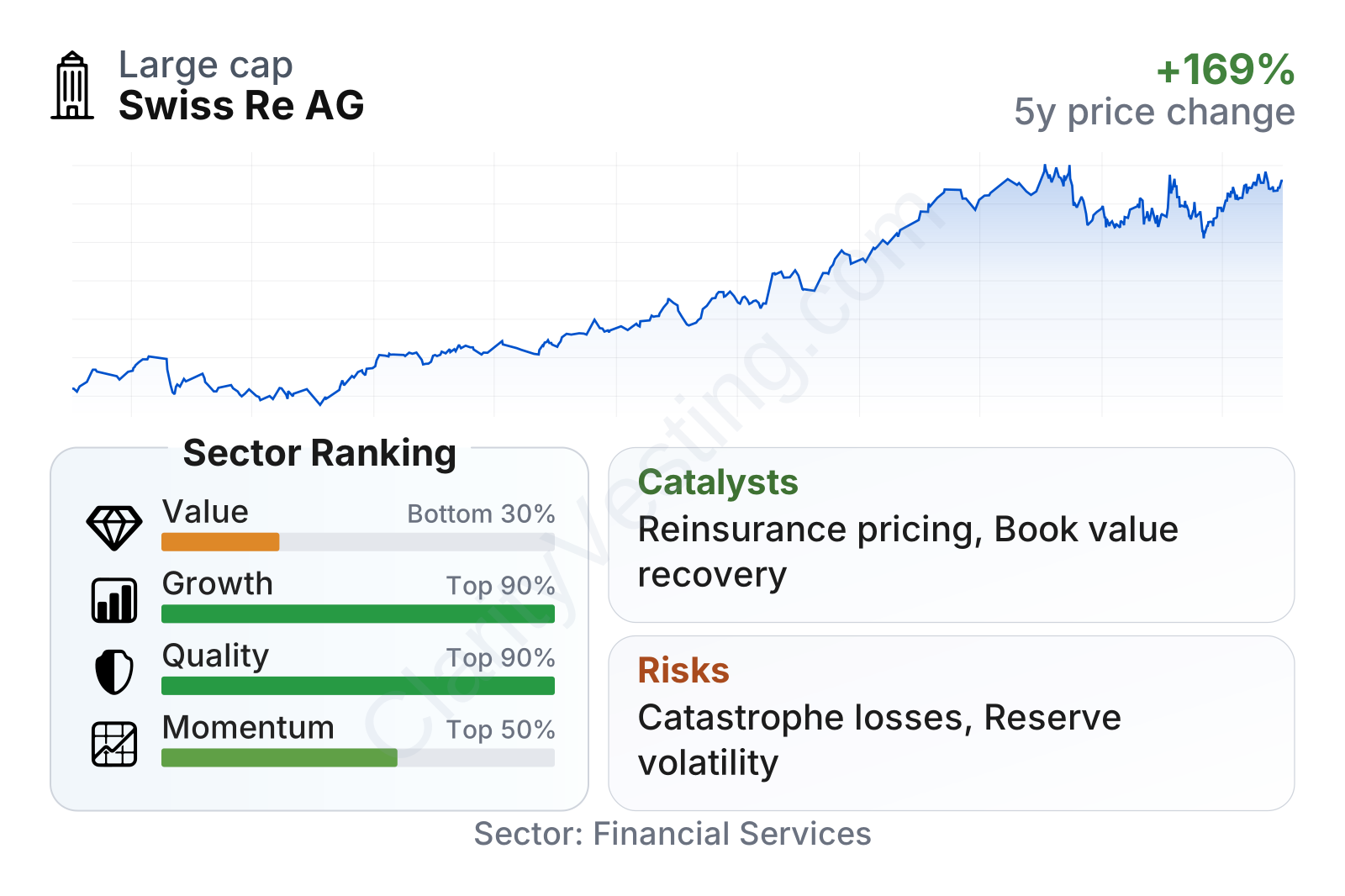
Swiss Re stands out as a very large global insurer with relatively low share-price volatility, as shown by its beta well below 1. The overall profile is strongest on quality and growth relative to the financial sector, while value looks more mixed. Earnings multiples are not demanding, and the dividend yield is above the sector median, but the price-to-book multiple is clearly richer than most peers. Momentum is more moderate, which fits a stock that has already had a strong multi-year rerating and now appears to be consolidating rather than accelerating.
Growth
Swiss Re operates in a sector with durable long-term demand. Reinsurance benefits from rising insured values, more frequent and costly natural catastrophes, increasing economic complexity, tighter regulation for insurers, and the need for additional capital support in life and health markets. These are not short-lived themes. As weather-related losses rise and balance-sheet pressure grows for primary insurers, large reinsurers with strong underwriting discipline can gain pricing power.
The group’s current strategy is built around underwriting profitability, selective growth, and capital discipline rather than simply chasing premium volume. That approach makes sense in reinsurance, where writing too much business at weak prices can damage results for years. Swiss Re has spent the last several renewal seasons emphasizing pricing adequacy and lower earnings volatility, particularly in property and casualty reinsurance and commercial insurance. In a favorable market, that can produce earnings growth without requiring dramatic top-line expansion.
The earnings pattern has been uneven over shorter periods, which is normal for catastrophe-exposed insurers, but the broader trend has improved substantially. Over five years, earnings per share growth has been exceptionally strong, helped by the rebound from a low base after weaker results in 2022. That means recent performance should be viewed as both a recovery and a sign that pricing conditions have become more supportive.
Book value per share is especially important for insurers because it reflects the capital base supporting underwriting. After a sharp drop in 2022, Swiss Re rebuilt book value strongly through 2023, 2024, and 2025. That recovery suggests that retained earnings, investment results, and improved underwriting have restored balance-sheet strength. It also helps explain why the market has been willing to assign a higher valuation multiple than in the past.
A meaningful catalyst in recent years has been the reinsurance pricing cycle. Following industry losses from catastrophes and inflation in repair and replacement costs, rates increased across several lines. Large, global reinsurers with strong relationships and underwriting capacity were in a good position to benefit. Swiss Re also continues to highlight demand linked to climate risk, cyber risk, and mortality and health trends, all of which support the need for sophisticated reinsurance solutions.
Recent company updates have also pointed to continued confidence in profitability targets and capital returns, which reinforces the idea that the earnings improvement is not only a one-quarter effect. For a long-term reader, the central growth question is less about rapid revenue expansion and more about whether Swiss Re can sustain strong underwriting margins and convert them into rising book value and cash distributions over time.
Risks
This article is for informational purposes only and does not constitute financial advice. Some content is AI-generated. See Disclaimer