Stock Analysis · Sunshine Silver Mining & Refining Company (SSMR)
Overview
Sunshine Silver Mining & Refining Company is a precious-metals development company focused on building value from silver-related mining assets rather than operating a large, diversified producing portfolio today. Public filings show that the business is centered on advancing mineral properties, preserving and improving its project base, and positioning those assets for future development as market conditions, permitting, financing, and engineering work progress. In practical terms, this means the company currently looks more like an asset developer than a mature miner with broad, recurring production revenue.
At this stage, revenue appears very limited and does not reflect a fully ramped mining business. Based on recent annual financials, the company’s reported revenue base is small enough that it is more useful to understand the business through its asset strategy and capital structure than through current sales alone. Available disclosures suggest the economic thesis is mainly tied to the future value of its mining properties and any refining or processing potential connected to those assets, rather than to meaningful present-day operating cash generation.
Because current revenue is minimal, a percentage split by operating source is not especially informative or reliable for long-term analysis. The business appears to depend primarily on:
- Future development of silver-focused mining assets.
- Potential upside from associated by-products or broader precious-metals exposure if projects move into production.
- Capital markets access, partnerships, asset transactions, or project-level financing to fund development before large-scale operating revenue exists.
This makes Sunshine Silver a company whose long-term potential depends much more on project execution and commodity exposure than on its present income statement.
The recent financial flow reinforces that point: revenue remains extremely small, while administrative and operating costs are far larger, producing substantial operating losses. One positive feature is that interest expense moved lower year over year, but that improvement was overshadowed by a much wider operating loss, showing that the key issue is not financing cost alone but the absence of a meaningful producing business at this stage.
Key Figures
| Metric | Value | Sector ⓘ |
|---|---|---|
| Date | Oct 17, 2026 | |
| Context | ||
| Sector | Basic Materials | |
| Industry | Other Industrial Metals & Mining | |
| Market Cap ⓘ | $1.97B | |
| Beta ⓘ | N/A | |
Value (Cheapness) | ||
| P/E Ratio ⓘ | N/A | 16.90 |
| P/B Ratio ⓘ | 5.50 | 1.65 |
| FCF Yield ⓘ | -2.22% | 5.76% |
| Dividend Yield ⓘ | N/A | 2.13% |
| EBIT / EV ⓘ | -1.47% | 6.30% |
| PEG ⓘ | N/A | |
Growth (Business expansion) | ||
| Revenue Growth ⓘ | N/A | 11.10% |
| RPS Growth (5Y CAGR) ⓘ | N/A | 4.49% |
| EPS Growth (5Y CAGR) ⓘ | N/A | -13.47% |
| BVPS Growth (5Y CAGR) ⓘ | N/A | 5.51% |
| Margin Growth (5Y Trend) ⓘ | N/A | -1.54% |
| FCF Growth (5Y CAGR) ⓘ | N/A | 0.37% |
| DPS Growth (5Y CAGR) ⓘ | N/A | 6.08% |
Quality (Business durability) | ||
| ROIC (Latest) ⓘ | N/A | 9.26% |
| ROA (Latest) ⓘ | N/A | 4.91% |
| ROIC (5Y Median) ⓘ | N/A | 7.70% |
| ROA (5Y Median) ⓘ | N/A | 3.86% |
| Net Debt / EBIT (Latest) ⓘ | N/A | 1.40 |
| Net Debt / EBIT (5Y Median) ⓘ | N/A | 1.70 |
| Net Debt / EBITDA (Latest) ⓘ | N/A | 0.95 |
| Net Debt / Assets ⓘ | -85.77% | 13.69% |
| EBITDA / Interest ⓘ | N/A | 12.34 |
| Operating Margin (Latest) ⓘ | -38128.29% | 13.20% |
| Operating Margin (5Y Median) ⓘ | N/A | 11.80% |
| Debt to Equity (Latest) ⓘ | 0.07% | 40.56% |
| Profit Margin (Latest) ⓘ | N/A | 6.43% |
| Free Cash Flow (Latest) ⓘ | -$43.73M | |
Momentum (Price trend) | ||
| 3Y Return ⓘ | N/A | +68.89% |
| 12M Return (excl. last month) ⓘ | N/A | +30.21% |
| 6M Return ⓘ | N/A | -4.16% |
| Price vs. 200-Day MA ⓘ | N/A | -1.27% |
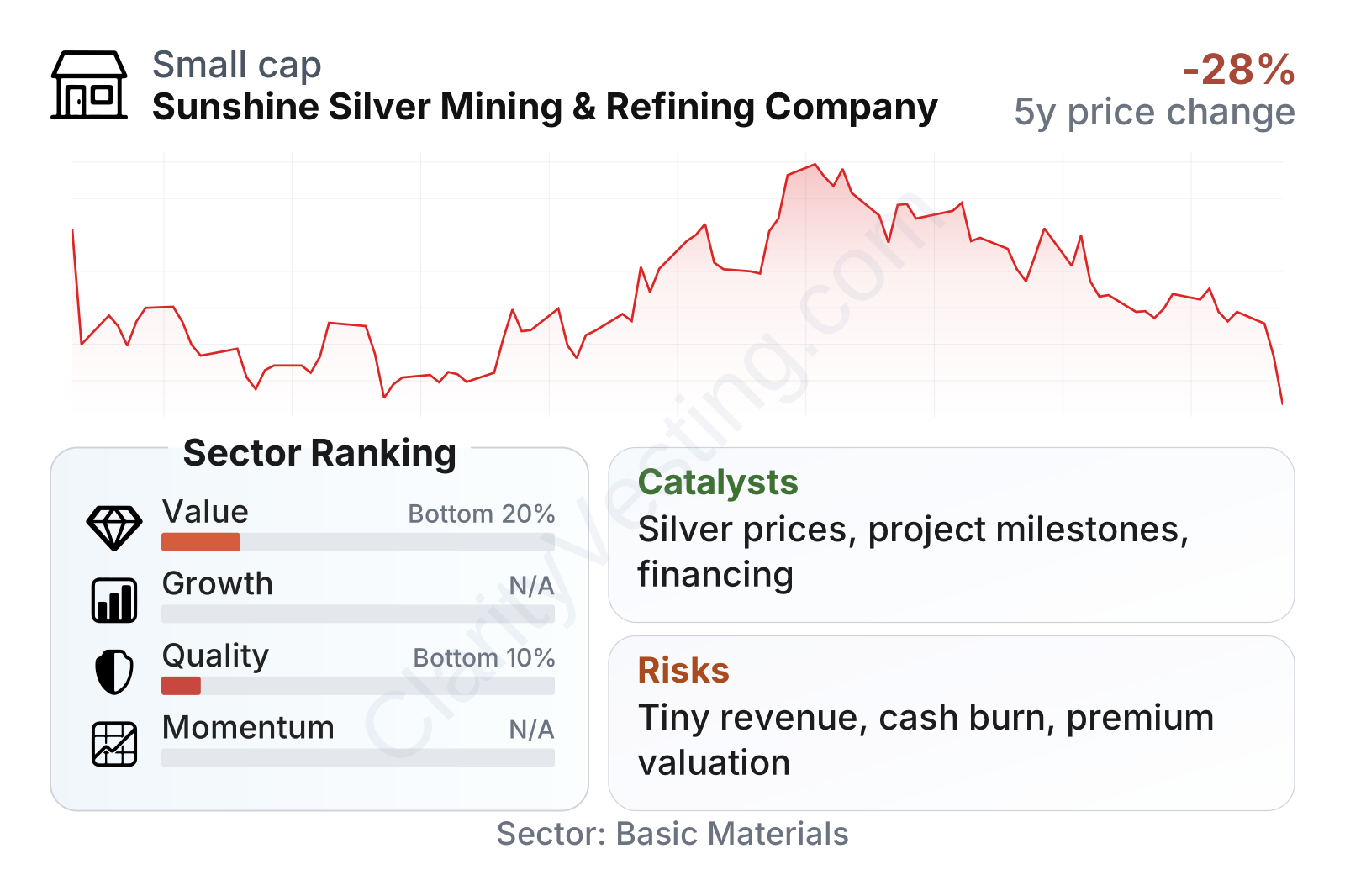
The market value places Sunshine Silver in the small-to-mid-cap range, but the operating profile is much weaker than that size might suggest. On valuation measures, it screens poorly versus much of the sector: price-to-book is well above the industry median, free-cash-flow yield is negative, and operating earnings relative to enterprise value are also negative. That combination usually means the market is assigning value to future asset potential rather than current profits.
Balance-sheet leverage is unusual in a better way. Debt-to-equity is close to 0%, and net debt relative to assets is strongly negative, which points to a net cash position rather than heavy leverage. However, that financial flexibility is offset by weak business quality metrics: profitability is deeply negative, free cash flow is negative, and returns on capital are far below what is typical in the sector. In short, the balance sheet looks cleaner than the income statement.
The recent share-price move has been positive over the last few months, with the stock rising modestly from early June to early September 2026. Even so, the bigger long-term question is whether that market optimism can eventually be matched by project milestones, larger-scale revenue, and a clearer path to sustainable operations.
Growth
Silver sits in a part of the mining market that can benefit from both investment demand and industrial demand. Beyond jewelry and bullion, silver is used in electronics, solar applications, and other industrial processes. That gives the metal a broader demand base than many people assume. For a developer like Sunshine Silver, this matters because a favorable silver market can improve project economics, funding options, and strategic interest from larger industry participants.
The company’s strategy can make sense if viewed through a long-term resource-development lens. A miner that is not yet generating meaningful production often aims to create value by de-risking assets step by step: technical studies, permitting progress, resource definition, infrastructure planning, and financing preparation. If those pieces improve, the market may eventually treat the company less like a speculative asset holder and more like a future producer. That is the main path to growth here.
The strongest catalyst is likely not near-term revenue acceleration, since current sales remain negligible, but rather a shift in project status. Any clear progress in development plans, resource updates, permitting, strategic partnerships, or project financing could matter more than ordinary quarterly revenue changes. The same is true for a stronger silver price environment, which can quickly improve the perceived value of undeveloped mineral assets.
There is also a macro catalyst in the company’s favor: if industrial silver demand continues to be supported by electrification and solar-related uses, developers with meaningful silver exposure may attract more attention than they would in a weaker demand backdrop. That does not remove execution risk, but it helps explain why a company with little current revenue can still command a market value in the billions.
Risks
This article is for informational purposes only and does not constitute financial advice. Some content is AI-generated. See Disclaimer


