Stock Analysis · Santos Ltd (SSLZY)
Overview
Santos Ltd is a large Australia-based energy producer focused on natural gas, liquefied natural gas (LNG), crude oil, condensate, and natural gas liquids. For U.S. readers, SSLZY is the ADR tied to the company’s Australian-listed shares. Santos produces energy from assets across Australia, Papua New Guinea, Timor-Leste, and Alaska, and its business spans exploration, production, processing, transportation, and LNG marketing.
In simple terms, Santos takes hydrocarbons out of the ground, processes them, and sells them either as gas for domestic markets or as LNG and liquids for export markets. The company has become more gas-weighted over time, which matters because gas is often presented as a lower-emission fossil fuel than coal in power generation and is central to energy security discussions in Asia.
Its revenue mix changes with commodity prices and production volumes, but recent company reporting shows the business is primarily driven by LNG and natural gas, with oil and condensate providing a meaningful secondary contribution. Based on Santos’s recent annual disclosures, the broad revenue picture can be summarized as follows:
- LNG and pipeline gas: approximately 60% to 70% of sales. This includes LNG exported to Asian customers and domestic gas sold into Australian markets.
- Crude oil and condensate: approximately 20% to 30% of sales. Condensate is a light hydrocarbon liquid produced alongside gas.
- LPG, ethane, and other products: approximately 5% to 10% of sales. These include natural gas liquids and smaller marketed products.
Geographically, Santos’s earnings are supported by a mix of Australian gas operations, its PNG LNG exposure, and newer long-life development options such as the Pikka project in Alaska. That diversification helps reduce dependence on any single field, although it does not remove the company’s exposure to oil and gas price cycles.
The multi-year financial flow also shows a business with strong operating leverage: profits expanded sharply in the high-price period of 2022, then moderated as prices normalized. Even so, the company remained profitable, which is important for a cyclical producer.
Over the last several years, revenue and earnings have clearly followed commodity markets rather than moving in a straight line. The more encouraging point is that Santos stayed solidly profitable through that normalization period instead of swinging into losses.
Key Figures
| Metric | Value | Sector ⓘ |
|---|---|---|
| Date | Oct 17, 2026 | |
| Context | ||
| Sector | Energy | |
| Industry | Oil & Gas E&P | |
| Market Cap ⓘ | $20.14B | |
| Beta ⓘ | -0.05 | |
Value (Cheapness) | ||
| P/E Ratio ⓘ | 28.18 | 15.44 |
| P/B Ratio ⓘ | 1.32 | 1.73 |
| FCF Yield ⓘ | 4.78% | 8.20% |
| Dividend Yield ⓘ | 3.47% | 3.59% |
| EBIT / EV ⓘ | N/A | 7.46% |
| PEG ⓘ | 0.52 | |
Growth (Business expansion) | ||
| Revenue Growth ⓘ | 1.60% | 26.90% |
| RPS Growth (5Y CAGR) ⓘ | -8.09% | 6.90% |
| EPS Growth (5Y CAGR) ⓘ | N/A | -15.73% |
| BVPS Growth (5Y CAGR) ⓘ | -6.53% | 6.07% |
| Margin Growth (5Y Trend) ⓘ | -2.80% | 0.58% |
| FCF Growth (5Y CAGR) ⓘ | -14.60% | 1.86% |
| DPS Growth (5Y CAGR) ⓘ | 23.22% | 16.79% |
Quality (Business durability) | ||
| ROIC (Latest) ⓘ | N/A | 11.40% |
| ROA (Latest) ⓘ | 5.86% | 6.06% |
| ROIC (5Y Median) ⓘ | 6.86% | 10.30% |
| ROA (5Y Median) ⓘ | 4.12% | 5.42% |
| Net Debt / EBIT (Latest) ⓘ | N/A | 1.64 |
| Net Debt / EBIT (5Y Median) ⓘ | 2.43 | 1.83 |
| Net Debt / EBITDA (Latest) ⓘ | 1.11 | 1.08 |
| Net Debt / Assets ⓘ | 20.38% | 17.29% |
| EBITDA / Interest ⓘ | 16.01 | 9.64 |
| Operating Margin (Latest) ⓘ | N/A | 16.27% |
| Operating Margin (5Y Median) ⓘ | 35.83% | 20.39% |
| Debt to Equity (Latest) ⓘ | 46.82% | 54.76% |
| Profit Margin (Latest) ⓘ | 14.74% | 8.82% |
| Free Cash Flow (Latest) ⓘ | $963.17M | |
Momentum (Price trend) | ||
| 3Y Return ⓘ | +54.64% | +67.38% |
| 12M Return (excl. last month) ⓘ | +29.18% | +49.19% |
| 6M Return ⓘ | +14.23% | +7.07% |
| Price vs. 200-Day MA ⓘ | +18.60% | +9.56% |
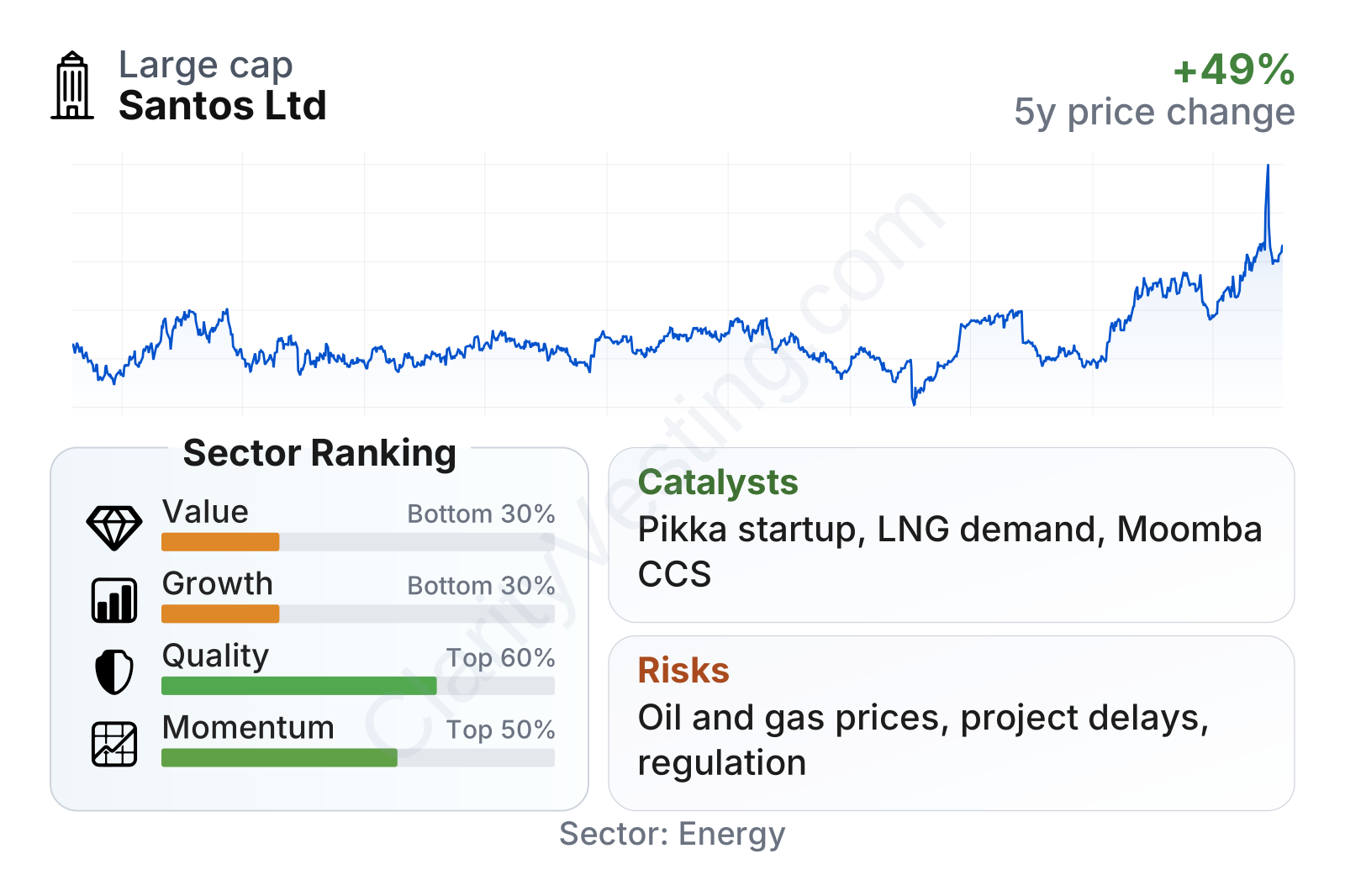
Santos is a large independent energy company with a market value around the large-cap range for international upstream producers. In the current factor breakdown, quality looks better than growth, while value appears weaker than the sector median. That combination usually describes a company with decent operating resilience but a share price that already reflects some of that strength.
The stock’s recent price trend has improved, with six-month performance and the position versus the 200-day average looking firmer than much of the sector. On the other hand, growth metrics are comparatively soft: recent revenue growth is low, five-year revenue per share has contracted, and free cash flow growth over a multi-year view has not kept pace with peers. Profitability and balance-sheet measures are more reassuring, especially interest coverage and profit margin relative to many energy peers.
Growth
Santos operates in a sector that still has a long runway in natural gas and LNG, especially in Asia. While the broader energy transition puts long-term pressure on oil and gas demand in some regions, gas remains important for electricity generation, industrial use, and export supply security. That gives Santos a more constructive industry backdrop than a pure oil producer, particularly because LNG remains strategically important for countries trying to balance affordability, reliability, and lower emissions than coal.
The company’s strategy is centered on three growth pillars: extending the life and output of its existing core assets, bringing new projects online, and developing carbon capture and storage to support lower-carbon credentials for its gas portfolio. The major production catalyst is Alaska’s Pikka project, where Santos is a partner and which is expected to add a meaningful new oil stream once completed. The company has also continued advancing its gas and LNG-linked positions in northern Australia and Papua New Guinea.
Recent operating updates from Santos have highlighted continued progress on key development projects, including Pikka, and ongoing focus on disciplined capital spending. For a long-term view, that matters because the company is not relying only on spot prices; it is trying to build future production from assets with multi-year reserve lives.
Revenue growth has been uneven. After the strong rebound during the energy price surge, year-over-year comparisons turned negative and stayed soft as prices normalized. That does not automatically mean the business is shrinking structurally, but it does show that near-term expansion has been driven more by the commodity cycle than by rapid volume growth.
Cash generation has been one of Santos’s stronger features. Even though free cash flow has fluctuated, the business has shown it can produce large amounts of cash when operating conditions are supportive. That cash can fund project development, debt management, and shareholder distributions, which is particularly relevant in a capital-intensive industry.
A further growth angle is carbon capture and storage. Santos has promoted projects such as Moomba CCS as part of its effort to lower emissions intensity and potentially create a competitive advantage in supplying lower-carbon LNG and gas. If these projects scale successfully, they could improve the company’s position with regulators and customers, though this remains more of a medium-term support factor than a near-term earnings driver.
Risks
This article is for informational purposes only and does not constitute financial advice. Some content is AI-generated. See Disclaimer


