Stock Analysis · Sirius Real Estate Limited (SRRLF)
Overview
Sirius Real Estate Limited is a property company focused mainly on business parks, industrial sites, and flexible workspaces in Germany, with an additional and growing presence in the United Kingdom through self-storage. Its model is relatively easy to understand: it buys and manages properties that can serve small and medium-sized businesses, then improves occupancy, upgrades the sites, and raises income over time. In practice, Sirius combines traditional rental income with asset management, redevelopment, and operating businesses inside its properties.
The company’s revenue base is diversified across recurring rent and service-related income, although exact line-by-line percentages can vary by year and by reporting presentation. Based on recent annual reporting and the structure of the business, the main sources of revenue are broadly the following:
- Rent from German business parks and industrial properties: approximately 60% to 70% of revenue. This includes leasing space to business, light industrial, logistics, and office tenants.
- Service charge and recoverable property income: approximately 15% to 25%. This generally covers utilities, site services, maintenance recovery, and related occupancy services.
- Self-storage income in the UK: approximately 10% to 20%. This comes mainly from the company’s storage platform and related customer services.
- Other property-related income: a smaller share, typically including management fees, ancillary services, and occasional transactional or redevelopment-related contributions.
The business profile is attractive for long-term analysis because much of the income is recurring, while management can still create upside through refurbishments, better occupancy, and selective acquisitions. Over the last several years, revenue has moved from about €210 million to about €348 million, showing that expansion has come from both organic improvements and portfolio growth. Profit conversion has also remained strong overall, despite some year-to-year volatility that is normal in real estate because property valuations, financing costs, and one-off items can affect accounting earnings.
The broad trend is favorable: revenue and gross profit have risen steadily since 2022, and operating income has also expanded meaningfully. Interest expense has increased as debt costs moved higher, but the growth in operating profit has more than offset that pressure so far.
Key Figures
| Metric | Value | Sector ⓘ |
|---|---|---|
| Date | Oct 17, 2026 | |
| Context | ||
| Sector | Real Estate | |
| Industry | Real Estate Services | |
| Market Cap ⓘ | $1.84B | |
| Beta ⓘ | 1.24 | |
Value (Cheapness) | ||
| P/E Ratio ⓘ | 6.82 | 17.38 |
| P/B Ratio ⓘ | 0.97 | 0.85 |
| FCF Yield ⓘ | 12.87% | 7.38% |
| Dividend Yield ⓘ | 5.52% | 4.85% |
| EBIT / EV ⓘ | N/A | 3.78% |
| PEG ⓘ | N/A | |
Growth (Business expansion) | ||
| Revenue Growth ⓘ | 15.60% | 5.30% |
| RPS Growth (5Y CAGR) ⓘ | 4.45% | 6.02% |
| EPS Growth (5Y CAGR) ⓘ | -12.31% | -11.37% |
| BVPS Growth (5Y CAGR) ⓘ | 3.39% | 0.45% |
| Margin Growth (5Y Trend) ⓘ | -16.37% | -0.22% |
| FCF Growth (5Y CAGR) ⓘ | 12.09% | 5.40% |
| DPS Growth (5Y CAGR) ⓘ | 20.38% | 5.02% |
Quality (Business durability) | ||
| ROIC (Latest) ⓘ | 14.23% | 5.69% |
| ROE (Latest) ⓘ | 23.25% | 7.56% |
| ROA (Latest) ⓘ | 12.69% | 2.85% |
| ROIC (5Y Median) ⓘ | 6.60% | 4.22% |
| ROE (5Y Median) ⓘ | 11.51% | 6.03% |
| ROA (5Y Median) ⓘ | 6.07% | 2.44% |
| Net Debt / EBIT (Latest) ⓘ | 2.33 | 7.59 |
| Net Debt / EBIT (5Y Median) ⓘ | 4.84 | 8.40 |
| Net Debt / EBITDA (Latest) ⓘ | 2.28 | 5.27 |
| Net Debt / Assets ⓘ | 29.20% | 37.76% |
| EBITDA / Interest ⓘ | 6.28 | 4.10 |
| Operating Margin (Latest) ⓘ | 67.36% | 35.29% |
| Operating Margin (5Y Median) ⓘ | 71.37% | 37.31% |
| Debt to Equity (Latest) ⓘ | 76.76% | 88.87% |
| Profit Margin (Latest) ⓘ | 65.19% | 19.61% |
| Free Cash Flow (Latest) ⓘ | $236.22M | |
Momentum (Price trend) | ||
| 3Y Return ⓘ | +39.36% | +30.75% |
| 12M Return (excl. last month) ⓘ | -4.13% | +4.36% |
| 6M Return ⓘ | -14.22% | -2.52% |
| Price vs. 200-Day MA ⓘ | -11.49% | -2.34% |
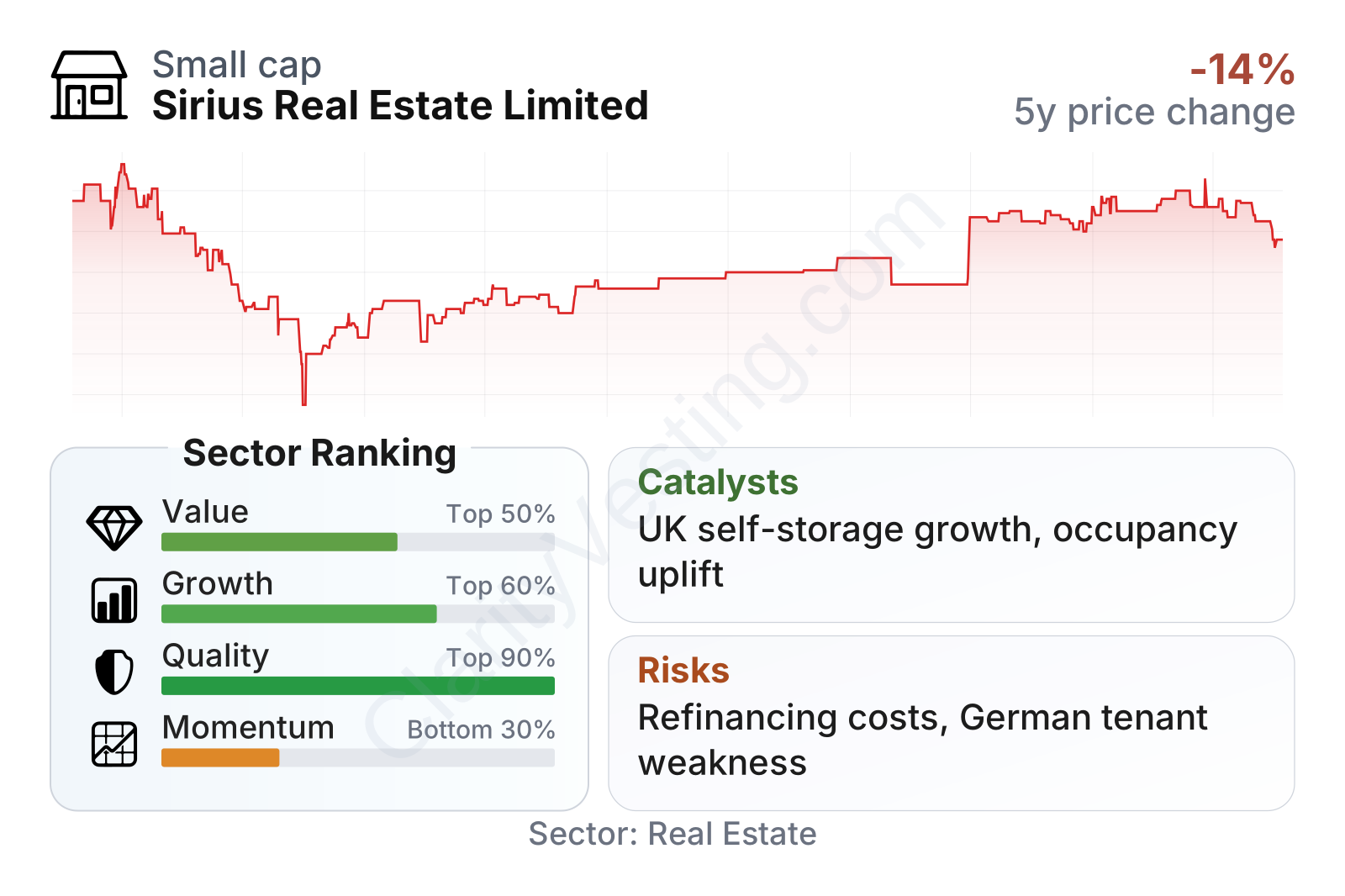
Sirius stands out more on business quality and cash generation than on short-term market momentum. Profitability measures are well above the sector median, leverage looks moderate for a real estate company, and free cash flow is strong relative to its size. On valuation, the earnings multiple appears low versus the broader real estate group, while the dividend yield is slightly above the sector median. The weaker area is recent share-price behavior, with the stock trailing the sector over the last six to twelve months even though the longer-term performance has been more resilient.
Growth
Sirius operates in parts of real estate that still have structural relevance: flexible industrial space, business parks for small and medium-sized tenants, and self-storage. These niches can be more resilient than large single-tenant office assets because they rely on a broader tenant base and serve practical operating needs. Germany remains a large market for light industrial and mixed-use business space, while self-storage in the UK continues to benefit from urban density, mobility, and demand from households and small businesses.
The company’s strategy also makes sense for future growth. Rather than depending only on rising property prices, Sirius aims to grow by improving buildings, lifting occupancy, optimizing tenant mix, and adding services. That is important because it gives management several ways to increase cash flow even in a slower property market. The company has also used acquisitions to add scale, especially in storage, which can create additional growth if integration and pricing remain disciplined.
Revenue per share has been broadly stable to slightly rising over the last five years. That may not look spectacular at first glance, but in property businesses it matters because it suggests that portfolio expansion has not simply been offset by dilution. Year-over-year revenue growth of about 16% is clearly stronger than the sector median, even if the five-year per-share growth rate is more moderate.
The dividend trend has also been constructive. After a sharp increase from 2022 through 2024, the payout has stabilized at a higher level, which fits a company that is balancing income distribution with reinvestment and financing discipline. A five-year dividend-per-share growth rate above 20% is strong, although that pace should not automatically be treated as a long-term baseline.
A meaningful catalyst is the company’s ability to keep turning underused space into higher-yielding space. Another is self-storage, where operational execution can drive pricing and occupancy improvements without needing major land expansion each year. If interest rates become less restrictive in Europe and the UK, that could also support property values, refinancing conditions, and market sentiment toward real estate operators like Sirius.
Risks
This article is for informational purposes only and does not constitute financial advice. Some content is AI-generated. See Disclaimer


