Stock Analysis · Scholar Rock Holding Corp (SRRK)
Overview
Scholar Rock Holding Corp is a clinical-stage biotechnology company focused on medicines that target growth factors in and around tissues such as muscle. In plain terms, it is trying to develop highly selective drugs that switch biological signals on or off before those signals trigger broader effects elsewhere in the body. The company’s main current focus is neuromuscular disease, especially spinal muscular atrophy, with additional work in obesity-related muscle preservation and other serious diseases where muscle biology matters.
Unlike a mature pharmaceutical company, Scholar Rock does not yet operate as a broad commercial business with multiple established product lines. Its economics are still driven mainly by research and development spending, while reported revenue has historically come from collaboration and license-related activity rather than recurring product sales. Based on recent annual trends, the revenue mix has effectively looked like this:
- Collaboration and license revenue: approximately 100% when present. This has included payments tied to partnerships, development arrangements, or other non-product sources.
- Product revenue: 0% so far, because the company remains in the development stage and has not yet built a meaningful recurring marketed-product revenue base in the reported periods.
This setup is important for long-term readers: Scholar Rock is not being evaluated on steady present-day sales, but on whether its drug pipeline can eventually become commercially valuable. Over the last several years, operating spending has risen sharply, with research and development clearly absorbing the largest share of resources. That is typical for a biotech company moving important drug candidates through late-stage clinical work, but it also means the business remains dependent on future milestones such as trial success, regulatory progress, and eventual launch execution.
The operating profile shows a company that has shifted away from intermittent collaboration revenue and toward a much heavier investment phase. Research spending has expanded faster than administrative costs, underlining that the core use of capital is pipeline advancement rather than overhead.
Key Figures
| Metric | Value | Sector ⓘ |
|---|---|---|
| Date | Oct 24, 2026 | |
| Context | ||
| Sector | Healthcare | |
| Industry | Biotechnology | |
| Market Cap ⓘ | $5.24B | |
| Beta ⓘ | 0.62 | |
Value (Cheapness) | ||
| P/E Ratio ⓘ | N/A | 25.42 |
| P/B Ratio ⓘ | 21.60 | 3.08 |
| FCF Yield ⓘ | -5.66% | 3.12% |
| Dividend Yield ⓘ | N/A | 1.85% |
| EBIT / EV ⓘ | -6.88% | 0.56% |
| PEG ⓘ | N/A | |
Growth (Business expansion) | ||
| Revenue Growth ⓘ | -100.00% | 7.50% |
| RPS Growth (5Y CAGR) ⓘ | N/A | 8.60% |
| EPS Growth (5Y CAGR) ⓘ | -7.97% | -17.73% |
| BVPS Growth (5Y CAGR) ⓘ | -17.80% | 3.72% |
| Margin Growth (5Y Trend) ⓘ | N/A | -0.57% |
| FCF Growth (5Y CAGR) ⓘ | N/A | 0.96% |
| DPS Growth (5Y CAGR) ⓘ | N/A | 6.69% |
Quality (Business durability) | ||
| ROIC (Latest) ⓘ | -76.99% | 3.17% |
| ROA (Latest) ⓘ | -87.37% | 2.98% |
| ROIC (5Y Median) ⓘ | -44.19% | 4.56% |
| ROA (5Y Median) ⓘ | -49.55% | 1.87% |
| Net Debt / EBIT (Latest) ⓘ | N/A | 1.34 |
| Net Debt / EBIT (5Y Median) ⓘ | N/A | 1.86 |
| Net Debt / EBITDA (Latest) ⓘ | N/A | 1.00 |
| Net Debt / Assets ⓘ | -44.55% | 5.06% |
| EBITDA / Interest ⓘ | N/A | 9.55 |
| Operating Margin (Latest) ⓘ | N/A | 9.25% |
| Operating Margin (5Y Median) ⓘ | N/A | 7.33% |
| Debt to Equity (Latest) ⓘ | 80.32% | 26.68% |
| Profit Margin (Latest) ⓘ | N/A | 3.34% |
| Free Cash Flow (Latest) ⓘ | -$296.35M | |
Momentum (Price trend) | ||
| 3Y Return ⓘ | +457.24% | +51.61% |
| 12M Return (excl. last month) ⓘ | +57.12% | +19.90% |
| 6M Return ⓘ | -11.35% | +10.10% |
| Price vs. 200-Day MA ⓘ | -12.99% | +6.44% |
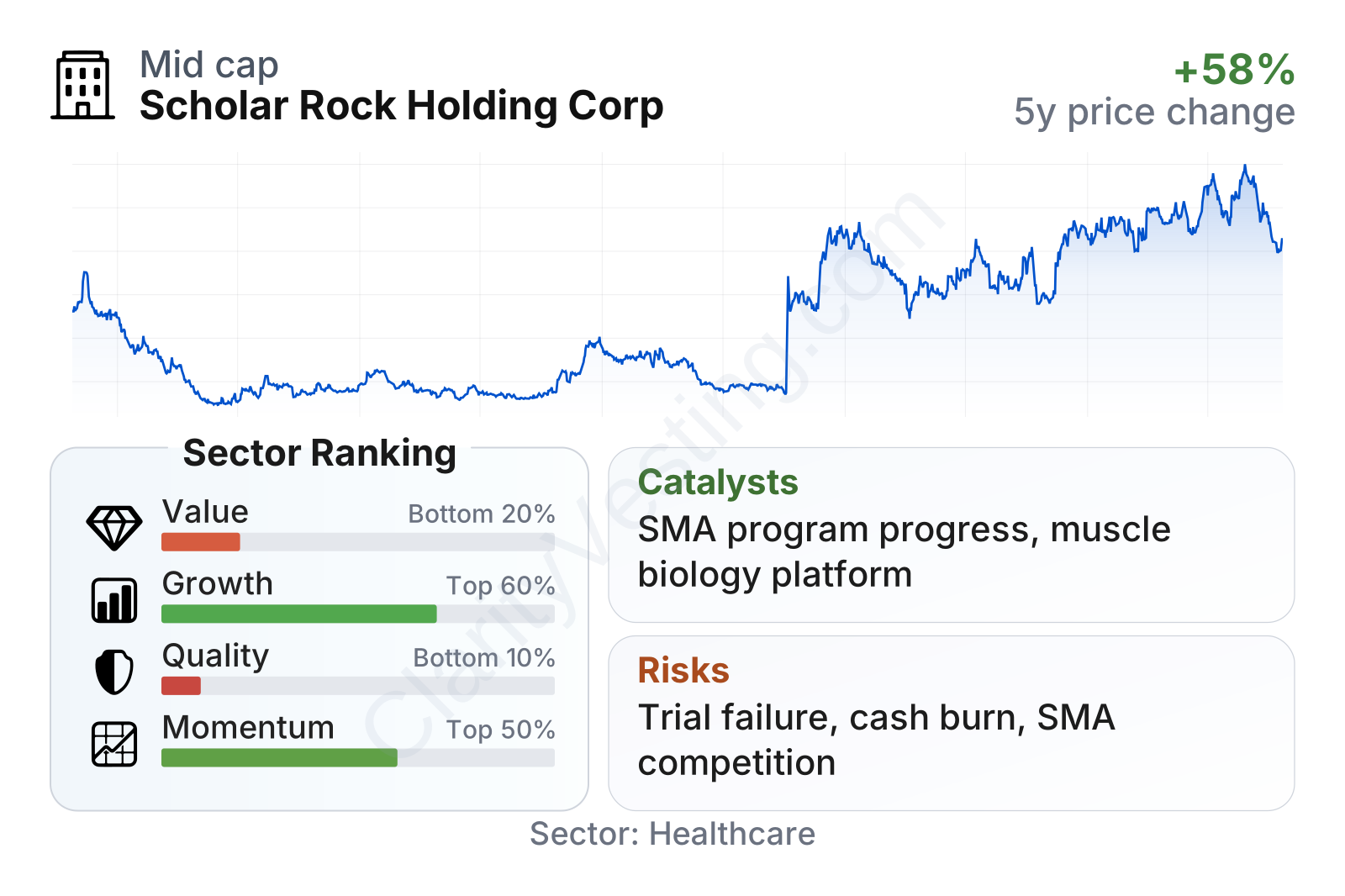
Scholar Rock is now a mid-sized biotech by market value, but its financial characteristics still look like a pre-commercial developer rather than an established healthcare company. On valuation measures tied to earnings or cash generation, it screens weakly because profits and free cash flow remain negative. Quality metrics are also far below sector norms, which is common for companies without approved products but still worth noting because it highlights how much of the current equity value depends on future execution rather than present fundamentals.
The stock’s longer-term share performance has been unusually strong compared with much of the biotech sector, especially over the last three years. That suggests the market has materially upgraded its expectations for the company’s lead programs. At the same time, the share price path has been highly volatile, which fits a company whose value can change quickly with clinical updates.
Growth
Scholar Rock operates in one of the healthcare industry’s most attractive niches for long-term growth: precision biotechnology for serious diseases with high unmet need. Neuromuscular diseases and therapies that help preserve muscle function are important medical markets because patients often have limited treatment options, and successful drugs can command meaningful pricing and specialist adoption. The sector is growing not because current sales are expanding evenly across all participants, but because scientific progress can rapidly create new markets when a therapy shows convincing benefit.
The company’s strategy is logically built around this opportunity. Rather than spreading resources across many unrelated assets, Scholar Rock has concentrated attention on a smaller number of programs where a positive clinical result could reshape the business. That focus matters because biotech companies often create more value by advancing one or two differentiated assets well than by running a crowded early-stage portfolio.
Reported revenue has not been a useful indicator of operating momentum because it has depended on episodic collaboration activity, including periods with little or no revenue. For this company, clinical progress is a better growth signal than accounting revenue trends. In other words, the investment case is tied far more to future product potential than to the recent top line.
A major catalyst has been the company’s lead muscle-targeting candidate in spinal muscular atrophy, which has drawn market attention because it aims to improve muscle outcomes through a mechanism distinct from the disease-modifying therapies already on the market. If that approach continues to show meaningful benefit, Scholar Rock could occupy a complementary role rather than trying to displace established backbone treatments directly. That can be commercially important because add-on or combination use may broaden the addressable patient population.
The company has also highlighted work that could extend its platform into areas where preserving lean muscle mass may become increasingly valuable, including settings linked to weight-loss treatment. That does not mean near-term revenue is around the corner, but it does widen the future strategic relevance of its science if early data continue to support the mechanism.
Cash burn has moved deeper into negative territory as development spending has accelerated. In a biotech context, that is not automatically a sign of deterioration; it can also reflect a company pushing pivotal studies, manufacturing preparation, and broader clinical development. Still, it raises the importance of balance-sheet planning and financing flexibility as the pipeline matures.
Recent company updates in 2026 have kept attention centered on execution around the lead program and the path toward potential regulatory and commercial milestones. For a business at Scholar Rock’s stage, that is the kind of news flow that can create significant opportunity because a single successful program can transform a company from research-focused to commercially relevant.
Risks
This article is for informational purposes only and does not constitute financial advice. Some content is AI-generated. See Disclaimer


