Stock Analysis · Sarepta Therapeutics Inc (SRPT)
Overview
Sarepta Therapeutics is a biotechnology company focused on rare genetic diseases. Its best-known work is in Duchenne muscular dystrophy, or DMD, a severe muscle-wasting disorder that mainly affects boys. The company sells approved DMD treatments and is also developing newer genetic medicines, including gene therapy and RNA-targeted drugs. In simple terms, Sarepta is trying to treat the underlying causes of rare inherited diseases rather than only managing symptoms.
Today, the business is still heavily centered on DMD. Based on the company’s latest annual disclosures and product mix, revenue comes mainly from marketed therapies, with the largest contribution coming from its PMO exon-skipping drugs and a smaller but still important contribution from gene therapy. Collaboration and other revenue have historically been much smaller than product sales.
- PMO exon-skipping therapies: approximately 65% to 75% of revenue in 2025. This group includes Exondys 51, Vyondys 53, Amondys 45, and Viltepso-related collaboration economics where applicable. These drugs are designed for specific mutation subgroups within DMD.
- Gene therapy: approximately 20% to 30% of revenue in 2025. This is primarily Elevidys, Sarepta’s micro-dystrophin gene therapy for DMD, which has become a major growth driver but also a major source of volatility.
- Other and collaboration revenue: generally below 10%. This includes partnership-related payments, royalties, and other smaller items.
Sarepta’s business model is unusual compared with large pharmaceutical companies because it is concentrated in a small number of rare-disease products. That can create strong pricing power and meaningful revenue per patient, but it also means that clinical, regulatory, or safety setbacks can have an outsized effect on the whole company.
Over the past several years, revenue expanded strongly, and the company briefly reached profitability in 2024 as sales scaled faster than operating expenses. However, 2025 brought a sharp reversal, with much heavier research spending and weaker profitability, showing how quickly the financial picture can change in biotech when launch costs, trials, and manufacturing investments rise.
The long-term pattern shows strong top-line growth from 2021 through 2025, but not a smooth earnings profile. Gross profit remained substantial, while research and development absorbed a very large share of revenue. That confirms Sarepta is still operating like a growth-stage biotech with commercial products, not like a mature cash-generating pharmaceutical company.
Key Figures
| Metric | Value | Sector ⓘ |
|---|---|---|
| Date | Oct 17, 2026 | |
| Context | ||
| Sector | Healthcare | |
| Industry | Biotechnology | |
| Market Cap ⓘ | $1.83B | |
| Beta ⓘ | 0.38 | |
Value (Cheapness) | ||
| P/E Ratio ⓘ | N/A | 24.79 |
| P/B Ratio ⓘ | 1.23 | 3.08 |
| FCF Yield ⓘ | -7.19% | 3.15% |
| Dividend Yield ⓘ | N/A | 1.94% |
| EBIT / EV ⓘ | -2.62% | 0.57% |
| PEG ⓘ | 159.25 | |
Growth (Business expansion) | ||
| Revenue Growth ⓘ | -34.30% | 7.45% |
| RPS Growth (5Y CAGR) ⓘ | 24.84% | 8.61% |
| EPS Growth (5Y CAGR) ⓘ | N/A | -17.81% |
| BVPS Growth (5Y CAGR) ⓘ | -1.19% | 3.72% |
| Margin Growth (5Y Trend) ⓘ | N/A | -0.62% |
| FCF Growth (5Y CAGR) ⓘ | -10.62% | 1.04% |
| DPS Growth (5Y CAGR) ⓘ | N/A | 6.77% |
Quality (Business durability) | ||
| ROIC (Latest) ⓘ | 0.93% | 3.24% |
| ROA (Latest) ⓘ | -4.09% | 3.01% |
| ROIC (5Y Median) ⓘ | -19.30% | 4.60% |
| ROA (5Y Median) ⓘ | -16.77% | 1.89% |
| Net Debt / EBIT (Latest) ⓘ | N/A | 1.34 |
| Net Debt / EBIT (5Y Median) ⓘ | N/A | 1.84 |
| Net Debt / EBITDA (Latest) ⓘ | N/A | 1.00 |
| Net Debt / Assets ⓘ | 14.89% | 5.45% |
| EBITDA / Interest ⓘ | N/A | 9.64 |
| Operating Margin (Latest) ⓘ | -3.00% | 9.27% |
| Operating Margin (5Y Median) ⓘ | -40.06% | 7.38% |
| Debt to Equity (Latest) ⓘ | 68.45% | 28.58% |
| Profit Margin (Latest) ⓘ | -6.93% | 3.59% |
| Free Cash Flow (Latest) ⓘ | -$131.47M | |
Momentum (Price trend) | ||
| 3Y Return ⓘ | -84.87% | +42.80% |
| 12M Return (excl. last month) ⓘ | +18.60% | +18.50% |
| 6M Return ⓘ | -18.13% | +7.57% |
| Price vs. 200-Day MA ⓘ | -6.01% | +5.12% |
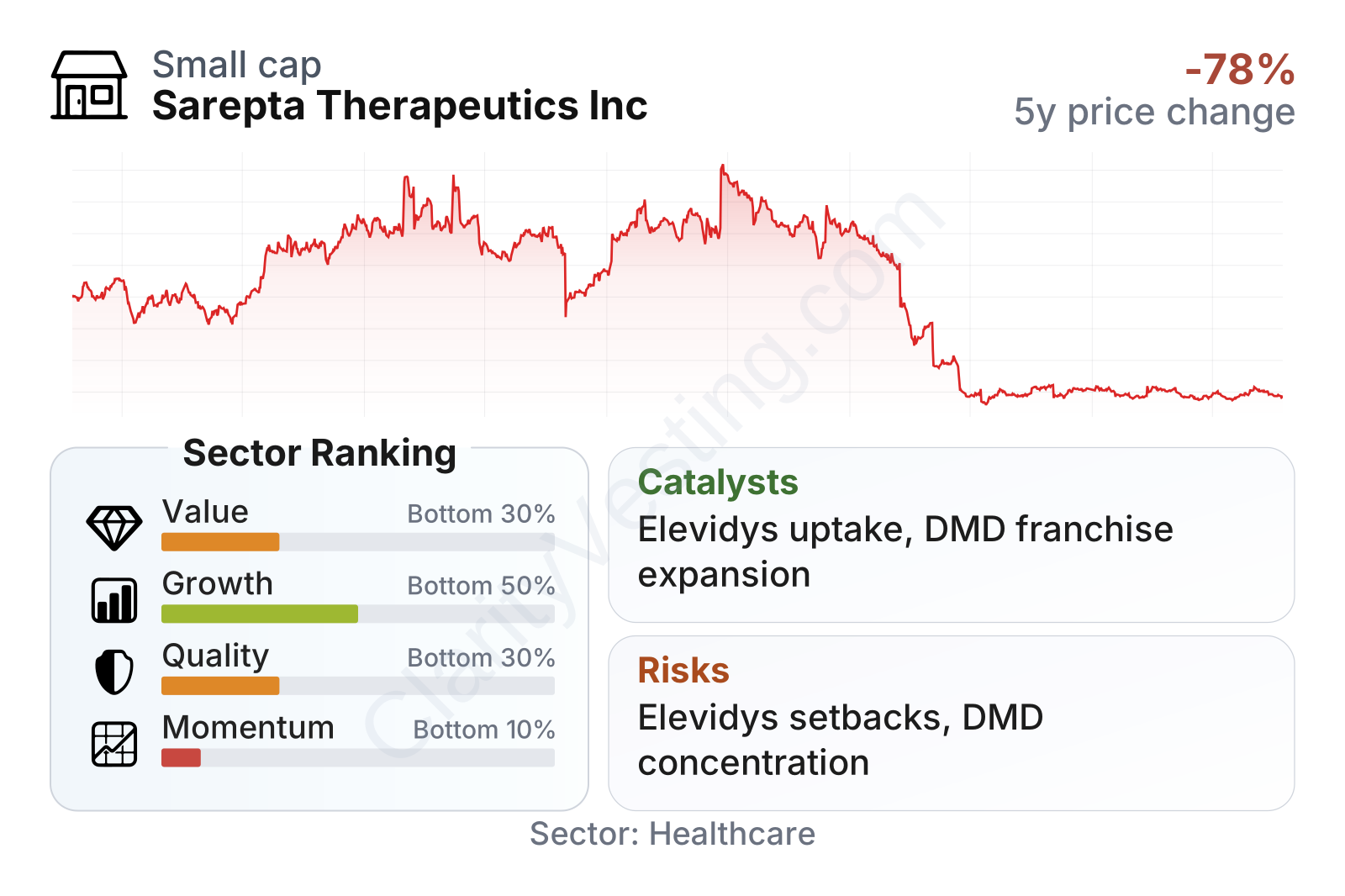
The overall profile is mixed. Sarepta is now a mid-sized biotechnology company by market value, but the quality, growth, and momentum rankings sit in the lower part of the healthcare sector. The weaker positioning is mainly explained by recent revenue contraction, negative free cash flow, and margins that have turned negative again after improving in 2024. On the other hand, the price-to-book ratio is below the sector median, reflecting how much optimism has already been removed from the share price.
The stock chart highlights just how dramatic sentiment has been. After trading well above current levels in 2023 and 2024, the shares fell sharply through 2025 and remained depressed in 2026. That kind of move usually signals that the market is no longer valuing Sarepta as a straightforward growth company and is instead placing much heavier weight on execution, safety, and regulatory risk.
Growth
Sarepta operates in a part of healthcare that still has real structural growth: rare disease, genetic medicine, and targeted therapies for conditions with high unmet need. This remains one of the more attractive niches in biotech because successful treatments can face limited direct competition, command premium pricing, and build long commercial lives. Duchenne muscular dystrophy in particular has drawn intense research interest because current treatment options remain incomplete and patient need is still significant.
Sarepta’s strategy broadly makes sense for future expansion. The company has built a commercial franchise in DMD with multiple approved exon-skipping products, then used that base to move into gene therapy with Elevidys. If that platform proves durable, Sarepta could capture more value per patient and broaden its role from treating smaller mutation-defined subgroups to addressing a larger portion of the DMD population.
Revenue growth was exceptionally strong through most of 2023, 2024, and the first half of 2025, with several periods well above normal sector growth. The more recent slowdown and decline are important, but they need to be read in context: Sarepta had been growing off a rapidly expanding launch base, especially around Elevidys. That means future growth likely depends less on simple launch momentum and more on sustained physician adoption, payer access, manufacturing reliability, and label-related progress.
A major opportunity is the continued rollout and potential broader use of Elevidys. For Sarepta, this is not just another product launch. It is the company’s clearest path to becoming a larger rare-disease franchise with a therapy that can potentially reshape treatment patterns in DMD. Beyond DMD, the company also continues to invest in its broader genetic medicine pipeline, which could create longer-term optionality if even a small number of programs succeed.
Cash generation has also shown signs of improvement compared with earlier periods. Free cash flow was deeply negative for several years, then turned positive in early 2026 on a trailing basis before becoming pressured again in the latest metrics. That pattern suggests the underlying commercial engine can produce cash, but not consistently enough yet to remove funding concerns entirely. For long-term analysis, the main question is whether Sarepta can convert product revenue into repeatable cash generation while still funding a very ambitious pipeline.
Recent company updates have kept attention on execution in gene therapy, manufacturing, and label development. In practical terms, the biggest growth catalyst remains the same: stable commercialization of Elevidys combined with continued demand for the existing DMD franchise. If those elements progress together, Sarepta still has a visible path back to stronger growth.
Risks
This article is for informational purposes only and does not constitute financial advice. Some content is AI-generated. See Disclaimer


