Stock Analysis · Seritage Growth Properties (SRG-PA)
Overview
Seritage Growth Properties is a real estate company that owns and manages a portfolio of retail, mixed-use, and residential-oriented properties in the United States. The company was originally formed around former Sears real estate and has spent years repositioning those sites through redevelopment, leasing, and selective asset sales. In practical terms, Seritage’s business is about taking underused properties, improving them, attracting new tenants, and trying to unlock more value from the land than the original legacy use provided.
Its revenue base is now relatively narrow and reflects a company in transition rather than a mature, stabilized landlord. Based on recent annual reporting, the main sources of revenue are:
- Base rental income: the largest recurring source, generated from tenants leasing retail and other commercial space.
- Expense reimbursements and tenant recoveries: payments from tenants for property-level costs such as common area maintenance, taxes, and insurance.
- Percentage rent, lease termination fees, and other property income: smaller and more variable items tied to lease terms and property operations.
- Gains from property sales and transaction-related proceeds: economically important for Seritage’s strategy, but not a stable operating revenue stream.
For a long-term reader, the important point is that Seritage is less a traditional income-producing REIT and more a real estate value-realization vehicle. Over the last several years, recurring revenue has fallen sharply as the portfolio has shrunk, while the investment case has become increasingly tied to asset monetization, redevelopment progress, and management’s ability to close the gap between private real estate value and public market value.
The broad financial flow also shows how difficult that transition has been: revenue has dropped from well above $100 million in 2021 to around $18 million in 2025, while interest expense and overhead have remained heavy enough to keep operating results negative despite some improvement from peak losses.
Key Figures
| Metric | Value | Sector ⓘ |
|---|---|---|
| Date | Oct 17, 2026 | |
| Context | ||
| Sector | Real Estate | |
| Industry | Real Estate Services | |
| Market Cap ⓘ | $2.11B | |
| Beta ⓘ | 2.24 | |
Value (Cheapness) | ||
| P/E Ratio ⓘ | N/A | 17.38 |
| P/B Ratio ⓘ | 3.98 | 0.85 |
| FCF Yield ⓘ | -1.00% | 7.38% |
| Dividend Yield ⓘ | N/A | 4.85% |
| EBIT / EV ⓘ | -3.68% | 3.78% |
| PEG ⓘ | N/A | |
Growth (Business expansion) | ||
| Revenue Growth ⓘ | -56.00% | 5.30% |
| RPS Growth (5Y CAGR) ⓘ | -41.46% | 6.02% |
| EPS Growth (5Y CAGR) ⓘ | N/A | -11.37% |
| BVPS Growth (5Y CAGR) ⓘ | -17.28% | 0.45% |
| Margin Growth (5Y Trend) ⓘ | N/A | -0.22% |
| FCF Growth (5Y CAGR) ⓘ | -28.82% | 5.40% |
| DPS Growth (5Y CAGR) ⓘ | -6.85% | 5.02% |
Quality (Business durability) | ||
| ROIC (Latest) ⓘ | -8.29% | 5.69% |
| ROE (Latest) ⓘ | -17.95% | 7.56% |
| ROA (Latest) ⓘ | -12.37% | 2.85% |
| ROIC (5Y Median) ⓘ | -6.44% | 4.22% |
| ROE (5Y Median) ⓘ | -18.61% | 6.03% |
| ROA (5Y Median) ⓘ | -11.00% | 2.44% |
| Net Debt / EBIT (Latest) ⓘ | N/A | 7.59 |
| Net Debt / EBIT (5Y Median) ⓘ | N/A | 8.40 |
| Net Debt / EBITDA (Latest) ⓘ | N/A | 5.27 |
| Net Debt / Assets ⓘ | 0.52% | 37.76% |
| EBITDA / Interest ⓘ | N/A | 4.10 |
| Operating Margin (Latest) ⓘ | -335.45% | 35.29% |
| Operating Margin (5Y Median) ⓘ | -263.36% | 37.31% |
| Debt to Equity (Latest) ⓘ | 17.20% | 88.87% |
| Profit Margin (Latest) ⓘ | N/A | 19.61% |
| Free Cash Flow (Latest) ⓘ | -$20.96M | |
Momentum (Price trend) | ||
| 3Y Return ⓘ | +10.51% | +30.75% |
| 12M Return (excl. last month) ⓘ | -3.83% | +4.36% |
| 6M Return ⓘ | -1.96% | -2.52% |
| Price vs. 200-Day MA ⓘ | -3.53% | -2.34% |
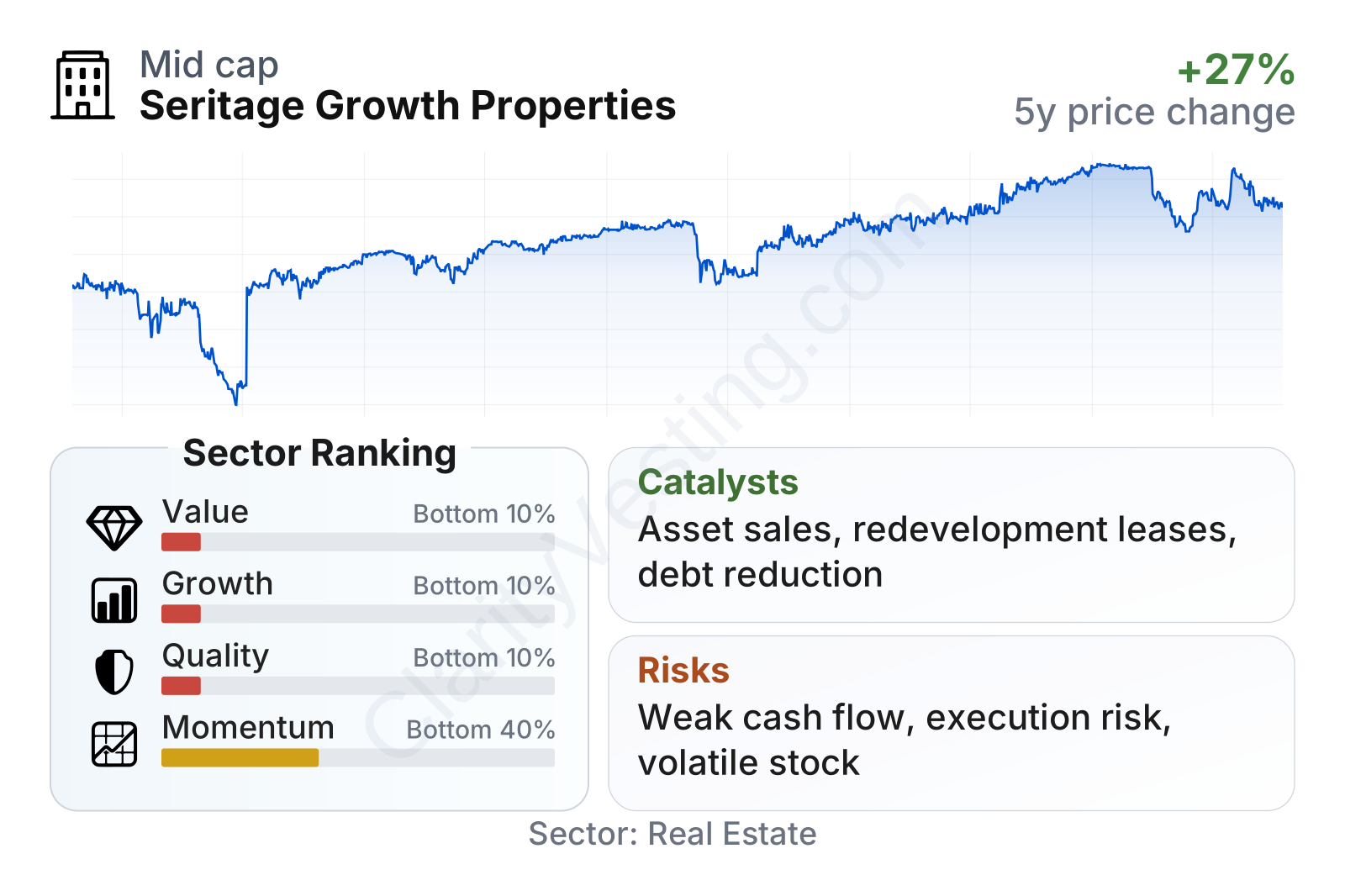
The main takeaway from the current profile is that Seritage screens weakly on value, growth, and quality versus most real estate peers, while share-price momentum has also lagged. The company’s market value is in the smaller public-company range, but its stock is unusually volatile, with a beta above 2.0. Profitability remains under pressure, free cash flow is still negative, and recent revenue trends are far below sector norms. At the same time, balance-sheet leverage looks lighter than many real estate peers on debt-to-equity and net-debt-to-assets measures, which matters because Seritage’s flexibility depends heavily on preserving asset value and managing redevelopment timing.
Growth
Seritage is exposed to parts of real estate that can benefit from long-term redevelopment demand, especially well-located sites that can be repurposed for stronger retail, mixed-use, entertainment, residential, or other higher-value uses. That is a real structural opportunity. Many legacy department-store properties sit on large parcels in established trade areas, and those locations can be more valuable after redevelopment than under the original format.
That said, Seritage is not currently participating in sector growth the way stronger diversified REITs are. Its recent operating trend reflects portfolio contraction more than expansion. Revenue per share has fallen dramatically over the last five years, showing that the company has not yet replaced sold assets and legacy vacancy with enough new stabilized income.
The strategic logic still makes sense on paper: simplify the portfolio, complete value-enhancing projects where returns justify the capital, lease space to a broader tenant base, and sell assets when private-market demand is attractive. A successful execution path would likely come from a combination of higher occupancy, redevelopment completions, and property sales at valuations above what the public market is implying.
Income investors should also note that the company is not currently offering a meaningful dividend profile. The payout trend has moved down over time, and the current trailing dividend yield is 0%, which reinforces that Seritage is not operating like a conventional yield-focused REIT at this stage.
A notable catalyst in recent years has been the company’s continued effort to sell assets, reduce obligations, and narrow its focus around extracting value from the remaining portfolio. For Seritage, a significant opportunity would come from sizable property dispositions, major new leases, or redevelopment milestones that make the residual asset base easier to value. Because the company’s current earnings are weak, even a small number of meaningful transactions can materially change market perception.
Risks
This article is for informational purposes only and does not constitute financial advice. Some content is AI-generated. See Disclaimer


