Stock Analysis · Sunrise Energy Metals Limited (SREMF)
Overview
Sunrise Energy Metals Limited is an Australian-listed battery materials company focused on nickel and cobalt development. Its main asset is the Syerston project in New South Wales, Australia, a large laterite deposit that the company plans to develop into a source of battery-grade nickel and cobalt materials for the electric vehicle and energy storage supply chain. In recent years, the company has also highlighted scandium potential at Syerston, which could add a specialty metals angle if commercialized at scale.
At this stage, Sunrise is primarily a development-stage company rather than a mature producer. That means its investment case is tied much more to the value of its mineral resource, project economics, financing progress, permitting, and future offtake partnerships than to current operating cash flow. The business is therefore best understood as an upstream battery materials platform with a flagship asset, not as a diversified industrial operator with recurring earnings.
The company’s revenue base is currently limited and uneven because commercial production has not yet been established at full scale. Based on recent public filings, the economic value of the business is mainly linked to future planned output rather than present sales.
- Project and related operating revenue: when present, this has represented the largest reported source, but it remains small and inconsistent because Sunrise is still in the development phase.
- Interest and other income: a secondary source, usually tied to cash balances or miscellaneous items rather than core mining operations.
- Future potential revenue streams: planned battery-grade nickel sulfate, cobalt products, and possibly scandium products if the Syerston project reaches commercial production.
In practical terms, Sunrise today is valued more on what it could become than on what it currently earns. That makes the quality of the asset and the path to funding especially important.
The operating picture shows a company that has kept financing costs very low but continues to run operating losses while advancing its project. Administrative spending had been reduced for several years, which helped narrow losses, but the latest period shows a renewed increase in costs as activity picked up. That pattern fits a company moving from preservation mode back toward active development.
Key Figures
| Metric | Value | Sector ⓘ |
|---|---|---|
| Date | Oct 03, 2026 | |
| Context | ||
| Sector | Industrials | |
| Industry | Pollution & Treatment Controls | |
| Market Cap ⓘ | $2.67B | |
| Beta ⓘ | 1.43 | |
Value (Cheapness) | ||
| P/E Ratio ⓘ | N/A | 22.45 |
| P/B Ratio ⓘ | 21.35 | 1.98 |
| FCF Yield ⓘ | N/A | 6.31% |
| Dividend Yield ⓘ | N/A | 1.96% |
| EBIT / EV ⓘ | -0.39% | 4.81% |
| PEG ⓘ | N/A | |
Growth (Business expansion) | ||
| Revenue Growth ⓘ | -28.80% | 9.10% |
| RPS Growth (5Y CAGR) ⓘ | N/A | 7.75% |
| EPS Growth (5Y CAGR) ⓘ | -11.33% | -13.59% |
| BVPS Growth (5Y CAGR) ⓘ | 28.36% | 6.22% |
| Margin Growth (5Y Trend) ⓘ | N/A | 0.72% |
| FCF Growth (5Y CAGR) ⓘ | -7.00% | 10.98% |
| DPS Growth (5Y CAGR) ⓘ | N/A | 9.48% |
Quality (Business durability) | ||
| ROIC (Latest) ⓘ | N/A | 10.92% |
| ROA (Latest) ⓘ | N/A | 5.41% |
| ROIC (5Y Median) ⓘ | -49.26% | 9.21% |
| ROA (5Y Median) ⓘ | -41.69% | 4.94% |
| Net Debt / EBIT (Latest) ⓘ | N/A | 2.07 |
| Net Debt / EBIT (5Y Median) ⓘ | N/A | 2.28 |
| Net Debt / EBITDA (Latest) ⓘ | N/A | 1.43 |
| Net Debt / Assets ⓘ | N/A | 19.27% |
| EBITDA / Interest ⓘ | N/A | 9.53 |
| Operating Margin (Latest) ⓘ | N/A | 10.50% |
| Operating Margin (5Y Median) ⓘ | N/A | 10.27% |
| Debt to Equity (Latest) ⓘ | N/A | 65.48% |
| Profit Margin (Latest) ⓘ | N/A | 6.62% |
| Free Cash Flow (Latest) ⓘ | N/A | |
Momentum (Price trend) | ||
| 3Y Return ⓘ | +2862.26% | +58.56% |
| 12M Return (excl. last month) ⓘ | +966.52% | +15.63% |
| 6M Return ⓘ | +151.20% | +4.19% |
| Price vs. 200-Day MA ⓘ | +71.45% | +0.93% |
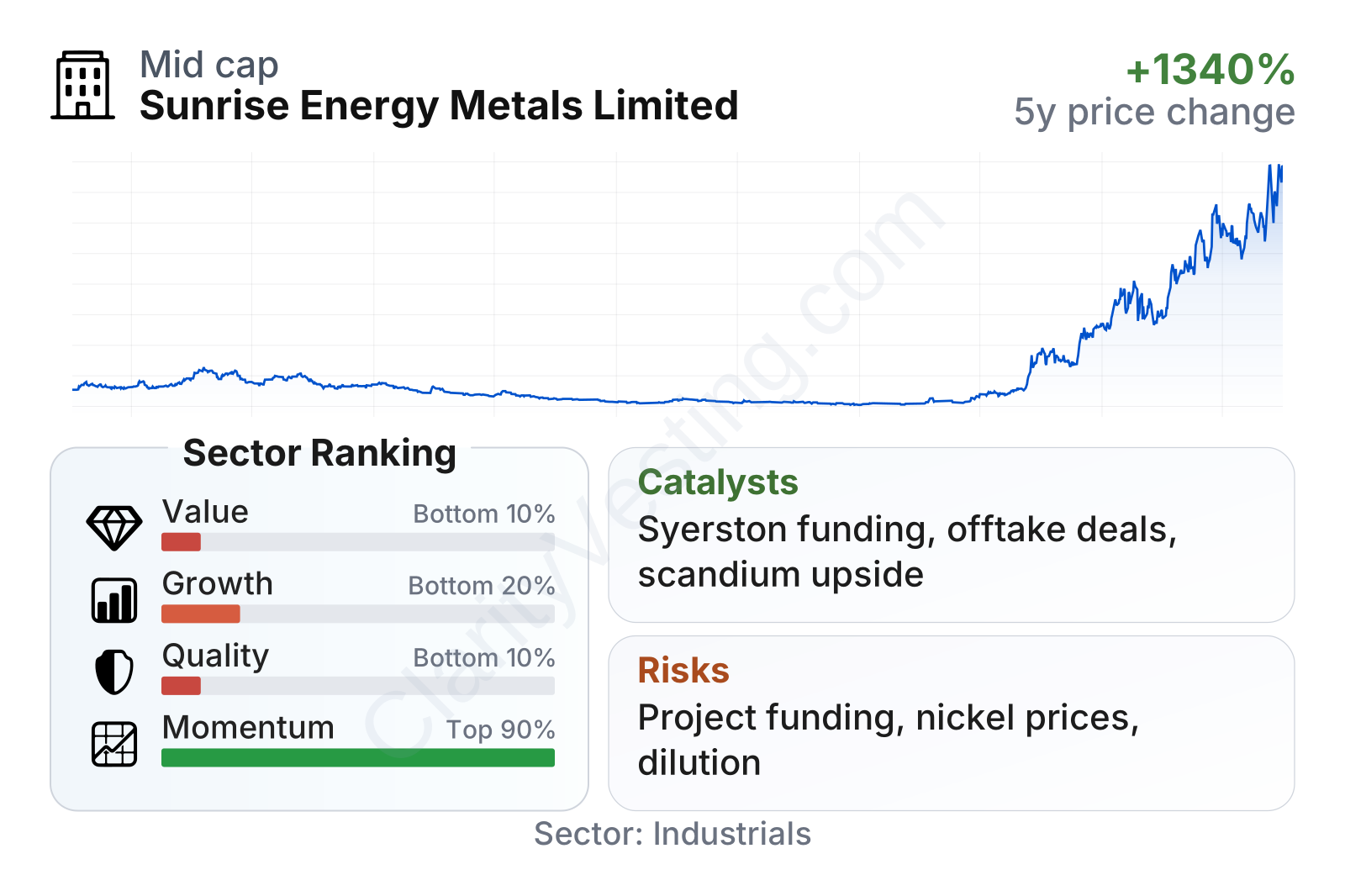
The market is treating Sunrise as a speculative growth asset rather than a proven operating business. The share price has surged sharply over the last year and sits far above its longer-term trend, showing strong momentum. At the same time, the company ranks weakly on value, growth, and quality measures compared with most industrial peers, which is typical for a pre-production resource developer. The high price-to-book ratio and negative operating returns suggest the market is already assigning substantial value to future project success, not present profitability.
Growth
Sunrise operates in a sector with credible long-term demand drivers. Nickel and cobalt remain important materials in many battery chemistries, especially for higher energy density applications used in electric vehicles and grid storage. Even though battery technology keeps evolving and some chemistries reduce cobalt use, the broader electrification trend still supports demand for secure, non-Chinese and non-Russian supply chains of critical minerals and battery intermediates.
The company’s strategy has a clear industrial logic. Rather than simply exporting raw ore, Sunrise has aimed to develop downstream processing capability that could produce higher-value battery materials. If that plan works, it could make the project more strategically relevant to automakers, battery makers, and governments looking to localize supply chains. This is a more ambitious path than being only a mine developer, but it also requires more capital, more engineering execution, and stronger commercial partnerships.
A major catalyst has been the increased market focus on critical minerals supply outside dominant producing regions. Sunrise has repeatedly positioned Syerston as a large, long-life source of nickel and cobalt in a stable mining jurisdiction. Recent company updates have centered on project optimization, strategic funding discussions, and advancement efforts around the project structure. For a company at this stage, milestones such as financing arrangements, binding offtake agreements, government support, and a final investment decision matter far more than small changes in near-term revenue.
There is also a scale argument behind the growth case. A successful development of Syerston could move Sunrise from a company with limited current income into a meaningful battery materials producer. That is the reason the market can tolerate weak present-day financial metrics: the upside case depends on an eventual step-change, not gradual quarterly improvement.
Risks
This article is for informational purposes only and does not constitute financial advice. Some content is AI-generated. See Disclaimer