Stock Analysis · Sempra Energy (SRE)
Overview
Sempra Energy is a large North American energy infrastructure company whose activities are centered on regulated electric and gas utilities, gas pipelines and storage, and liquefied natural gas infrastructure. In simple terms, it operates businesses that move energy to homes, businesses, and industrial customers, while also developing export and cross-border energy assets. Its footprint is especially important in California, Texas, and Mexico.
The business is organized mainly through three large platforms: Sempra California, Sempra Texas Utilities, and Sempra Infrastructure. That mix matters for long-term analysis because regulated utilities usually provide steadier earnings, while infrastructure projects can add growth but also require heavy spending and execution discipline.
Based on recent company reporting, Sempra’s earnings mix is more useful than consolidated revenue alone because commodity pass-through and utility accounting can distort sales comparisons. On a business basis, the company’s economic engine is concentrated in the following areas:
- Sempra California: approximately 35% to 45% of earnings in recent periods. This includes San Diego Gas & Electric and Southern California Gas, which provide regulated electricity and natural gas delivery.
- Sempra Texas Utilities: approximately 25% to 35% of earnings. This is primarily its ownership stake in Oncor, a large regulated electric transmission and distribution utility in Texas.
- Sempra Infrastructure: approximately 25% to 35% of earnings. This segment includes LNG, pipelines, storage, and energy networks in North America, including operations and development projects in Mexico and the U.S. Gulf Coast.
Looking at consolidated financial flow over recent years, revenue has been uneven, but operating income stayed relatively strong and margins improved meaningfully versus earlier years. That pattern suggests the company has become less dependent on pure top-line expansion and more reliant on regulated returns, asset mix, and project economics.
The broad picture is that sales have moved up and down, while operating profitability has remained comparatively resilient. Interest expense has also risen over time, which is an important point for a capital-intensive utility group.
Key Figures
| Metric | Value | Sector ⓘ |
|---|---|---|
| Date | Oct 17, 2026 | |
| Context | ||
| Sector | Utilities | |
| Industry | Utilities - Diversified | |
| Market Cap ⓘ | $53.86B | |
| Beta ⓘ | 0.56 | |
Value (Cheapness) | ||
| P/E Ratio ⓘ | 23.81 | 17.28 |
| P/B Ratio ⓘ | 2.43 | 1.51 |
| FCF Yield ⓘ | -9.73% | 0.65% |
| Dividend Yield ⓘ | 3.19% | 3.77% |
| EBIT / EV ⓘ | 4.48% | 5.01% |
| PEG ⓘ | 0.67 | |
Growth (Business expansion) | ||
| Revenue Growth ⓘ | -0.10% | 6.10% |
| RPS Growth (5Y CAGR) ⓘ | 0.17% | 3.87% |
| EPS Growth (5Y CAGR) ⓘ | -18.66% | -11.30% |
| BVPS Growth (5Y CAGR) ⓘ | -3.70% | 4.23% |
| Margin Growth (5Y Trend) ⓘ | 20.64% | 3.57% |
| FCF Growth (5Y CAGR) ⓘ | N/A | -8.84% |
| DPS Growth (5Y CAGR) ⓘ | 2.46% | 4.84% |
Quality (Business durability) | ||
| ROIC (Latest) ⓘ | 4.58% | 6.53% |
| ROA (Latest) ⓘ | 2.05% | 3.20% |
| ROIC (5Y Median) ⓘ | 4.84% | 5.95% |
| ROA (5Y Median) ⓘ | 2.84% | 2.75% |
| Net Debt / EBIT (Latest) ⓘ | 9.10 | 7.13 |
| Net Debt / EBIT (5Y Median) ⓘ | 10.04 | 7.23 |
| Net Debt / EBITDA (Latest) ⓘ | 5.60 | 4.31 |
| Net Debt / Assets ⓘ | 31.67% | 38.42% |
| EBITDA / Interest ⓘ | 4.20 | 4.58 |
| Operating Margin (Latest) ⓘ | 29.50% | 20.83% |
| Operating Margin (5Y Median) ⓘ | 24.61% | 20.08% |
| Debt to Equity (Latest) ⓘ | 112.11% | 137.69% |
| Profit Margin (Latest) ⓘ | 16.82% | 11.37% |
| Free Cash Flow (Latest) ⓘ | -$5.24B | |
Momentum (Price trend) | ||
| 3Y Return ⓘ | +29.63% | +52.37% |
| 12M Return (excl. last month) ⓘ | +1.73% | +8.84% |
| 6M Return ⓘ | -13.41% | -3.95% |
| Price vs. 200-Day MA ⓘ | -7.35% | -0.79% |
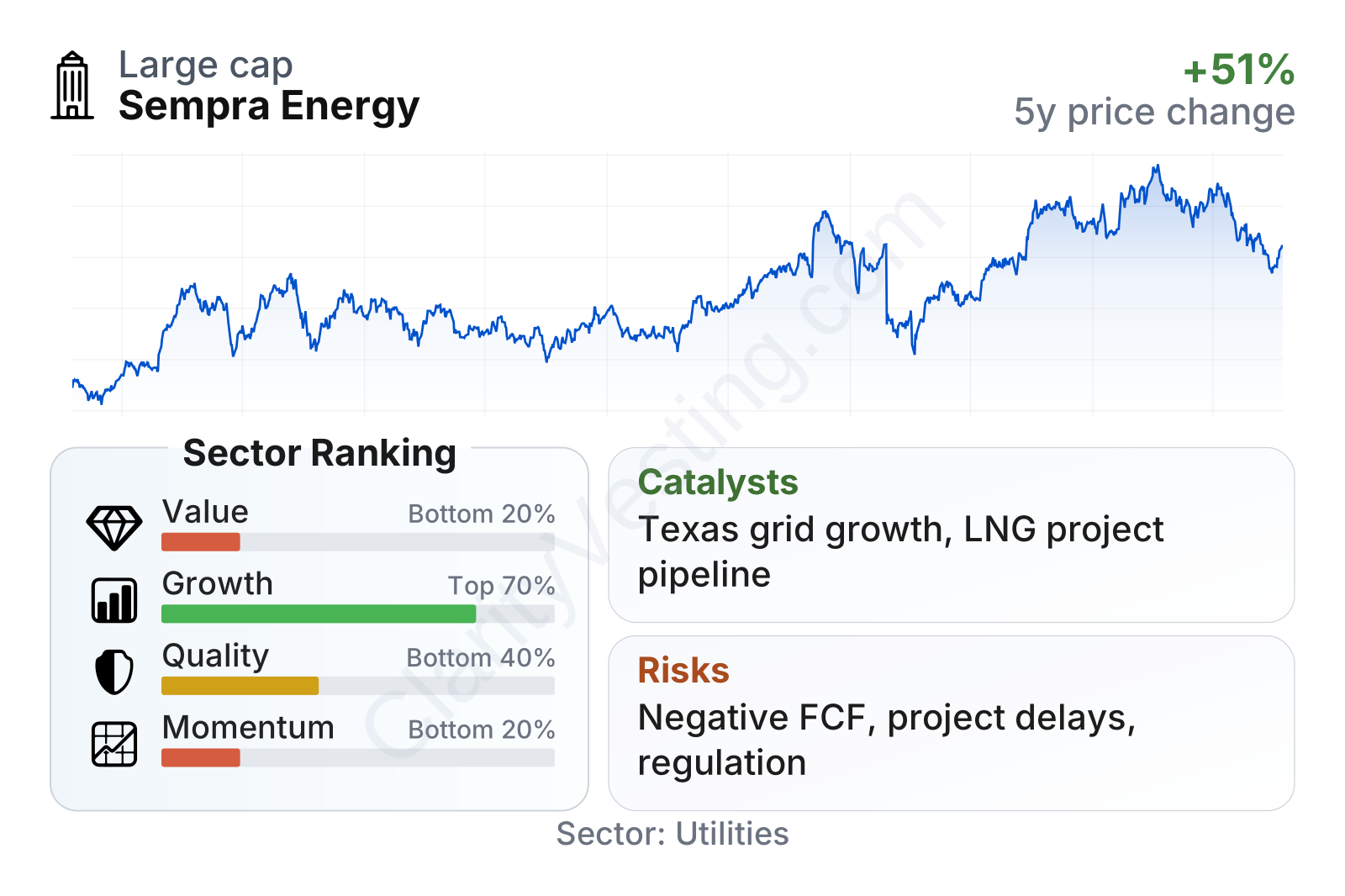
Sempra is a very large utility company with relatively low share-price volatility, as reflected by a beta well below 1. In the factor summary, value metrics look weak relative to the utility sector because the stock trades above the sector median on earnings and book value while free cash flow remains negative. Growth is mixed rather than strong: margin improvement and book value growth stand out, but revenue and earnings-per-share growth have been softer. Quality is also mixed, with above-median profitability margins offset by higher leverage and modest returns on capital. Momentum has recently been one of the weakest areas, with the stock trailing much of the sector over shorter periods.
Growth
The sector itself has attractive long-term demand drivers. Electric grids need major upgrades, Texas continues to add population and industrial load, and North American natural gas remains important for power generation, exports, and industrial use. Those trends support companies that own regulated wires, gas systems, and strategic infrastructure. Sempra fits that profile well.
The company’s strategy also makes sense on paper. It is leaning into areas where long-lived assets can earn contracted or regulated returns: California utility networks, Texas transmission and distribution, and large-scale energy infrastructure tied to LNG and cross-border gas demand. Texas is particularly important because population growth, data center development, and manufacturing expansion can increase the need for transmission investment over time.
Revenue per share has been mostly flat over the past five years after a jump in 2022 and a pullback in 2024. That does not automatically signal a weak business in utilities, where accounting and commodity pass-through can make revenue noisy. More important is that Sempra has still expanded book value per share and maintained healthy operating margins, which points to continuing asset-base growth even without strong reported sales growth.
Free cash flow is a central issue in understanding the company. It has remained deeply negative in recent periods, largely because Sempra is spending heavily on long-duration infrastructure and utility investment. For a utility, negative free cash flow is not unusual during large buildout phases, but it does mean future growth depends on successful project execution, regulatory recovery, and continued access to debt and equity capital.
A notable catalyst is the company’s exposure to LNG and energy infrastructure development through Sempra Infrastructure. If major projects move ahead on time and on budget, they can add another layer of earnings growth beyond the steadier utility base. At the same time, the Oncor investment offers a more predictable growth avenue because regulated transmission spending in Texas can rise with electricity demand and grid expansion needs.
Recent company communications have continued to emphasize a large capital plan, utility investment opportunities, and the value of the development pipeline at its infrastructure platform. That combination gives Sempra visible expansion paths, although much of the upside depends on multiyear execution rather than near-term volume growth.
Risks
This article is for informational purposes only and does not constitute financial advice. Some content is AI-generated. See Disclaimer


