Stock Analysis · 1st Source Corporation (SRCE)
Overview
1st Source Corporation is a regional bank headquartered in Indiana. Through 1st Source Bank, it provides traditional banking services such as commercial and consumer lending, deposit accounts, wealth management, and trust services. What makes the company somewhat different from many small and mid-sized regional banks is its long-standing focus on specialized lending niches, especially equipment finance tied to areas such as aircraft, construction equipment, and commercial vehicles.
Its revenue mainly comes from two broad buckets: net interest income, which is the spread between what the bank earns on loans and securities and what it pays on deposits and borrowings, and noninterest income, which includes fees from wealth advisory, trust, brokerage, card services, and other banking activities. Based on recent annual reporting, the business mix is still clearly led by interest-related banking income.
The main revenue drivers can be summarized as follows:
- Net interest income: about 75% to 80% of total revenue. This is the core engine of the bank and reflects income from commercial loans, consumer loans, specialty finance, and investment securities after funding costs.
- Wealth advisory, trust, and other fee income: about 10% to 15%. This includes fiduciary and investment-related services for individuals, businesses, and institutions.
- Service charges, card fees, and other banking fees: about 5% to 10%. These come from deposit account activity, debit and credit card usage, and treasury-related services.
- Other noninterest income: a small share. This can include gains, insurance-related activity, and miscellaneous banking income depending on the year.
In practical terms, 1st Source is still mainly a spread-based banking business, but it has a useful secondary layer of fee income that adds some diversification. Over the last several years, total revenue has moved up materially, while net income has also trended higher, suggesting that the company has so far managed a difficult interest-rate cycle better than many regional peers.
The long-term pattern shows a clear rise in revenue and profit since 2021. Expenses have increased too, but operating income and net income have also expanded, which points to a business that has preserved profitability while growing its balance sheet and lending activity.
Key Figures
| Metric | Value | Sector ⓘ |
|---|---|---|
| Date | Oct 17, 2026 | |
| Context | ||
| Sector | Financial Services | |
| Industry | Banks - Regional | |
| Market Cap ⓘ | $2.03B | |
| Beta ⓘ | 0.56 | |
Value (Cheapness) | ||
| P/E Ratio ⓘ | 12.08 | 12.26 |
| P/B Ratio ⓘ | 1.63 | 1.23 |
| FCF Yield ⓘ | 10.77% | 10.40% |
| Dividend Yield ⓘ | 0.95% | 3.02% |
| EBIT / EV ⓘ | 9.88% | 8.14% |
| PEG ⓘ | 1.37 | |
Growth (Business expansion) | ||
| Revenue Growth ⓘ | 16.00% | 9.35% |
| RPS Growth (5Y CAGR) ⓘ | 14.78% | 12.19% |
| EPS Growth (5Y CAGR) ⓘ | -7.78% | -9.53% |
| BVPS Growth (5Y CAGR) ⓘ | 10.02% | 4.99% |
| Margin Growth (5Y Trend) ⓘ | -9.46% | -3.86% |
| FCF Growth (5Y CAGR) ⓘ | 6.78% | 4.81% |
| DPS Growth (5Y CAGR) ⓘ | 5.92% | 8.79% |
Quality (Business durability) | ||
| ROIC (Latest) ⓘ | 11.66% | 9.49% |
| ROE (Latest) ⓘ | 13.96% | 13.90% |
| ROA (Latest) ⓘ | 1.87% | 1.55% |
| ROIC (5Y Median) ⓘ | 11.19% | 7.86% |
| ROE (5Y Median) ⓘ | 13.93% | 12.17% |
| ROA (5Y Median) ⓘ | 1.50% | 1.30% |
| Net Debt / EBIT (Latest) ⓘ | -0.31 | 0.96 |
| Net Debt / EBIT (5Y Median) ⓘ | 1.45 | 0.73 |
| Net Debt / EBITDA (Latest) ⓘ | -0.30 | 0.92 |
| Operating Margin (Latest) ⓘ | 36.39% | 22.30% |
| Operating Margin (5Y Median) ⓘ | 34.18% | 24.63% |
| Debt to Equity (Latest) ⓘ | 22.46% | 58.56% |
| Profit Margin (Latest) ⓘ | 38.64% | 26.57% |
| Free Cash Flow (Latest) ⓘ | $218.74M | |
Momentum (Price trend) | ||
| 3Y Return ⓘ | +116.87% | +88.33% |
| 12M Return (excl. last month) ⓘ | +41.03% | +19.38% |
| 6M Return ⓘ | +17.25% | +4.75% |
| Price vs. 200-Day MA ⓘ | +12.58% | +3.50% |
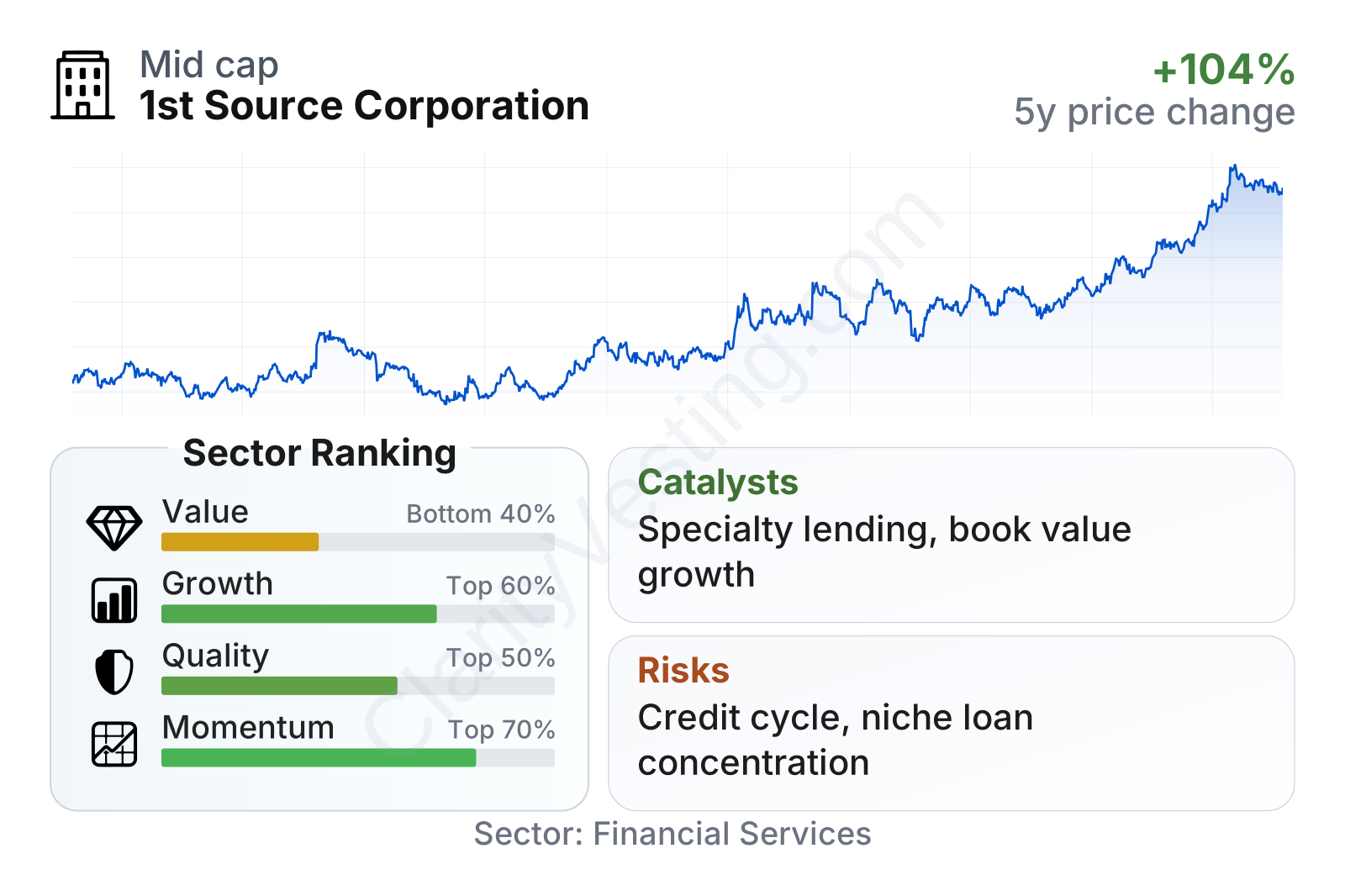
1st Source is a relatively small public bank by market value, but its profitability metrics are strong for its peer group. Quality measures are generally above the sector median, with return on equity around 14% and return on assets close to 1.9%, both healthy levels for a regional bank. Growth is mixed but still respectable overall: revenue has been expanding faster than the sector median, while book value per share has compounded at a notably stronger pace than many peers. On valuation, the stock does not look stretched on earnings, but it does trade at a premium on book value, which usually means the market is giving credit for above-average profitability and steadier execution.
The share price trend has also been strong. Over the last few years, the stock has recovered well from the regional banking pressure seen in 2023 and has gone on to reach materially higher levels in 2026, indicating improving market confidence in the company’s earnings power and balance-sheet resilience.
Growth
Banking is not a high-growth sector in the same way as software or semiconductors, but regional banks can still create attractive long-term compounding when they consistently grow loans, deposits, fee income, and book value while keeping credit losses under control. 1st Source operates in a mature industry, yet its niche positioning gives it more room to grow than a plain-vanilla community bank.
The company’s strategy appears coherent. It combines local relationship banking with specialty finance verticals where experience matters and pricing can be better than in highly commoditized lending. That matters because specialized underwriting can create stronger customer retention and somewhat better margins if risk is managed well. It also helps explain why the company has produced above-median operating margins and returns.
Earnings per share have climbed steadily from 2021 through 2025, showing that recent growth has not been purely cosmetic or driven only by balance-sheet expansion. This is important for long-term analysis because sustained EPS growth usually signals that a bank is increasing its earning power per share rather than merely getting larger.
Book value per share has also risen sharply after a temporary dip in 2022. For banks, this is one of the most useful long-term indicators because it reflects the growth of the underlying equity base. Here, the trend is encouraging: the company has been building capital while still generating solid profitability, which gives it more flexibility for lending growth, dividends, and resilience in weaker periods.
A meaningful catalyst is the company’s exposure to equipment finance and specialized commercial lending. If business investment remains healthy in its markets, these niches can support loan growth and fee generation beyond what a standard local bank might achieve. Another positive factor is that 1st Source has continued to post strong profitability despite changing rates, suggesting it may be benefiting from disciplined pricing and a favorable business mix.
Recent company reporting in 2026 has also reinforced the picture of stable credit quality and continued earnings strength rather than a turnaround case. That is a notable distinction: the opportunity here is tied more to consistent execution and compounding than to a dramatic recovery narrative.
Risks
This article is for informational purposes only and does not constitute financial advice. Some content is AI-generated. See Disclaimer


