Stock Analysis · SES-imagotag Société Anonyme (SRBEF)
Overview
SES-imagotag Société Anonyme is a retail technology company best known for electronic shelf labels, the small digital price tags used in stores instead of paper labels. Over time, the business has expanded beyond labels into a broader in-store digital platform that helps retailers automate pricing, manage inventory, improve product availability, and connect physical shelves with software, data, and cloud tools. Its customers are mainly large retailers, especially grocery and other chain-store operators that need frequent price changes and better store efficiency.
The company’s revenue is still primarily tied to hardware deployments, but its offering increasingly includes software and value-added services linked to store digitalization. Based on company reporting and business descriptions, the revenue mix can be understood approximately as follows:
- Electronic shelf labels and related in-store devices: approximately 75% to 85% of revenue. This includes digital price tags and associated physical infrastructure installed in stores.
- Software, cloud platform, and subscriptions: approximately 10% to 20% of revenue. This covers the software layer used to manage pricing, store operations, and connected devices.
- Services and other revenue: approximately 5% to 10% of revenue. This generally includes installation support, maintenance, and other project-related services.
The business model has an important characteristic for long-term analysis: large hardware rollouts can drive strong growth, while software and recurring services can help improve stability and margins over time. The financial flow over recent years shows a business that scaled rapidly from just over €400 million in annual revenue in 2021 to roughly €1.5 billion in 2025, with gross profit also rising strongly. Profitability, however, has not been perfectly smooth, as 2024 showed a setback before a sharp rebound in 2025.
The operating profile suggests a company moving from a product-led rollout phase toward a more mature platform model. Revenue expansion has been impressive, but the swings in operating income and net income also show that execution and project mix matter a great deal.
Key Figures
| Metric | Value | Sector ⓘ |
|---|---|---|
| Date | Oct 17, 2026 | |
| Context | ||
| Sector | Technology | |
| Industry | Software - Application | |
| Market Cap ⓘ | $2.39B | |
| Beta ⓘ | 0.60 | |
Value (Cheapness) | ||
| P/E Ratio ⓘ | 7.68 | 30.28 |
| FCF Yield ⓘ | 3.43% | 4.19% |
| Dividend Yield ⓘ | 0.63% | 1.30% |
| EBIT / EV ⓘ | N/A | 2.79% |
| PEG ⓘ | N/A | |
Growth (Business expansion) | ||
| Revenue Growth ⓘ | 33.50% | 15.70% |
| RPS Growth (5Y CAGR) ⓘ | 34.42% | 8.56% |
| EPS Growth (5Y CAGR) ⓘ | N/A | -11.54% |
| Margin Growth (5Y Trend) ⓘ | 12.39% | 0.46% |
| FCF Growth (5Y CAGR) ⓘ | N/A | 9.72% |
| DPS Growth (5Y CAGR) ⓘ | 1.42% | 7.73% |
Quality (Business durability) | ||
| ROIC (Latest) ⓘ | -2.53% | 9.44% |
| ROIC (5Y Median) ⓘ | 7.67% | 8.35% |
| Net Debt / EBIT (Latest) ⓘ | -0.43 | 0.50 |
| Net Debt / EBIT (5Y Median) ⓘ | -0.16 | 0.48 |
| Net Debt / EBITDA (Latest) ⓘ | -0.25 | 0.28 |
| Net Debt / Assets ⓘ | -6.93% | 3.48% |
| EBITDA / Interest ⓘ | 15.63 | 12.91 |
| Operating Margin (Latest) ⓘ | 8.02% | 9.77% |
| Operating Margin (5Y Median) ⓘ | 4.56% | 8.53% |
| Debt to Equity (Latest) ⓘ | 9.64% | 34.51% |
| Profit Margin (Latest) ⓘ | 16.98% | 7.14% |
| Free Cash Flow (Latest) ⓘ | $81.95M | |
Momentum (Price trend) | ||
| 3Y Return ⓘ | +14.45% | +56.52% |
| 12M Return (excl. last month) ⓘ | -40.67% | +13.17% |
| 6M Return ⓘ | +20.29% | +15.38% |
| Price vs. 200-Day MA ⓘ | -3.87% | +7.53% |
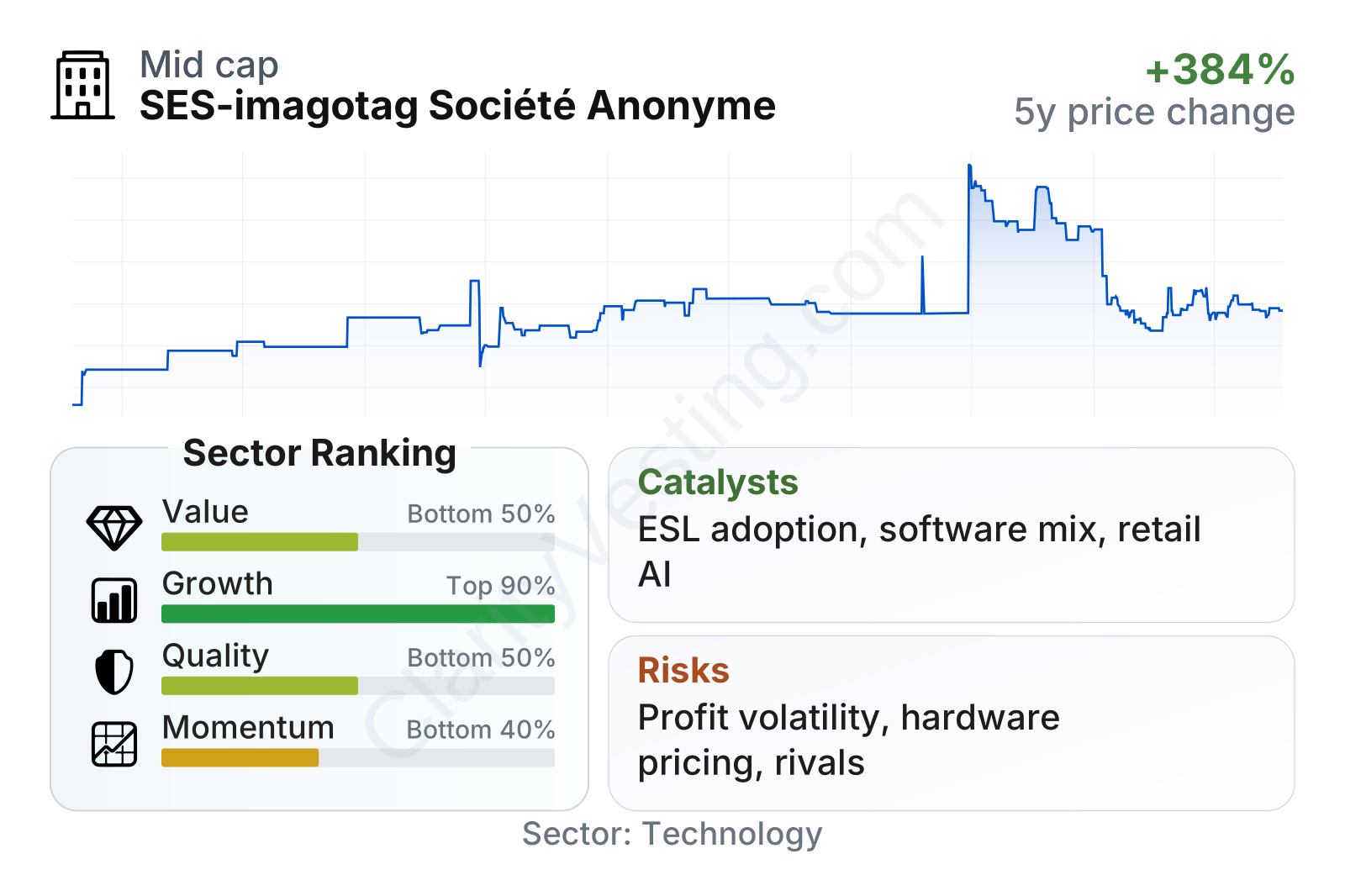
SES-imagotag is a mid-sized technology company with a relatively low share-price volatility profile, reflected in a beta well below 1. On valuation metrics, it screens as inexpensive compared with much of the software and application sector: the earnings multiple is far below the sector median, and free cash flow yield is unusually high. Growth metrics are also strong, with annual revenue growth around the low-30% range and a five-year revenue-per-share growth rate in the mid-30% range, both clearly above sector norms.
The weaker area is business quality. Profit margin is currently strong, and leverage appears modest, with debt-to-equity near 12%, well below the sector median. The company also appears to hold net cash relative to EBIT, which gives it balance-sheet flexibility. However, return on invested capital over the last twelve months is negative, which signals that recent capital use has not translated cleanly into current-period operating returns. Market performance has also been soft compared with the sector over the last year, even after some recovery in recent months.
Growth
The company operates in a part of retail technology that still has a long runway. Retailers around the world continue to push for automation, labor savings, better price accuracy, and tighter inventory control. Electronic shelf labels are one of the clearest tools for that transition because they replace manual shelf ticket changes with centralized updates. That matters even more in food retail, where price changes, promotions, and compliance requirements are frequent.
SES-imagotag’s strategy is logical for this environment. Instead of selling only labels, it is positioning itself as a store digitization platform. That broadens its role from a one-time hardware supplier to a provider of systems that can support pricing, shelf monitoring, customer engagement, and operational analytics. If that transition continues, it could make the company less dependent on pure device volume and more exposed to software-like revenue streams, which are usually more resilient and more profitable.
The recent growth record supports the broader thesis. Revenue has compounded rapidly over the last several years, and the company has outgrown the median business in its sector by a wide margin. The sharp increase in sales between 2021 and 2025 suggests both rising adoption and larger project wins. Public company materials have also highlighted partnerships with major retailers and technology providers, which can help the company scale internationally and deepen its position inside customer operations.
A meaningful catalyst is the simple economics for retailers. Labor savings, faster price changes, and lower error rates can make the return on investment easier to justify, particularly for large chains. Another catalyst is the expanding use of store data and automation tools linked to AI-enabled retail operations. As stores become more connected, shelf labels can become part of a larger digital infrastructure rather than a stand-alone product. That could support larger contract values and stronger customer retention.
Recent business momentum also matters. The rebound in 2025 after the difficult 2024 period suggests that the underlying market opportunity remains intact. For a long-term assessment, the key point is that the sector itself appears favorable, and the company is aligned with durable themes in retail modernization.
Risks
This article is for informational purposes only and does not constitute financial advice. Some content is AI-generated. See Disclaimer


