Stock Analysis · Spire Inc (SR)
Overview
Spire Inc is a regulated natural gas utility and energy infrastructure company based in the United States. Its core business is delivering natural gas to homes and businesses through local distribution systems, mainly in Missouri and Alabama. Because most of that activity is regulated, a large part of Spire’s earnings depends on customer volumes, approved rates, infrastructure investment, and decisions by state utility commissions rather than on highly cyclical commodity markets.
In recent years, Spire has also built a smaller group of non-utility activities around gas marketing, storage, transportation, and related services. That creates some diversification, but the company remains primarily a utility. Based on its recent annual reporting structure, revenue is concentrated in the following areas:
- Gas Utility: approximately 80% to 90% of revenue in the latest fiscal year. This includes regulated gas distribution to residential, commercial, and industrial customers, plus infrastructure and rate-based utility operations.
- Gas Marketing: approximately 10% to 20% of revenue. This business buys and sells natural gas and provides related services; revenue can be large in dollar terms, but margins are usually much thinner than in regulated utility operations.
- Midstream and other: a small share of revenue. This includes storage, transportation, and other energy-related operations that are much less important than the utility segment.
What matters most for long-term analysis is not just revenue mix, but profit mix. Spire’s regulated utility operations generally contribute a larger share of earnings than their revenue share alone would suggest, because the marketing segment tends to have lower margins. The company therefore behaves more like a traditional defensive utility than like a trading-oriented energy company.
The business flow also shows a familiar utility pattern: relatively steady operating profit, meaningful interest expense because infrastructure is debt-funded, and earnings that are more stable than cash flow. Revenue moved around over the last several years, but operating income and net income have held up better than top-line figures, which is typical when fuel pass-through mechanisms and regulated returns shape results.
Over the last few fiscal years, revenue has fluctuated while operating income has gradually improved, suggesting that underlying utility economics have been steadier than headline sales. Interest expense has also risen, which is important because financing costs are becoming a larger part of the earnings equation.
Key Figures
| Metric | Value | Sector ⓘ |
|---|---|---|
| Date | Oct 17, 2026 | |
| Context | ||
| Sector | Utilities | |
| Industry | Utilities - Regulated Gas | |
| Market Cap ⓘ | $4.73B | |
| Beta ⓘ | 0.54 | |
Value (Cheapness) | ||
| P/E Ratio ⓘ | 23.54 | 17.28 |
| P/B Ratio ⓘ | 1.32 | 1.51 |
| FCF Yield ⓘ | -4.29% | 0.65% |
| Dividend Yield ⓘ | 4.10% | 3.77% |
| EBIT / EV ⓘ | 4.52% | 5.01% |
| PEG ⓘ | 2.45 | |
Growth (Business expansion) | ||
| Revenue Growth ⓘ | 19.20% | 6.10% |
| RPS Growth (5Y CAGR) ⓘ | -0.61% | 3.87% |
| EPS Growth (5Y CAGR) ⓘ | 7.75% | -11.30% |
| BVPS Growth (5Y CAGR) ⓘ | 5.43% | 4.23% |
| Margin Growth (5Y Trend) ⓘ | 1.64% | 3.57% |
| FCF Growth (5Y CAGR) ⓘ | -2.11% | -8.84% |
| DPS Growth (5Y CAGR) ⓘ | 4.06% | 4.84% |
Quality (Business durability) | ||
| ROIC (Latest) ⓘ | 4.39% | 6.53% |
| ROA (Latest) ⓘ | 4.27% | 3.20% |
| ROIC (5Y Median) ⓘ | 5.49% | 5.95% |
| ROA (5Y Median) ⓘ | 2.37% | 2.75% |
| Net Debt / EBIT (Latest) ⓘ | 13.56 | 7.13 |
| Net Debt / EBIT (5Y Median) ⓘ | 9.77 | 7.23 |
| Net Debt / EBITDA (Latest) ⓘ | 8.31 | 4.31 |
| Net Debt / Assets ⓘ | 51.37% | 38.42% |
| EBITDA / Interest ⓘ | 3.26 | 4.58 |
| Operating Margin (Latest) ⓘ | 21.04% | 20.83% |
| Operating Margin (5Y Median) ⓘ | 19.70% | 20.08% |
| Debt to Equity (Latest) ⓘ | 202.61% | 137.69% |
| Profit Margin (Latest) ⓘ | 20.56% | 11.37% |
| Free Cash Flow (Latest) ⓘ | -$202.90M | |
Momentum (Price trend) | ||
| 3Y Return ⓘ | +57.71% | +52.37% |
| 12M Return (excl. last month) ⓘ | +11.18% | +8.84% |
| 6M Return ⓘ | -12.05% | -3.95% |
| Price vs. 200-Day MA ⓘ | -3.89% | -0.79% |
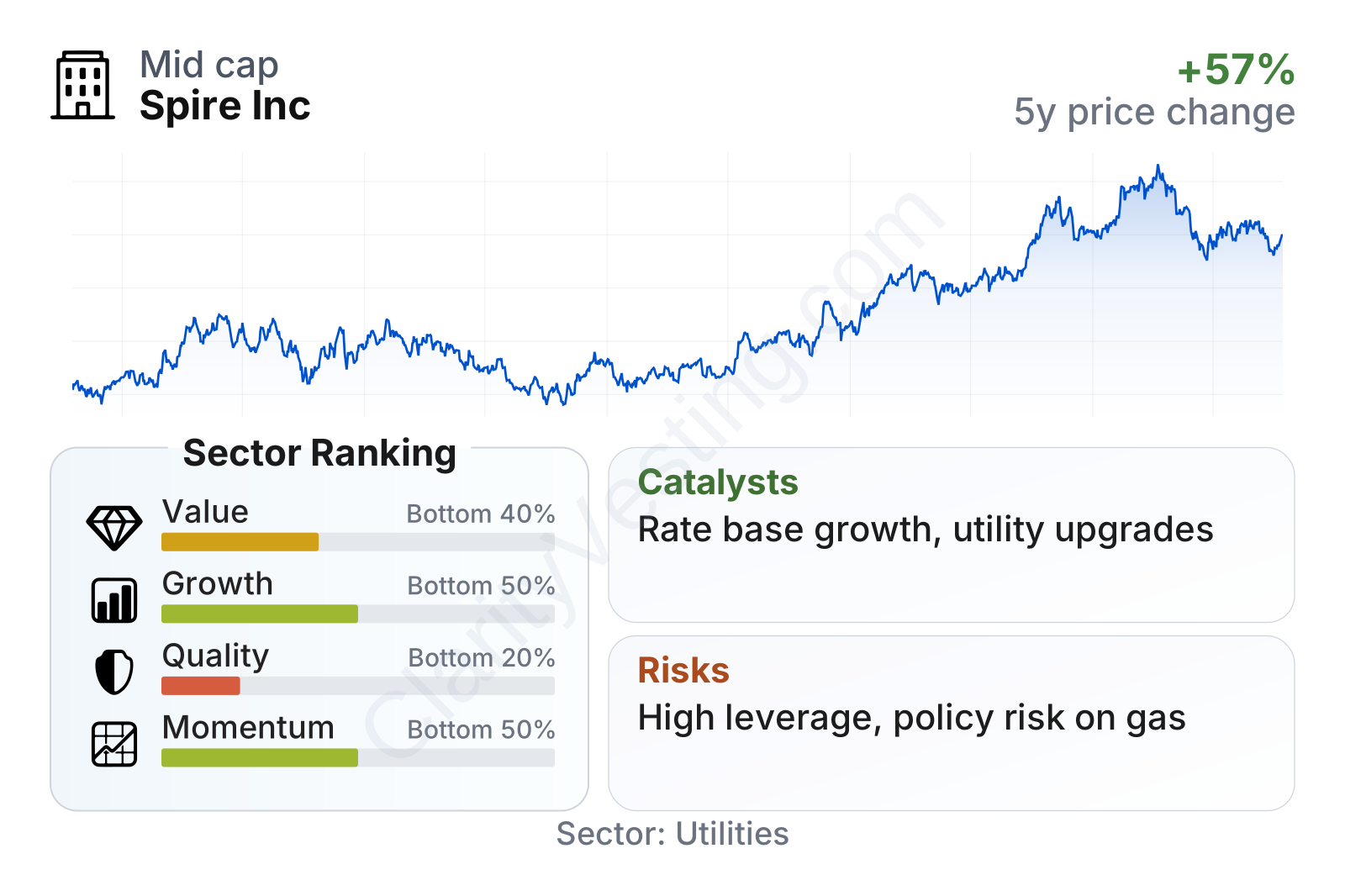
Spire is a mid-sized regulated gas utility with a low beta, which fits its generally defensive profile. On valuation, it screens close to the sector median on earnings, while book value is somewhat cheaper. The weak points in the current snapshot are quality and balance-sheet leverage: returns on invested capital are below many peers, debt levels are elevated, and free cash flow is negative. Growth is mixed, with short-term revenue growth looking strong but longer-term revenue-per-share trends softer than the sector. Profitability at the net margin level has recently improved, and the dividend yield remains slightly above the sector median.
Growth
Spire operates in a mature sector rather than a fast-expanding one. Regulated gas utilities do not usually produce rapid growth through customer adoption alone. Instead, they grow through rate base expansion: investing in pipeline replacement, safety upgrades, storage, and system modernization, then earning an allowed return on that capital over time. That means the growth question is less about disruption and more about whether the company has a credible pipeline of approved projects and a supportive regulatory framework.
That strategy does make sense for a utility like Spire. Population stability in its service territories, ongoing infrastructure replacement needs, and the essential nature of home heating and gas distribution all support a gradual compounding model. The company has continued to emphasize capital spending on utility infrastructure, which can expand earnings over time if regulators keep allowing recovery of those investments.
Revenue per share has been uneven over the last several years rather than consistently upward. That is a reminder that utility revenue can move with weather, gas costs, and accounting pass-throughs, so it is not always the best single indicator of business progress. In Spire’s case, earnings and book value trends look more constructive than revenue per share alone.
Free cash flow has been volatile and recently negative again. For utilities, that does not automatically signal a weak business because large infrastructure spending programs often push free cash flow below zero for extended periods. Still, future growth depends on those investments earning attractive regulated returns and being financed without overstraining the balance sheet.
A practical catalyst is continued rate relief and capital deployment in its utility jurisdictions. Another is the contribution from pipeline and storage assets that support reliability and system operations. Spire has also continued to raise its dividend over time, which indirectly reflects management’s confidence in future regulated cash generation, although dividend growth does not remove the need for disciplined financing.
One important recent opportunity is the broader policy focus on energy reliability, grid resilience, and utility infrastructure replacement. Even in an environment with more electrification, gas networks remain critical for heating, industrial use, and backup system reliability in many regions. That supports ongoing utility spending programs, which are the main engine of Spire’s long-term expansion.
Risks
This article is for informational purposes only and does not constitute financial advice. Some content is AI-generated. See Disclaimer


