Stock Analysis · Sociedad Quimica y Minera de Chile SA B (SQM)
Overview
Sociedad Quimica y Minera de Chile S.A., usually known as SQM, is a Chile-based specialty chemicals and mining company with a global presence. It is best known for lithium, but the business is broader than that. SQM produces lithium chemicals used in electric vehicle batteries and energy storage, specialty plant nutrition products used in agriculture, iodine for medical and industrial applications, and industrial chemicals such as potassium and solar salts.
The company’s business model is built around mineral resources in northern Chile, especially the Salar de Atacama, plus processing, refining, and global distribution. That resource position matters because long-life, high-grade assets can support lower production costs than many newer projects around the world.
Based on recent company reporting, SQM’s revenue mix is still led by lithium, but it has meaningful diversification across other specialty chemical markets. Approximate revenue sources, from largest to smallest, are:
- Lithium and derivatives: about 45% to 55% of revenue in the recent mix. This includes lithium carbonate and lithium hydroxide, mainly tied to batteries, electric vehicles, and energy storage.
- Specialty plant nutrition: about 20% to 30%. This segment includes specialty fertilizers and potassium nitrate products used in higher-value agriculture.
- Iodine and derivatives: about 10% to 15%. These products are used in pharmaceuticals, X-ray contrast media, disinfectants, and industrial uses.
- Potassium: about 5% to 10%. This business is more exposed to agricultural input cycles and commodity pricing.
- Industrial chemicals: about 5% to 10%. This includes solar salts and other industrial inputs.
The broad pattern over the last few years is clear: lithium drove an exceptional earnings surge in 2022, then a sharp normalization followed as lithium prices retreated. Even so, the company remained profitable again after a difficult 2024, helped by strong underlying operating margins and a recovery in cash generation.
The financial flow over the last five years shows how exposed SQM is to pricing cycles. Revenue and profits spiked in 2022, then fell sharply through 2023 and 2024 as lithium pricing normalized. What stands out, however, is that operating profitability remained relatively strong compared with many materials businesses, which suggests the asset base still has cost advantages even in a weaker market.
Key Figures
| Metric | Value | Sector ⓘ |
|---|---|---|
| Date | Oct 24, 2026 | |
| Context | ||
| Sector | Basic Materials | |
| Industry | Specialty Chemicals | |
| Market Cap ⓘ | $17.15B | |
| Beta ⓘ | 1.07 | |
Value (Cheapness) | ||
| P/E Ratio ⓘ | 12.36 | 16.92 |
| P/B Ratio ⓘ | 4.26 | 1.66 |
| FCF Yield ⓘ | 11.34% | 5.83% |
| Dividend Yield ⓘ | 4.04% | 2.07% |
| EBIT / EV ⓘ | 12.82% | 6.38% |
| PEG ⓘ | 0.32 | |
Growth (Business expansion) | ||
| Revenue Growth ⓘ | 136.70% | 11.25% |
| RPS Growth (5Y CAGR) ⓘ | 12.40% | 4.49% |
| EPS Growth (5Y CAGR) ⓘ | -30.02% | -15.24% |
| BVPS Growth (5Y CAGR) ⓘ | 1.17% | 5.49% |
| Margin Growth (5Y Trend) ⓘ | -7.17% | -1.54% |
| FCF Growth (5Y CAGR) ⓘ | 5.17% | 0.37% |
| DPS Growth (5Y CAGR) ⓘ | -70.60% | 5.91% |
Quality (Business durability) | ||
| ROIC (Latest) ⓘ | 15.35% | 9.59% |
| ROA (Latest) ⓘ | 9.81% | 4.92% |
| ROIC (5Y Median) ⓘ | 13.29% | 7.91% |
| ROA (5Y Median) ⓘ | 9.76% | 3.92% |
| Net Debt / EBIT (Latest) ⓘ | 0.73 | 1.36 |
| Net Debt / EBIT (5Y Median) ⓘ | 1.19 | 1.69 |
| Net Debt / EBITDA (Latest) ⓘ | 0.63 | 0.93 |
| Net Debt / Assets ⓘ | 11.64% | 13.69% |
| EBITDA / Interest ⓘ | 15.43 | 12.38 |
| Operating Margin (Latest) ⓘ | 39.18% | 13.24% |
| Operating Margin (5Y Median) ⓘ | 32.26% | 11.82% |
| Debt to Equity (Latest) ⓘ | 84.21% | 40.30% |
| Profit Margin (Latest) ⓘ | 20.62% | 6.38% |
| Free Cash Flow (Latest) ⓘ | $1.94B | |
Momentum (Price trend) | ||
| 3Y Return ⓘ | +17.34% | +73.47% |
| 12M Return (excl. last month) ⓘ | +63.05% | +27.59% |
| 6M Return ⓘ | -31.70% | -4.02% |
| Price vs. 200-Day MA ⓘ | -22.37% | -0.65% |
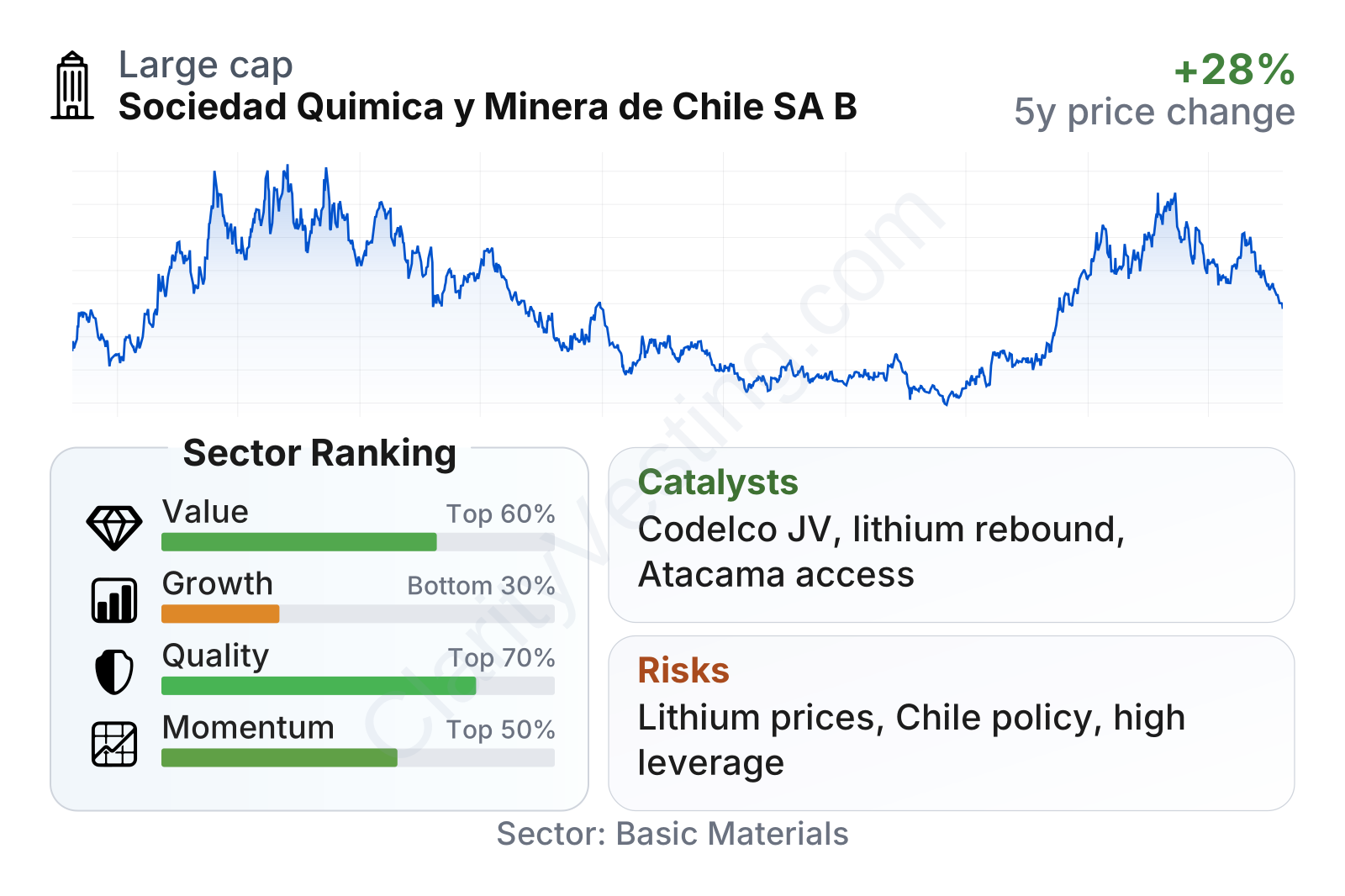
SQM is a large specialty chemicals company with share-price volatility close to the overall market. The current factor profile is unusual: value metrics look attractive versus much of the sector, quality is solid, but growth rankings remain weak because recent earnings and margin trends still reflect the after-effects of the lithium downturn. Profitability and returns on capital remain clearly above sector medians, while free cash flow yield and EBIT relative to enterprise value also compare favorably. At the same time, debt to equity is elevated for the sector, so the balance sheet is not weak, but it is not conservative either.
Growth
SQM operates in sectors with real long-term demand drivers, especially lithium for electric vehicles, grid storage, and broader battery applications. That does not mean straight-line growth. The lithium industry tends to move in cycles: periods of strong demand often attract new supply, which can pressure prices before demand catches up again. For a long-term view, the central question is less about one year’s lithium price and more about whether SQM can remain a low-cost, relevant producer as the market expands.
The company’s strategy broadly supports that goal. SQM has continued to invest in lithium capacity, maintain its position in value-added lithium products, and preserve diversification through iodine and specialty plant nutrition. That diversification matters because it softens the impact of weak lithium pricing, even if lithium remains the main earnings engine.
Revenue growth has been extremely volatile. After extraordinary expansion in 2022, sales contracted through much of 2023 and 2024, which was mainly a pricing reset rather than a collapse in the business model. More recently, growth has turned sharply positive again, pointing to a recovery phase. For long-term analysis, this is a reminder that SQM’s top line is heavily influenced by commodity prices, not just by production volume.
Cash generation has also improved meaningfully after turning negative during the downturn. Free cash flow moved from a peak during the lithium boom to a weak phase, then recovered back above the billion-dollar level on a trailing basis. That rebound is important because it indicates the company is again converting operations into cash after a difficult stretch.
A major catalyst is the planned new public-private structure for lithium production in Chile, under which SQM and Codelco are working toward a long-term partnership for operations in the Salar de Atacama. If fully implemented as outlined by the companies and Chilean authorities, this could extend resource access well beyond the current contractual horizon and provide more visibility for future production. Another favorable element is that battery demand is still expected to grow over the long run even if short-term EV demand fluctuates by region.
Recent company updates have also pointed to improving lithium market conditions compared with the low point of the downturn. That does not remove cyclicality, but it does support the idea that 2024 may have been closer to a trough than to a new normal.
Risks
This article is for informational purposes only and does not constitute financial advice. Some content is AI-generated. See Disclaimer


