Stock Analysis · SPX Corp (SPXC)
Overview
SPX Corporation is an industrial company focused on engineered products used in essential infrastructure. Its business is centered on heating, ventilation, and air conditioning systems, as well as detection and measurement equipment used in fire protection, communications, and specialty industrial applications. In simple terms, SPX sells equipment that helps buildings regulate temperature, supports public safety, and serves niche industrial needs.
The company reports its activities mainly through two business segments. Based on recent annual reporting, revenue is weighted toward HVAC, with the remainder coming from Detection & Measurement.
- HVAC: approximately 70% to 75% of revenue. This includes cooling towers, boilers, air handling and other heating and cooling products sold largely for commercial buildings, industrial facilities, and institutional customers.
- Detection & Measurement: approximately 25% to 30% of revenue. This includes fire detection and suppression-related products, communication technologies, and specialty measurement solutions.
This mix makes SPX more of a focused industrial operator than a broad conglomerate. Over the last few years, the company has also reshaped itself through acquisitions and divestitures, increasing its exposure to HVAC and other higher-margin platforms. Revenue has expanded meaningfully since 2021, while operating income has grown even faster, showing that the portfolio is becoming more profitable as it scales.
The financial flow over recent years points to a favorable trend: sales have climbed from about $1.2 billion in 2021 to more than $2.2 billion in 2025, while operating income and net income have improved sharply after a weak 2022. Gross profit has risen steadily, and overhead has grown much more slowly than revenue, which suggests better operating leverage.
Key Figures
| Metric | Value | Sector ⓘ |
|---|---|---|
| Date | Oct 24, 2026 | |
| Context | ||
| Sector | Industrials | |
| Industry | Building Products & Equipment | |
| Market Cap ⓘ | $8.23B | |
| Beta ⓘ | 1.24 | |
Value (Cheapness) | ||
| P/E Ratio ⓘ | 28.97 | 22.29 |
| P/B Ratio ⓘ | 3.63 | 1.98 |
| FCF Yield ⓘ | 3.69% | 6.26% |
| Dividend Yield ⓘ | N/A | 1.92% |
| EBIT / EV ⓘ | 4.65% | 4.83% |
| PEG ⓘ | 0.98 | |
Growth (Business expansion) | ||
| Revenue Growth ⓘ | 22.90% | 9.30% |
| RPS Growth (5Y CAGR) ⓘ | 15.51% | 7.76% |
| EPS Growth (5Y CAGR) ⓘ | 5.00% | -13.17% |
| BVPS Growth (5Y CAGR) ⓘ | 18.09% | 6.13% |
| Margin Growth (5Y Trend) ⓘ | 9.18% | 0.74% |
| FCF Growth (5Y CAGR) ⓘ | 9.96% | 10.79% |
| DPS Growth (5Y CAGR) ⓘ | N/A | 9.41% |
Quality (Business durability) | ||
| ROIC (Latest) ⓘ | 11.11% | 10.75% |
| ROA (Latest) ⓘ | 7.55% | 5.41% |
| ROIC (5Y Median) ⓘ | 10.77% | 9.37% |
| ROA (5Y Median) ⓘ | 7.72% | 4.95% |
| Net Debt / EBIT (Latest) ⓘ | 1.11 | 2.04 |
| Net Debt / EBIT (5Y Median) ⓘ | 1.71 | 2.27 |
| Net Debt / EBITDA (Latest) ⓘ | 0.84 | 1.39 |
| Net Debt / Assets ⓘ | 11.38% | 19.27% |
| EBITDA / Interest ⓘ | 14.28 | 9.58 |
| Operating Margin (Latest) ⓘ | 16.29% | 10.49% |
| Operating Margin (5Y Median) ⓘ | 12.26% | 10.30% |
| Debt to Equity (Latest) ⓘ | 26.18% | 64.82% |
| Profit Margin (Latest) ⓘ | 11.27% | 6.67% |
| Free Cash Flow (Latest) ⓘ | $303.40M | |
Momentum (Price trend) | ||
| 3Y Return ⓘ | +112.55% | +67.77% |
| 12M Return (excl. last month) ⓘ | -3.64% | +12.05% |
| 6M Return ⓘ | -22.34% | 0.00% |
| Price vs. 200-Day MA ⓘ | -19.56% | +0.67% |
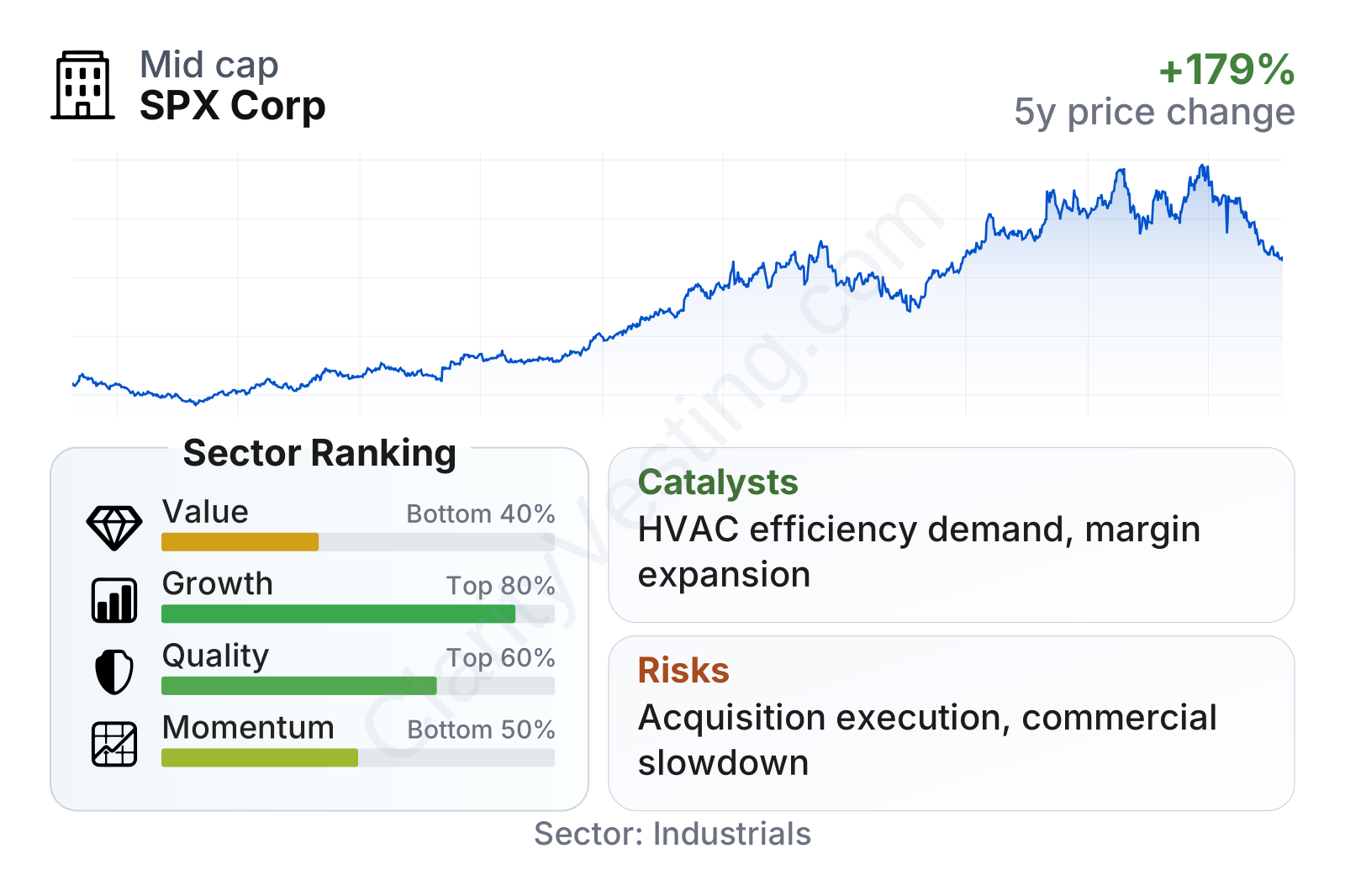
SPX is now a mid-sized industrial company with a market value in the high single-digit billions. The stock has had a very strong multi-year rise, although recent trading has been less favorable than the broader industrial peer group. On fundamentals, the picture is mixed but generally constructive: growth ranks well above much of the sector, quality is solid, leverage is restrained, and profitability is comfortably ahead of the sector median. The weaker point is valuation, with earnings and book multiples above typical industry levels and cash flow yield below the sector median.
Growth
SPX operates in areas that benefit from durable long-term demand rather than short-lived consumer trends. HVAC demand is supported by building efficiency upgrades, data center cooling needs, aging installed systems, stricter energy standards, and non-residential construction. Detection and measurement markets also benefit from safety regulations and infrastructure modernization. These are not speculative end markets; they are tied to real operational needs in buildings and facilities.
The company’s strategy appears consistent with those trends. Management has spent several years concentrating the portfolio around engineered HVAC and related platforms, where aftermarket demand, replacement cycles, and specialized products can support stronger margins than more commoditized industrial businesses. That strategic direction matters because it can make revenue more resilient and profitability less dependent on one-time project activity.
Revenue growth has remained strong for an industrial company. Recent year-over-year increases have often been in the low-double-digit to low-20% range, and the latest reading is still well above the sector median. Over a five-year period, revenue per share growth has also clearly outpaced the typical company in the sector. That indicates SPX has not only grown through acquisitions, but has also translated expansion into stronger per-share economics.
Cash generation has improved materially after earlier volatility. Free cash flow moved from negative territory in 2023 to a solid positive level and has continued rising into 2026. That improvement is important because it gives the company more flexibility to fund acquisitions, invest in operations, and manage debt without relying heavily on outside capital.
A notable catalyst is SPX’s continued positioning in HVAC niches tied to efficiency and cooling demand. Commercial and institutional buildings increasingly need upgrades, while digital infrastructure has created more attention around thermal management. The company has also shown an ability to integrate acquisitions and expand margins, which can create an additional growth engine beyond the underlying market.
Recent company updates and filings have also highlighted a healthy backlog and sustained demand in core HVAC categories. That does not eliminate cyclicality, but it does support the view that SPX is participating in end markets with visible medium-term momentum.
Risks
This article is for informational purposes only and does not constitute financial advice. Some content is AI-generated. See Disclaimer


